MEMORIAL OF SAINT ISIDORE THE FARMER; SAINTS PETER, ANDREW, PAUL, AND DENISE, MARTYRS; SAINT DYMPHNA, VIRGIN AND MARTYR; SAINT MARY DE LA CABEZA; AND SAINT TORQUATUS, BISHOP ~ FEAST DAY: MAY 15TH: Today, we celebrate the Memorial of Saint Isidore, the Farmer and Saints Peter, Andrew, Paul and Denise (Dionysia), Martyrs. Through the intercession of our Blessed Mother Mary and the Saints on this feast day, we humbly pray for the sick and dying, especially those suffering from terminal diseases and those with cancer. We also pray for the safety and well-being of all farmers, the poor and the needy all over the world. We continue to pray for peace in our families and throughout our world, for the Church, the Clergy, for persecuted christians, for the conversion of sinners, and Christians all over the world🙏
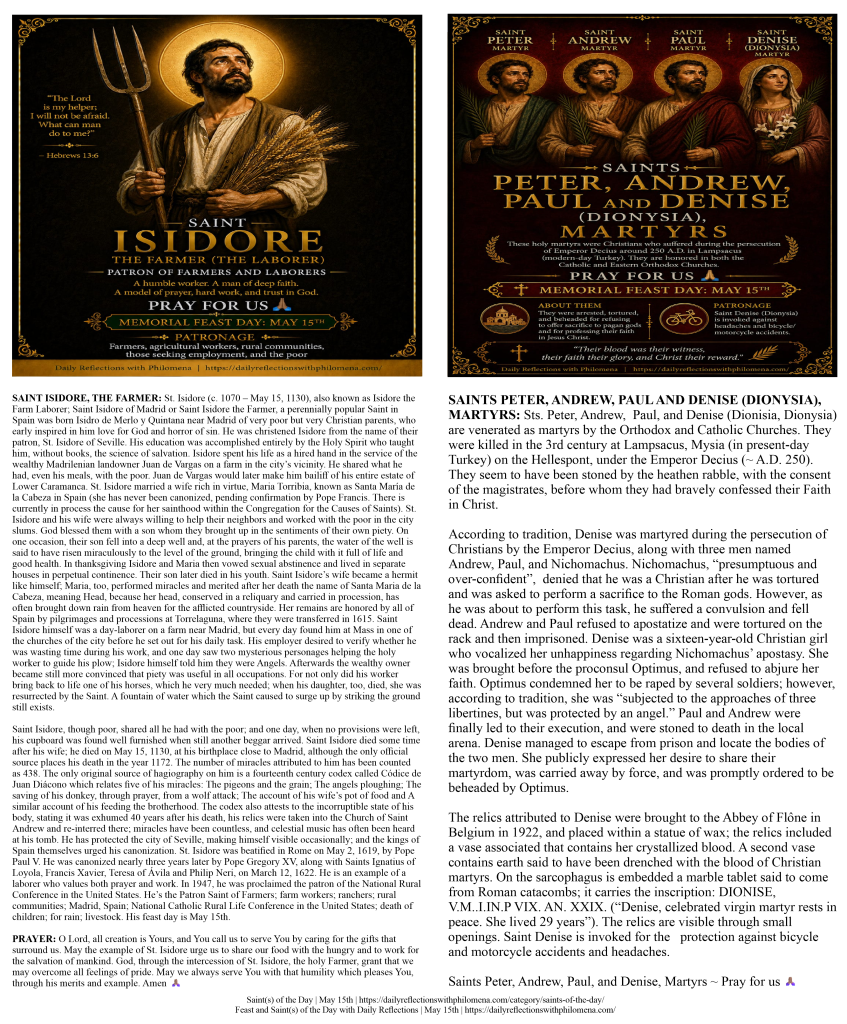
SAINT ISIDORE, THE FARMER: St. Isidore (c. 1070 – May 15, 1130), also known as Isidore the Farm Laborer; Saint Isidore of Madrid or Saint Isidore the Farmer, a perennially popular Saint in Spain was born Isidro de Merlo y Quintana near Madrid of very poor but very Christian parents, who early inspired in him love for God and horror of sin. He was christened Isidore from the name of their patron, St. Isidore of Seville. His education was accomplished entirely by the Holy Spirit who taught him, without books, the science of salvation. Isidore spent his life as a hired hand in the service of the wealthy Madrilenian landowner Juan de Vargas on a farm in the city’s vicinity. He shared what he had, even his meals, with the poor. Juan de Vargas would later make him bailiff of his entire estate of Lower Caramanca. St. Isidore married a wife rich in virtue, Maria Torribia, known as Santa María de la Cabeza in Spain (she has never been canonized, pending confirmation by Pope Francis. There is currently in process the cause for her sainthood within the Congregation for the Causes of Saints). St. Isidore and his wife were always willing to help their neighbors and worked with the poor in the city slums. God blessed them with a son whom they brought up in the sentiments of their own piety. On one occasion, their son fell into a deep well and, at the prayers of his parents, the water of the well is said to have risen miraculously to the level of the ground, bringing the child with it full of life and good health. In thanksgiving Isidore and Maria then vowed sexual abstinence and lived in separate houses in perpetual continence. Their son later died in his youth. Saint Isidore’s wife became a hermit like himself; Maria, too, performed miracles and merited after her death the name of Santa Maria de la Cabeza, meaning Head, because her head, conserved in a reliquary and carried in procession, has often brought down rain from heaven for the afflicted countryside. Her remains are honored by all of Spain by pilgrimages and processions at Torrelaguna, where they were transferred in 1615. Saint Isidore himself was a day-laborer on a farm near Madrid, but every day found him at Mass in one of the churches of the city before he set out for his daily task. His employer desired to verify whether he was wasting time during his work, and one day saw two mysterious personages helping the holy worker to guide his plow; Isidore himself told him they were Angels. Afterwards the wealthy owner became still more convinced that piety was useful in all occupations. For not only did his worker bring back to life one of his horses, which he very much needed; when his daughter, too, died, she was resurrected by the Saint. A fountain of water which the Saint caused to surge up by striking the ground still exists.
Saint Isidore, though poor, shared all he had with the poor; and one day, when no provisions were left, his cupboard was found well furnished when still another beggar arrived. Saint Isidore died some time after his wife; he died on May 15, 1130, at his birthplace close to Madrid, although the only official source places his death in the year 1172. The number of miracles attributed to him has been counted as 438. The only original source of hagiography on him is a fourteenth century codex called Códice de Juan Diácono which relates five of his miracles: The pigeons and the grain; The angels ploughing; The saving of his donkey, through prayer, from a wolf attack; The account of his wife’s pot of food and A similar account of his feeding the brotherhood. The codex also attests to the incorruptible state of his body, stating it was exhumed 40 years after his death, his relics were taken into the Church of Saint Andrew and re-interred there; miracles have been countless, and celestial music has often been heard at his tomb. He has protected the city of Seville, making himself visible occasionally; and the kings of Spain themselves urged his canonization. St. Isidore was beatified in Rome on May 2, 1619, by Pope Paul V. He was canonized nearly three years later by Pope Gregory XV, along with Saints Ignatius of Loyola, Francis Xavier, Teresa of Ávila and Philip Neri, on March 12, 1622. He is an example of a laborer who values both prayer and work. In 1947, he was proclaimed the patron of the National Rural Conference in the United States. He’s the Patron Saint of Farmers; farm workers; ranchers; rural communities; Madrid, Spain; National Catholic Rural Life Conference in the United States; death of children; for rain; livestock. His feast day is May 15th.
PRAYER: O Lord, all creation is Yours, and You call us to serve You by caring for the gifts that surround us. May the example of St. Isidore urge us to share our food with the hungry and to work for the salvation of mankind. God, through the intercession of St. Isidore, the holy Farmer, grant that we may overcome all feelings of pride. May we always serve You with that humility which pleases You, through his merits and example ~ Amen🙏
SAINTS PETER, ANDREW, PAUL AND DENISE (DIONYSIA), MARTYRS: Sts. Peter, Andrew, Paul, and Denise (Dionisia, Dionysia) are venerated as martyrs by the Orthodox and Catholic Churches. They were killed in the 3rd century at Lampsacus, Mysia (in present-day Turkey) on the Hellespont, under the Emperor Decius (~ A.D. 250). They seem to have been stoned by the heathen rabble, with the consent of the magistrates, before whom they had bravely confessed their Faith in Christ.
According to tradition, Denise was martyred during the persecution of Christians by the Emperor Decius, along with three men named Andrew, Paul, and Nichomachus. Nichomachus, “presumptuous and over-confident”, denied that he was a Christian after he was tortured and was asked to perform a sacrifice to the Roman gods. However, as he was about to perform this task, he suffered a convulsion and fell dead. Andrew and Paul refused to apostatize and were tortured on the rack and then imprisoned. Denise was a sixteen-year-old Christian girl who vocalized her unhappiness regarding Nichomachus’ apostasy. She was brought before the proconsul Optimus, and refused to abjure her faith. Optimus condemned her to be raped by several soldiers; however, according to tradition, she was “subjected to the approaches of three libertines, but was protected by an angel.” Paul and Andrew were finally led to their execution, and were stoned to death in the local arena. Denise managed to escape from prison and locate the bodies of the two men. She publicly expressed her desire to share their martyrdom, was carried away by force, and was promptly ordered to be beheaded by Optimus.
The relics attributed to Denise were brought to the Abbey of Flône in Belgium in 1922, and placed within a statue of wax; the relics included a vase associated that contains her crystallized blood. A second vase contains earth said to have been drenched with the blood of Christian martyrs. On the sarcophagus is embedded a marble tablet said to come from Roman catacombs; it carries the inscription: DIONISE, V.M..I.IN.P VIX. AN. XXIX. (“Denise, celebrated virgin martyr rests in peace. She lived 29 years”). The relics are visible through small openings. Saint Denise is invoked for the protection against bicycle and motorcycle accidents and headaches.
Saints Peter, Andrew, Paul, and Denise, Martyrs ~ Pray for us🙏
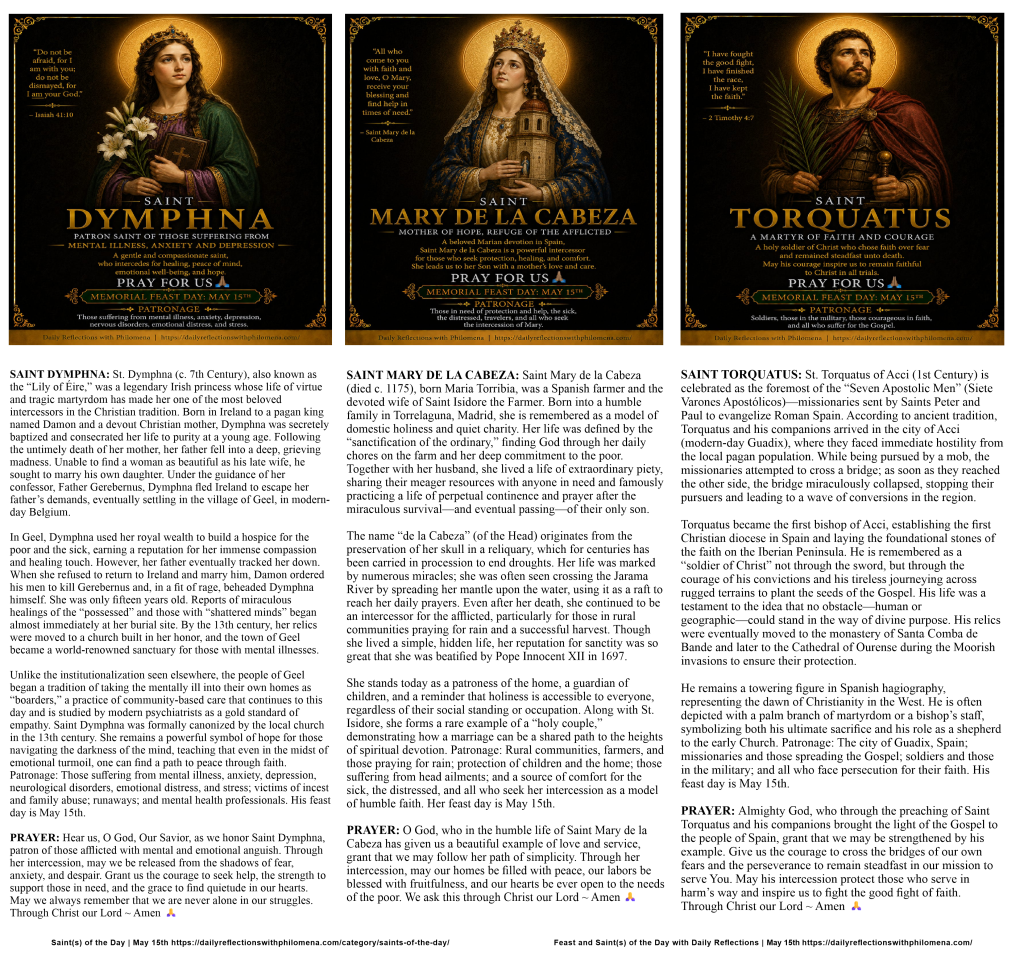
SAINT DYMPHNA: St. Dymphna (c. 7th Century), also known as the “Lily of Éire,” was a legendary Irish princess whose life of virtue and tragic martyrdom has made her one of the most beloved intercessors in the Christian tradition. Born in Ireland to a pagan king named Damon and a devout Christian mother, Dymphna was secretely baptized and consecrated her life to purity at a young age. Following the untimely death of her mother, her father fell into a deep, grieving madness. Unable to find a woman as beautiful as his late wife, he sought to marry his own daughter. Under the guidance of her confessor, Father Gerebernus, Dymphna fled Ireland to escape her father’s demands, eventually settling in the village of Geel, in modern-day Belgium.
In Geel, Dymphna used her royal wealth to build a hospice for the poor and the sick, earning a reputation for her immense compassion and healing touch. However, her father eventually tracked her down. When she refused to return to Ireland and marry him, Damon ordered his men to kill Gerebernus and, in a fit of rage, beheaded Dymphna himself. She was only fifteen years old. Reports of miraculous healings of the “possessed” and those with “shattered minds” began almost immediately at her burial site. By the 13th century, her relics were moved to a church built in her honor, and the town of Geel became a world-renowned sanctuary for those with mental illnesses.
Unlike the institutionalization seen elsewhere, the people of Geel began a tradition of taking the mentally ill into their own homes as “boarders,” a practice of community-based care that continues to this day and is studied by modern psychiatrists as a gold standard of empathy. Saint Dymphna was formally canonized by the local church in the 13th century. She remains a powerful symbol of hope for those navigating the darkness of the mind, teaching that even in the midst of emotional turmoil, one can find a path to peace through faith.
Patronage: Those suffering from mental illness, anxiety, depression, neurological disorders, emotional distress, and stress; victims of incest and family abuse; runaways; and mental health professionals. His feast day is May 15th.
PRAYER: Hear us, O God, Our Savior, as we honor Saint Dymphna, patron of those afflicted with mental and emotional anguish. Through her intercession, may we be released from the shadows of fear, anxiety, and despair. Grant us the courage to seek help, the strength to support those in need, and the grace to find quietude in our hearts. May we always remember that we are never alone in our struggles. Through Christ our Lord ~ Amen🙏
SAINT MARY DE LA CABEZA: Saint Mary de la Cabeza (died c. 1175), born Maria Torribia, was a Spanish farmer and the devoted wife of Saint Isidore the Farmer. Born into a humble family in Torrelaguna, Madrid, she is remembered as a model of domestic holiness and quiet charity. Her life was defined by the “sanctification of the ordinary,” finding God through her daily chores on the farm and her deep commitment to the poor. Together with her husband, she lived a life of extraordinary piety, sharing their meager resources with anyone in need and famously practicing a life of perpetual continence and prayer after the miraculous survival—and eventual passing—of their only son.
The name “de la Cabeza” (of the Head) originates from the preservation of her skull in a reliquary, which for centuries has been carried in procession to end droughts. Her life was marked by numerous miracles; she was often seen crossing the Jarama River by spreading her mantle upon the water, using it as a raft to reach her daily prayers. Even after her death, she continued to be an intercessor for the afflicted, particularly for those in rural communities praying for rain and a successful harvest. Though she lived a simple, hidden life, her reputation for sanctity was so great that she was beatified by Pope Innocent XII in 1697.
She stands today as a patroness of the home, a guardian of children, and a reminder that holiness is accessible to everyone, regardless of their social standing or occupation. Along with St. Isidore, she forms a rare example of a “holy couple,” demonstrating how a marriage can be a shared path to the heights of spiritual devotion.
Patronage: Rural communities, farmers, and those praying for rain; protection of children and the home; those suffering from head ailments; and a source of comfort for the sick, the distressed, and all who seek her intercession as a model of humble faith. Her feast day is May 15th.
PRAYER: O God, who in the humble life of Saint Mary de la Cabeza has given us a beautiful example of love and service, grant that we may follow her path of simplicity. Through her intercession, may our homes be filled with peace, our labors be blessed with fruitfulness, and our hearts be ever open to the needs of the poor. We ask this through Christ our Lord ~ Amen🙏
SAINT TORQUATUS: St. Torquatus of Acci (1st Century) is celebrated as the foremost of the “Seven Apostolic Men” (Siete Varones Apostólicos)—missionaries sent by Saints Peter and Paul to evangelize Roman Spain. According to ancient tradition, Torquatus and his companions arrived in the city of Acci (modern-day Guadix), where they faced immediate hostility from the local pagan population. While being pursued by a mob, the missionaries attempted to cross a bridge; as soon as they reached the other side, the bridge miraculously collapsed, stopping their pursuers and leading to a wave of conversions in the region.
Torquatus became the first bishop of Acci, establishing the first Christian diocese in Spain and laying the foundational stones of the faith on the Iberian Peninsula. He is remembered as a “soldier of Christ” not through the sword, but through the courage of his convictions and his tireless journeying across rugged terrains to plant the seeds of the Gospel. His life was a testament to the idea that no obstacle—human or geographic—could stand in the way of divine purpose. His relics were eventually moved to the monastery of Santa Comba de Bande and later to the Cathedral of Ourense during the Moorish invasions to ensure their protection.
He remains a towering figure in Spanish hagiography, representing the dawn of Christianity in the West. He is often depicted with a palm branch of martyrdom or a bishop’s staff, symbolizing both his ultimate sacrifice and his role as a shepherd to the early Church.
Patronage: The city of Guadix, Spain; missionaries and those spreading the Gospel; soldiers and those in the military; and all who face persecution for their faith. His feast day is May 15th.
PRAYER: Almighty God, who through the preaching of Saint Torquatus and his companions brought the light of the Gospel to the people of Spain, grant that we may be strengthened by his example. Give us the courage to cross the bridges of our own fears and the perseverance to remain steadfast in our mission to serve You. May his intercession protect those who serve in harm’s way and inspire us to fight the good fight of faith. Through Christ our Lord ~ Amen🙏
Discover more from DailyReflections
Subscribe to get the latest posts sent to your email.