MEMORIAL OF SAINT MÉDARD, BISHOP AND SAINT WILLIAM OF YORK, BISHOP
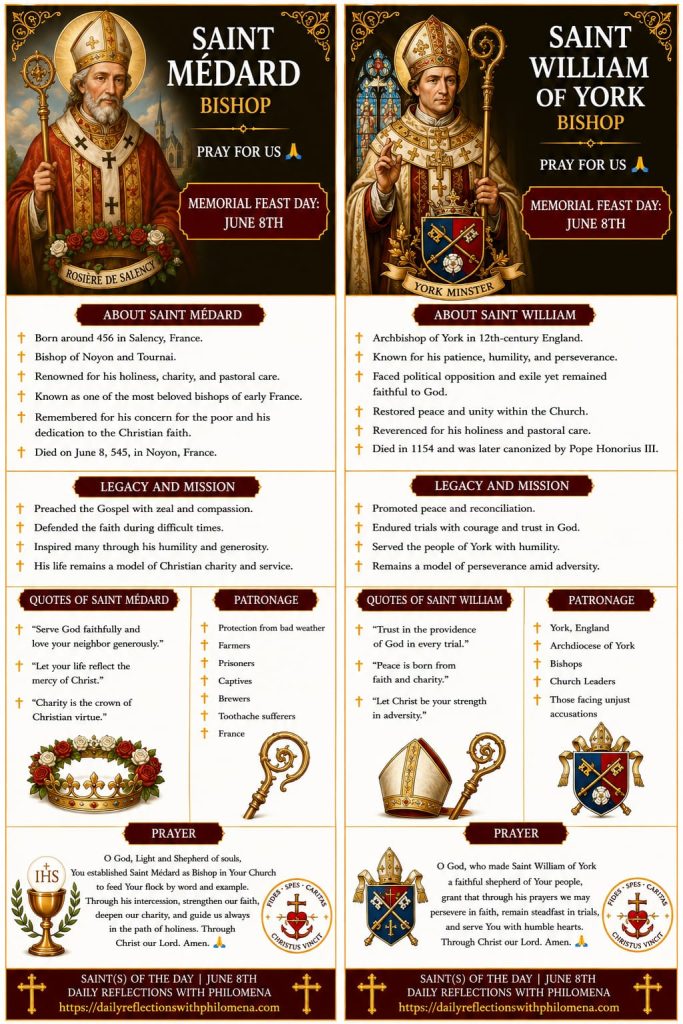
SAINT MÉDARD, BISHOP: He’s also known as Saint Medardus (456–545) was the Bishop of Noyon, France. St. Médard or Medardus was one of the most honored bishops of his time, often depicted laughing, with his mouth wide open, and therefore he was invoked against toothache. Legend says that a sudden shower once fell, soaking everyone except St Médard who remained perfectly dry, because an eagle had spread its wings over him. Ever since, Médard was known as maître de la pluie—master of rain. In religious art, an eagle shelters Médard from the rain. St. Médard of Noyon was born at Salency (Oise), Picardy, France about 456. His father, Nectardus, was of Frankish origin, while his mother, named Protagia, was Gallo-Roman. It is believed that St. Gildardus, Bishop of Rouen, was his brother. Under the care of his pious parents he made rapid strides in virtue, evincing particularly a great charity for the poor. His youth was entirely consecrated to the practise of Christian virtues and to the study of sacred and profane letters. He often accompanied his father on business to Vermand and to Tournai, and frequented the schools, carefully avoiding all worldly dissipation. At thirty-three years of age he was ordained to the priesthood and became a bright ornament of that holy state, preaching to the people by both word and example. His exemplary piety and his knowledge, considerable for that time, decided the Bishop of Vermand (d. 530) to confer on him Holy Orders, and caused him to be chosen as his successor. In 530, St. Medard became Bishop of Augusta Verumanduorum, being consecrated by St. Remigius, who had baptized King Clovis in 496. Forced, in spite of his objections, to accept this heavy charge, he devoted himself zealously to his new duties. In an effort to accomplish those duties in greater security, since Vermand and the northern part of France in general were then generally troubled by wars and exposed to the incursions of the barbarians, he removed his episcopal see in 531 from Vermand, a little city without defence, to Noyon, the strongest place in that region. The year following, St. Eleutherius, Bishop of Tournai, died and St. Médard was invited to assume the direction of that diocese also. He refused at first, but being urged by Clotaire himself he at last accepted. This union of the two dioceses lasted until 1146, when they were again separated.
Although he was then seventy-two years old, he redoubled his labors, extending his zeal wherever the honor of God seemed to require it. He bore persecutions in silence and with patience. Though he had the affliction of beholding his diocese ravaged by the Huns and Vandals, it gave him a fresh opportunity to practice charity. In 544, Radegondes, Queen of France, received the religious veil from the Saint’s hands, and she was made a deaconess with the consent of her husband, King Clotaire, who, doing penance for the sins of his youth, allowed himself to be guided by the counsels of St. Medard. The holy man died in his episcopal city on June 8, 545, Noyon, Oise, Picardy, France and the whole kingdom lamented his loss. A celebrated Benedictine abbey afterward arose over his tomb at Soissons. King Clotaire, who had paid him a last visit at Noyon, had his body transferred to the royal manor of Crouy at the gates of the city of Soissons. Over the tomb of St. Médard was erected the celebrated Benedictine abbey which bears his name. St. Médard was one of the most honoured bishops of his time, his memory has always been popularly venerated in the north of France, and he soon became the hero of numerous legends. One of which says that if it rains on St. Médard’s feast day it will be followed by forty days of rain; and forty days of sunshine will follow if it is clear. St. Médard was one of the most honoured bishops of his time, his memory has always been venerated in northern France, and he soon became the hero of numerous legends. Each year on his memorial the Rosiere is awarded to the young girl who has been judged the most virtuous and exemplary in the region of Salency, France; she is escorted by 12 boys and 12 girls to the church, where she is crowned with roses and given a gift of money. This is a continuation of a yearly stipend or “scholarship” he apparently instituted when bishop. His younger sister was the first to be crowned the Rosiere. He’s Patron Saint of weather; invoked against bad weather, against toothache, against imprisonment; against sterility; brewers; captives; harvests; for good weather; for rain; imprisoned people; mentally ill people; peasants; prisoners; vineyards.
PRAYER: God, Light and Shepherd of souls, You established St. Medard as Bishop in Your Church to feed Your flock by his word and form it by his example. Help us through his intercession to keep the Faith he taught by his word and follow the way he showed by his example. Amen🙏🏽
SAINT WILLIAM OF YORK, BISHOP: St. William of York (d. 1154) also known as William Fitzherbert or William of Thwayt was Archbishop of York. He was born to a powerful family in England, the nephew of King Stephen, whose sister Emma was believed to have married Herbert of Winchester, treasurer to Henry I. St. William became a priest, and about 1130 he was canon and treasurer of York Minster Cathedral at the time when the English crown was contested by two grandchildren of William the Conqueror. In 1142 when the Archbishop of York died, St. William was chosen to take his place at the insistance of the king, in opposition to the candidature of Henry Murdac, a Cistercian monk. Kind-hearted and generous to the poor, St. William was well-liked by the people; however, he faced political and ecclesiastical opposition from the rival to the English throne. The validity of the election was disputed on the ground of alleged simony and royal influence, and Archbishop Theobald refused to consecrate him pending an appeal to Rome. St. Bernard exercised his powerful influence against St. William in favour of Murdac, but in 1143 the pope decided that St. William should be consecrated, if he could clear himself from the accusation of bribery, and if the chapter could show that there had been no undue royal pressure. St. William proved his innocence so conclusively that the legate consecrated him archbishop at Winchester 26 September, 1143. He set himself at once to carry out reforms in his diocese, and his gentleness and charity soon won him popularity; but he neglected to obtain from Cardinal Hincmar the pallium which Lucius II sent him in 1146, and the pope died before William had been invested. Because he was consecrated without papal approval, William was accused of wrongdoing by those who wanted their preferred prelate in the position; even St. Bernard of Clairvaux opposed him. Although he eventually confirmed William’s appointment, the Pope died before the pallium was given, and the new pope took the side of William’s detractors. The new pope, Blessed Eugenius III, was himself a Cistercian, and the English Cistercians soon renewed their complaints against St. William, which St. Bernard supported. Meanwhile Hincmar carried the pallium back to Rome, so that, in 1147, St. William had to travel there to obtain it, raising the expenses of his journey by sale of treasures and privileges belonging to York. This afforded fresh matter of complaint and finally the new pope suspended him from his functions on the ground that he had enthroned the Bishop of Durham without exacting the pledges required by the former pope.
A new archbishop was ordained in St. William’s place and he took refuge with his friend, the King of Sicily and went to live as a monk with his uncle, a bishop, in quiet prayer and penance. But his partisans in England took an unwise revenge by destroying Fountains Abbey, of which Murdac was now prior. This further inflamed St. William’s enemies, who again approached the pope, with the result that in 1147 he deposed the archbishop from his seat; and on the failure of the chapter to elect a successor, he consecrated Murdac in his stead. St. William devoted himself to prayer and mortification at Winchester till 1153, six years later when the pope and St. Bernard were both dead. He then appealed to the new pope, Anastasius IV, for restoration to his see, a request which the death of Murdac in October made it easier to obtain. The new pope made St. William the successor. St. William having received the pallium, returned to York, where he showed the greatest kindness to the Cistercians who had opposed him, and promised full restitution to Fountains Abbey. The people were overjoyed at his return—so many came to greet him as he entered the city that a bridge collapsed under their weight; the fact that no one was hurt was considered a miracle. A few months later, after celebrating Mass on Trinity Sunday, St. William became ill and died. Poisoning was suspected but never confirmed. Miracles took place at his tomb which gave rise to his canonization in 1227 by Pope Honorius III. In 1283 his relics were translated to a shrine behind the high altar of York Minster, where they remained till the Reformation. His feast day is June 8th.
Saint William of York, Bishop ~ Pray for us🙏🏽
Discover more from DailyReflections
Subscribe to get the latest posts sent to your email.