THE PALLIUM: A SIGN OF COMMUNION, UNITY, AND PASTORAL CARE IN THE CATHOLIC CHURCH
“Feed my lambs… Tend my sheep… Feed my sheep.” — John 21:15–17
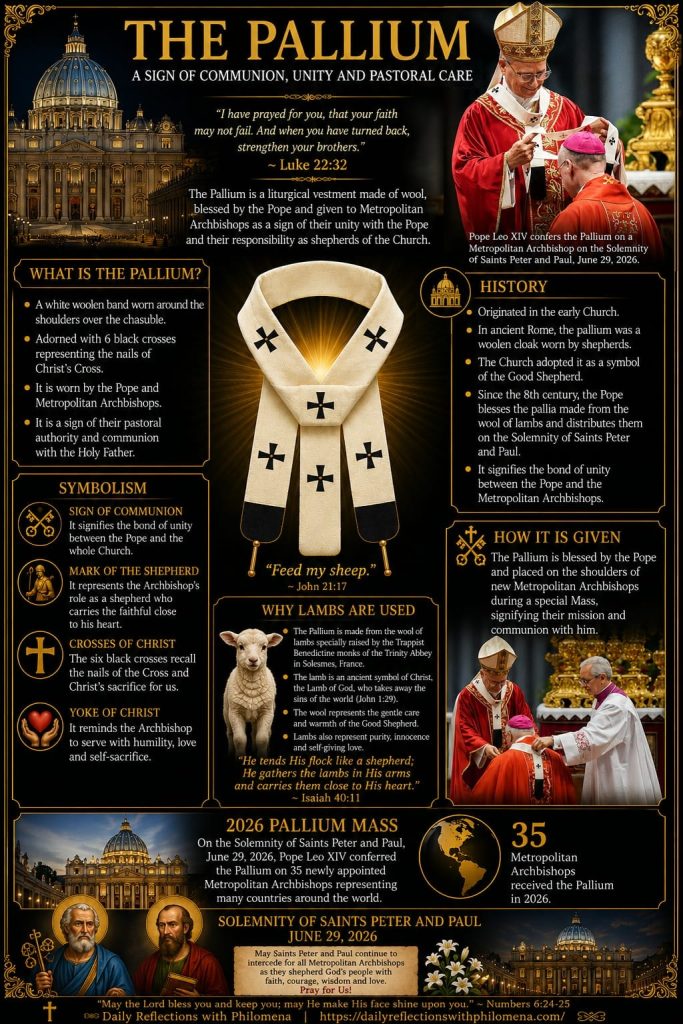
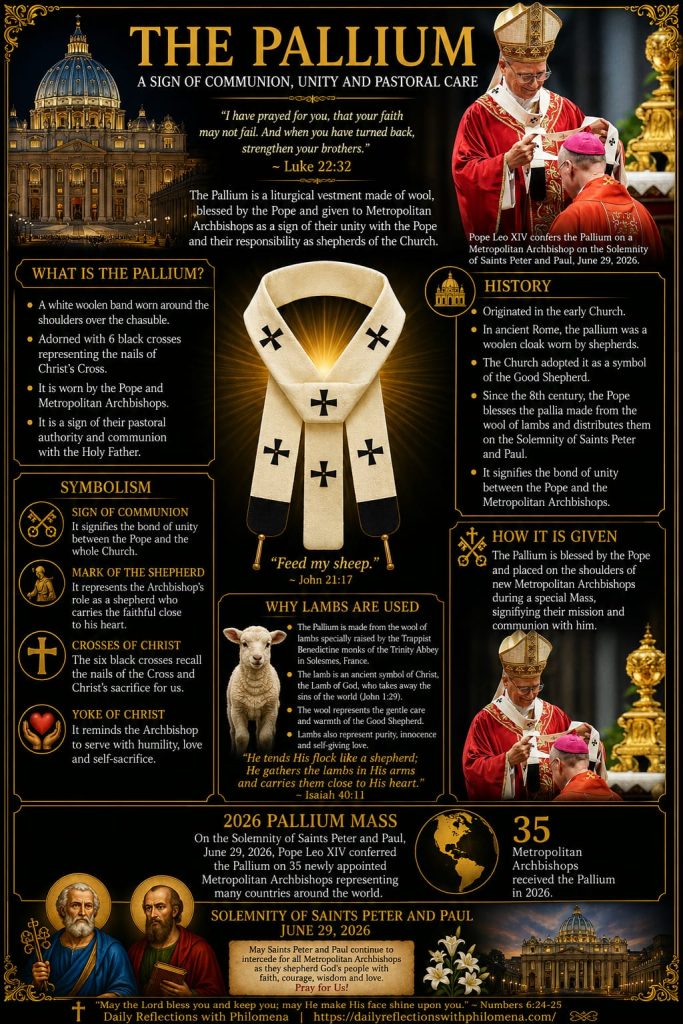
Each year, on the Solemnity of Saints Peter and Paul (June 29), one of the most beautiful and meaningful ceremonies of the Catholic Church takes place in St. Peter’s Basilica in Vatican City: the conferral of the Pallium upon newly appointed Metropolitan Archbishops by the Holy Father.
The Pallium is much more than a liturgical vestment. It is a profound symbol of apostolic succession, ecclesial communion, pastoral responsibility, sacrificial love, and unity with the Successor of St. Peter.
On June 29, 2026, Pope Leo XIV conferred the Pallium upon 35 newly appointed Metropolitan Archbishops representing more than twenty countries throughout the world. This sacred rite reminds the Church that every archbishop is called to imitate Christ, the Good Shepherd, by lovingly leading, protecting, and serving God’s people.
What is the Pallium?
The Pallium is a narrow circular band of white wool worn around the shoulders over the chasuble. Two pendants hang from the front and back, and the vestment is decorated with six black silk crosses.
It is worn only by:
- The Pope
- Metropolitan Archbishops within their ecclesiastical provinces
The Pallium signifies:
- Communion with the Pope
- Participation in the pastoral mission entrusted to the Apostles
- Responsibility for shepherding Christ’s flock
- Fidelity to the Catholic faith
- Unity of the universal Church
Although Metropolitan Archbishops wear the Pallium only within their own ecclesiastical provinces, the Pope wears it universally as the Supreme Pastor of the Catholic Church.
History of the Pallium
The word Pallium comes from the Latin word pallium, meaning “cloak” or “mantle.”
Early Origins
In ancient Rome, the pallium was simply an outer garment worn over the shoulders.
During the early centuries of Christianity, the Church adopted this garment and gradually transformed it into a sacred symbol of episcopal authority and pastoral ministry.
By the sixth and seventh centuries, the Popes began granting the Pallium to Metropolitan Bishops as a visible sign that they exercised their ministry in communion with the Bishop of Rome.
By the ninth century, receiving the Pallium had become an essential requirement before a Metropolitan Archbishop could fully exercise his office.
Today, the tradition continues virtually unchanged.
Why is the Pallium Made from Lamb’s Wool?
One of the most beautiful traditions surrounding the Pallium concerns its material.
The Pallium is woven entirely from the wool of two white lambs.
These lambs are solemnly blessed every year on the Feast of Saint Agnes (January 21).
The lambs are traditionally raised by the Trappist monks of the Abbey of the Three Fountains near Rome and presented for blessing. Afterward, their wool is used by the Benedictine nuns of the Basilica of Saint Cecilia in Trastevere, who carefully weave the Pallia by hand.
The finished Pallia are then kept overnight near the tomb of Saint Peter before being conferred upon the Metropolitan Archbishops on June 29.
Why Lambs?
The lamb carries profound biblical symbolism.
- Christ, the Lamb of God
John the Baptist proclaimed:
“Behold, the Lamb of God, who takes away the sin of the world.” (John 1:29)
The lamb reminds every archbishop that Christ is the true Shepherd who became the sacrificial Lamb for humanity’s salvation.
- The Good Shepherd
Jesus teaches:
“I am the Good Shepherd. The Good Shepherd lays down His life for the sheep.” (John 10:11)
Just as Christ carries His flock with love and sacrifice, every Metropolitan Archbishop is called to carry the faithful entrusted to his care.
- Purity and Innocence
Throughout Scripture, lambs symbolize:
- Purity
- Innocence
- Gentleness
- Obedience
- Sacrifice
The white wool reflects the holiness to which every shepherd of the Church is called.
The Six Black Crosses
The Pallium contains six black crosses.
These crosses remind the Archbishop of:
- Christ’s Passion
- The nails of the Crucifixion
- The Cross that every disciple must carry
- Sacrificial service
- Faithfulness to Christ
- The willingness to suffer for the Gospel
The black color signifies humility, sacrifice, and perseverance in carrying one’s pastoral responsibilities.
How the Pallium is Worn
The Pallium rests upon the shoulders like the Good Shepherd carrying a sheep.
Its two pendants hang:
- One in front
- One behind
This design symbolizes that the Archbishop must care for all the faithful entrusted to him, both those nearby and those who may have wandered away.
The Meaning and Symbolism of the Pallium
Communion with the Pope
The Pallium expresses the Archbishop’s visible communion with the Holy Father and the universal Church.
Apostolic Unity
The Pallium links today’s bishops directly with the Apostles, especially Saints Peter and Paul.
Pastoral Responsibility
The Archbishop is reminded that authority in the Church exists to serve—not to dominate.
His mission is to teach, sanctify, and shepherd God’s people with humility.
The Yoke of Christ
The Pallium represents the gentle yoke of Christ.
“Take my yoke upon you… for my yoke is easy and my burden is light.” (Matthew 11:29–30)
Every Archbishop accepts this yoke freely in loving service to Christ and His Church.
Why is the Pallium Given on the Feast of Saints Peter and Paul?
Saint Peter represents:
- Unity
- The Papacy
- The authority entrusted by Christ
Saint Paul represents:
- Missionary zeal
- Evangelization
- Faithful witness to the Gospel
Together, they embody the Church’s unity and missionary mission. Receiving the Pallium on their feast day reminds Metropolitan Archbishops that they are successors to this apostolic mission.
The 2026 Pallium Mass
On June 29, 2026, during the Solemnity of Saints Peter and Paul, Pope Leo XIV conferred the Pallium upon 35 newly appointed Metropolitan Archbishops from more than twenty countries.
The ceremony emphasized:
- Unity within the universal Church
- Fidelity to the Successor of Saint Peter
- Pastoral charity
- Service modeled after Christ the Good Shepherd
Spiritual Reflection
Although only Metropolitan Archbishops wear the Pallium, its message speaks to every Christian.
Each of us is called to:
- Carry one another’s burdens.
- Serve with humility.
- Remain united with Christ and His Church.
- Love sacrificially.
- Shepherd those entrusted to our care—our families, friends, and communities.
Like the Good Shepherd, we are invited to lead not by power, but by love; not by prestige, but by service; not by seeking honor, but by laying down our lives for others.
Prayer
Heavenly Father, We thank You for the gift of the Holy Father, Pope Leo XIV, and for all Metropolitan Archbishops who shepherd Your people throughout the world. As they wear the Pallium, remind them daily that they are called to imitate Christ, the Good Shepherd, who came not to be served but to serve and to give His life for His sheep. Grant them wisdom, humility, courage, holiness, and unwavering fidelity to the Gospel. May Saints Peter and Paul intercede for them, and may all of us grow in communion with Your Church, faithfully carrying the yoke of Christ with joy and love. We ask this through Christ our Lord. Amen.
THE PALLIUM | https://dailyreflectionswithphilomena.com/the-pallium-2026/
Daily Reflections with Philomena | https://dailyreflectionswithphilomena.com/
Discover more from DailyReflections
Subscribe to get the latest posts sent to your email.