MEMORIAL OF SAINT HERIBERT (HERBERT) OF COLOGNE, BISHOP AND SAINT ABRAHAM OF EDESSA, PRIEST: FEAST DAY ~ MARCH 16TH: Today, we honor the Memorial of Saint Heribert of Cologne, Bishop, a devoted shepherd of the Church known for his deep prayer life, acts of charity, and miraculous intercessions for rain during times of drought. He faithfully served as Archbishop of Cologne and worked for peace and reconciliation, strengthening the faith of his people. He is the Patron Saint invoked against drought and for rain. We also commemorate Saint Abraham of Edessa, Priest, a holy hermit who lived a life of extreme asceticism, dedicating himself entirely to prayer and penance. Despite his desire for solitude, he was called to preach and lead a town away from sin, tirelessly working for their conversion. His life is a testament to perseverance, self-sacrifice, and the power of prayer.
Through the intercession of Our Blessed Mother Mary and these holy Saints, we humbly offer prayers for all who suffer from drought and natural disasters, for bishops and leaders of the Church, for those who work for reconciliation, and for those called to the difficult mission of conversion and evangelization. We pray for priests, hermits, and those who dedicate themselves to prayer and penance. May their examples inspire us to trust in God’s providence, embrace sacrifice, and labor for the salvation of souls.
O God, who raised up Saint Heribert to shepherd Your people with wisdom and compassion, and who strengthened Saint Abraham to lead souls to repentance, grant that through their intercession, we may remain faithful in prayer, generous in service, and steadfast in faith. May we always trust in Your divine providence and be instruments of Your peace. Through Christ our Lord. Amen.
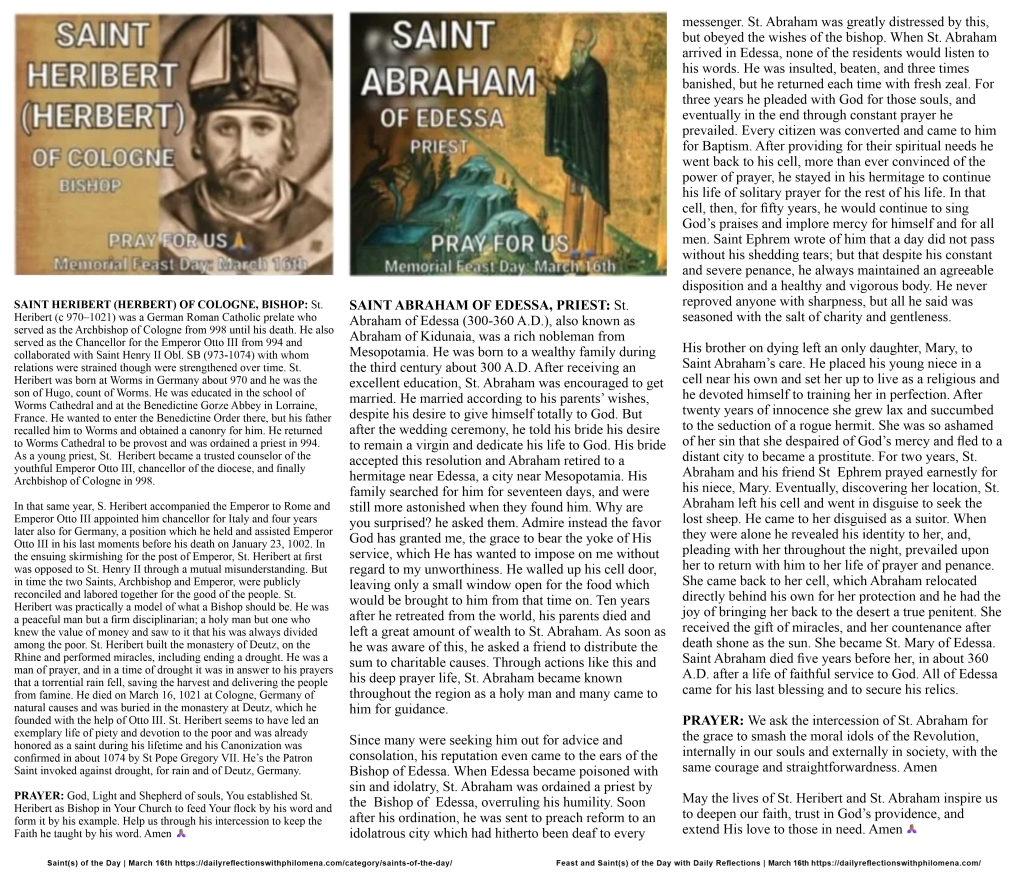
Saint Heribert of Cologne and Saint Abraham of Edessa, pray for us! 🙏
SAINT HERIBERT (HERBERT) OF COLOGNE, BISHOP: St. Heribert (c 970–1021) was a German Roman Catholic prelate who served as the Archbishop of Cologne from 998 until his death. He also served as the Chancellor for the Emperor Otto III from 994 and collaborated with Saint Henry II Obl. SB (973-1074) with whom relations were strained though were strengthened over time. St. Heribert was born at Worms in Germany about 970 and he was the son of Hugo, count of Worms. He was educated in the school of Worms Cathedral and at the Benedictine Gorze Abbey in Lorraine, France. He wanted to enter the Benedictine Order there, but his father recalled him to Worms and obtained a canonry for him. He returned to Worms Cathedral to be provost and was ordained a priest in 994. As a young priest, St. Heribert became a trusted counselor of the youthful Emperor Otto III, chancellor of the diocese, and finally Archbishop of Cologne in 998.
In that same year, S. Heribert accompanied the Emperor to Rome and Emperor Otto III appointed him chancellor for Italy and four years later also for Germany, a position which he held and assisted Emperor Otto III in his last moments before his death on January 23, 1002. In the ensuing skirmishing for the post of Emperor, St. Heribert at first was opposed to St. Henry II through a mutual misunderstanding. But in time the two Saints, Archbishop and Emperor, were publicly reconciled and labored together for the good of the people. St. Heribert was practically a model of what a Bishop should be. He was a peaceful man but a firm disciplinarian; a holy man but one who knew the value of money and saw to it that his was always divided among the poor. St. Heribert built the monastery of Deutz, on the Rhine and performed miracles, including ending a drought. He was a man of prayer, and in a time of drought it was in answer to his prayers that a torrential rain fell, saving the harvest and delivering the people from famine. He died on March 16, 1021 at Cologne, Germany of natural causes and was buried in the monastery at Deutz, which he founded with the help of Otto III. St. Heribert seems to have led an exemplary life of piety and devotion to the poor and was already honored as a saint during his lifetime and his Canonization was confirmed in about 1074 by St Pope Gregory VII. He’s the Patron Saint invoked against drought, for rain and of Deutz, Germany.
PRAYER: God, Light and Shepherd of souls, You established St. Heribert as Bishop in Your Church to feed Your flock by his word and form it by his example. Help us through his intercession to keep the Faith he taught by his word. Amen🙏
SAINT ABRAHAM OF EDESSA, PRIEST: St. Abraham of Edessa (300-360 A.D.), also known as Abraham of Kidunaia, was a rich nobleman from Mesopotamia. He was born to a wealthy family during the third century about 300 A.D. After receiving an excellent education, St. Abraham was encouraged to get married. He married according to his parents’ wishes, despite his desire to give himself totally to God. But after the wedding ceremony, he told his bride his desire to remain a virgin and dedicate his life to God. His bride accepted this resolution and Abraham retired to a hermitage near Edessa, a city near Mesopotamia. His family searched for him for seventeen days, and were still more astonished when they found him. Why are you surprised? he asked them. Admire instead the favor God has granted me, the grace to bear the yoke of His service, which He has wanted to impose on me without regard to my unworthiness. He walled up his cell door, leaving only a small window open for the food which would be brought to him from that time on. Ten years after he retreated from the world, his parents died and left a great amount of wealth to St. Abraham. As soon as he was aware of this, he asked a friend to distribute the sum to charitable causes. Through actions like this and his deep prayer life, St. Abraham became known throughout the region as a holy man and many came to him for guidance.
Since many were seeking him out for advice and consolation, his reputation even came to the ears of the Bishop of Edessa. When Edessa became poisoned with sin and idolatry, St. Abraham was ordained a priest by the Bishop of Edessa, overruling his humility. Soon after his ordination, he was sent to preach reform to an idolatrous city which had hitherto been deaf to every messenger. St. Abraham was greatly distressed by this, but obeyed the wishes of the bishop. When St. Abraham arrived in Edessa, none of the residents would listen to his words. He was insulted, beaten, and three times banished, but he returned each time with fresh zeal. For three years he pleaded with God for those souls, and eventually in the end through constant prayer he prevailed. Every citizen was converted and came to him for Baptism. After providing for their spiritual needs he went back to his cell, more than ever convinced of the power of prayer, he stayed in his hermitage to continue his life of solitary prayer for the rest of his life. In that cell, then, for fifty years, he would continue to sing God’s praises and implore mercy for himself and for all men. Saint Ephrem wrote of him that a day did not pass without his shedding tears; but that despite his constant and severe penance, he always maintained an agreeable disposition and a healthy and vigorous body. He never reproved anyone with sharpness, but all he said was seasoned with the salt of charity and gentleness.
His brother on dying left an only daughter, Mary, to Saint Abraham’s care. He placed his young niece in a cell near his own and set her up to live as a religious and he devoted himself to training her in perfection. After twenty years of innocence she grew lax and succumbed to the seduction of a rogue hermit. She was so ashamed of her sin that she despaired of God’s mercy and fled to a distant city to became a prostitute. For two years, St. Abraham and his friend St Ephrem prayed earnestly for his niece, Mary. Eventually, discovering her location, St. Abraham left his cell and went in disguise to seek the lost sheep. He came to her disguised as a suitor. When they were alone he revealed his identity to her, and, pleading with her throughout the night, prevailed upon her to return with him to her life of prayer and penance. She came back to her cell, which Abraham relocated directly behind his own for her protection and he had the joy of bringing her back to the desert a true penitent. She received the gift of miracles, and her countenance after death shone as the sun. She became St. Mary of Edessa. Saint Abraham died five years before her, in about 360 A.D. after a life of faithful service to God. All of Edessa came for his last blessing and to secure his relics.
PRAYER: We ask the intercession of St. Abraham for the grace to smash the moral idols of the Revolution, internally in our souls and externally in society, with the same courage and straightforwardness. Amen🙏🏽
May the lives of St. Heribert and St. Abraham inspire us to deepen our faith, trust in God’s providence, and extend His love to those in need. Amen 🙏🏽
Discover more from DailyReflections
Subscribe to get the latest posts sent to your email.