MEMORIAL OF SAINT THEOPHANES THE CHRONICLER; SAINT SERAPHINA, VIRGIN AND SAINT LUIGI ORIONE, PRIEST: FEAST DAY ~ MARCH 12TH: Today, we honor the Memorial of Saint Theophanes the Chronicler (a devoted monk and historian who endured imprisonment for defending the faith), Saint Seraphina, Virgin, a young woman who embraced suffering with unwavering faith and trust in God, (Patron Saint of the physically challenged, disabled people and spinners), and Saint Luigi Orione, Priest (a tireless servant of the poor and founder of charitable works devoted to the care of the needy and evangelization). Saint Gregory the Great was formerly celebrated on this day but now celebrated on September 3rd.
Through the intercession of Our Blessed Mother Mary and these holy Saints, we offer prayers today for all who endure trials, whether through persecution, illness, or poverty. We humbly pray for those who are sick, especially those who are physically challenged. May they find strength in Christ, hope in His promises, and consolation in His love. We also pray for historians, writers, and all who preserve and defend the truth, for those who suffer from physical afflictions, and for missionaries and charitable workers who serve the most vulnerable. May the example of these saints inspire us to embrace our own crosses with faith and to live lives of service and holiness.
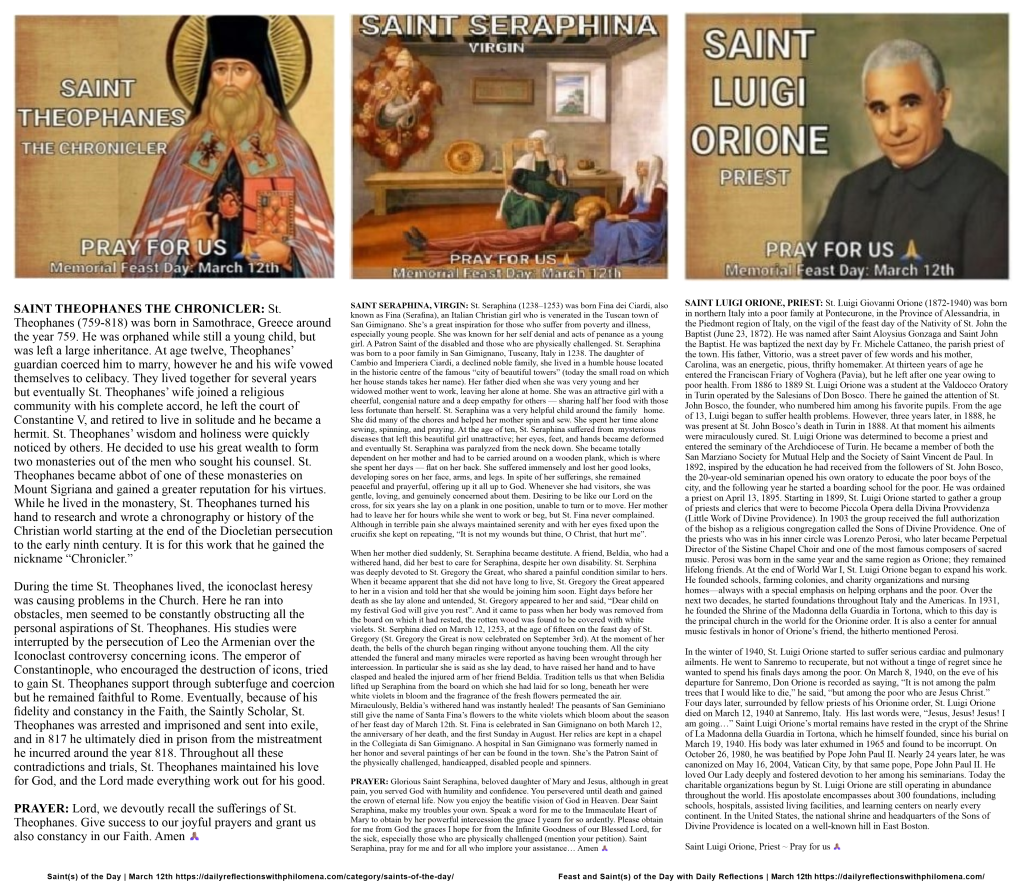
Saint Theophanes, Saint Seraphina, and Saint Luigi Orione ~ Pray for us. 🙏🏽
SAINT THEOPHANES THE CHRONICLER: St. Theophanes (759-818) was born in Samothrace, Greece around the year 759. He was orphaned while still a young child, but was left a large inheritance. At age twelve, Theophanes’ guardian coerced him to marry, however he and his wife vowed themselves to celibacy. They lived together for several years but eventually St. Theophanes’ wife joined a religious community with his complete accord, he left the court of Constantine V, and retired to live in solitude and he became a hermit. St. Theophanes’ wisdom and holiness were quickly noticed by others. He decided to use his great wealth to form two monasteries out of the men who sought his counsel. St. Theophanes became abbot of one of these monasteries on Mount Sigriana and gained a greater reputation for his virtues. While he lived in the monastery, St. Theophanes turned his hand to research and wrote a chronography or history of the Christian world starting at the end of the Diocletian persecution to the early ninth century. It is for this work that he gained the nickname “Chronicler.”
During the time St. Theophanes lived, the iconoclast heresy was causing problems in the Church. Here he ran into obstacles, men seemed to be constantly obstructing all the personal aspirations of St. Theophanes. His studies were interrupted by the persecution of Leo the Armenian over the Iconoclast controversy concerning icons. The emperor of Constantinople, who encouraged the destruction of icons, tried to gain St. Theophanes support through subterfuge and coercion but he remained faithful to Rome. Eventually, because of his fidelity and constancy in the Faith, the Saintly Scholar, St. Theophanes was arrested and imprisoned and sent into exile, and in 817 he ultimately died in prison from the mistreatment he incurred around the year 818. Throughout all these contradictions and trials, St. Theophanes maintained his love for God, and the Lord made everything work out for his good.
PRAYER: Lord, we devoutly recall the sufferings of St. Theophanes. Give success to our joyful prayers and grant us also constancy in our Faith. Amen🙏
SAINT SERAPHINA, VIRGIN: St. Seraphina (1238–1253) was born Fina dei Ciardi, also known as Fina (Serafina), an Italian Christian girl who is venerated in the Tuscan town of San Gimignano. She’s a great inspiration for those who suffer from poverty and illness, especially young people. She was known for her self denial and acts of penance as a young girl. A Patron Saint of the disabled and those who are physically challenged. St. Seraphina was born to a poor family in San Gimignano, Tuscany, Italy in 1238. The daughter of Cambio and Imperiera Ciardi, a declined noble family, she lived in a humble house located in the historic centre of the famous “city of beautiful towers” (today the small road on which her house stands takes her name). Her father died when she was very young and her widowed mother went to work, leaving her alone at home. She was an attractive girl with a cheerful, congenial nature and a deep empathy for others — sharing half her food with those less fortunate than herself. St. Seraphina was a very helpful child around the family home. She did many of the chores and helped her mother spin and sew. She spent her time alone sewing, spinning, and praying. At the age of ten, St. Seraphina suffered from mysterious diseases that left this beautiful girl unattractive; her eyes, feet, and hands became deformed and eventually St. Seraphina was paralyzed from the neck down. She became totally dependent on her mother and had to be carried around on a wooden plank, which is where she spent her days — flat on her back. She suffered immensely and lost her good looks, developing sores on her face, arms, and legs. In spite of her sufferings, she remained peaceful and prayerful, offering up it all up to God. Whenever she had visitors, she was gentle, loving, and genuinely concerned about them. Desiring to be like our Lord on the cross, for six years she lay on a plank in one position, unable to turn or to move. Her mother had to leave her for hours while she went to work or beg, but St. Fina never complained. Although in terrible pain she always maintained serenity and with her eyes fixed upon the crucifix she kept on repeating, “It is not my wounds but thine, O Christ, that hurt me”.
When her mother died suddenly, St. Seraphina became destitute. A friend, Beldia, who had a withered hand, did her best to care for Seraphina, despite her own disability. St. Serphina was deeply devoted to St. Gregory the Great, who shared a painful condition similar to hers. When it became apparent that she did not have long to live, St. Gregory the Great appeared to her in a vision and told her that she would be joining him soon. Eight days before her death as she lay alone and untended, St. Gregory appeared to her and said, “Dear child on my festival God will give you rest”. And it came to pass when her body was removed from the board on which it had rested, the rotten wood was found to be covered with white violets. St. Serphina died on March 12, 1253, at the age of fifteen on the feast day of St. Gregory (St. Gregory the Great is now celebrated on September 3rd). At the moment of her death, the bells of the church began ringing without anyone touching them. All the city attended the funeral and many miracles were reported as having been wrought through her intercession. In particular she is said as she lay dead, to have raised her hand and to have clasped and healed the injured arm of her friend Beldia. Tradition tells us that when Belidia lifted up Seraphina from the board on which she had laid for so long, beneath her were white violets in bloom and the fragrance of the fresh flowers permeated the air. Miraculously, Beldia’s withered hand was instantly healed! The peasants of San Geminiano still give the name of Santa Fina’s flowers to the white violets which bloom about the season of her feast day of March 12th. St. Fina is celebrated in San Gimignano on both March 12, the anniversary of her death, and the first Sunday in August. Her relics are kept in a chapel in the Collegiata di San Gimignano. A hospital in San Gimignano was formerly named in her honor and several paintings of her can be found in the town. She’s the Patron Saint of the physically challenged, handicapped, disabled people and spinners.
PRAYER: Glorious Saint Seraphina, beloved daughter of Mary and Jesus, although in great pain, you served God with humility and confidence. You persevered until death and gained the crown of eternal life. Now you enjoy the beatific vision of God in Heaven. Dear Saint Seraphina, make my troubles your own. Speak a word for me to the Immaculate Heart of Mary to obtain by her powerful intercession the grace I yearn for so ardently. Please obtain for me from God the graces I hope for from the Infinite Goodness of our Blessed Lord, for the sick, especially those who are physically challenged (mention your petition). Saint Seraphina, pray for me and for all who implore your assistance… Amen🙏
SAINT LUIGI ORIONE, PRIEST: St. Luigi Giovanni Orione (1872-1940) was born in northern Italy into a poor family at Pontecurone, in the Province of Alessandria, in the Piedmont region of Italy, on the vigil of the feast day of the Nativity of St. John the Baptist (June 23, 1872). He was named after Saint Aloysius Gonzaga and Saint John the Baptist. He was baptized the next day by Fr. Michele Cattaneo, the parish priest of the town. His father, Vittorio, was a street paver of few words and his mother, Carolina, was an energetic, pious, thrifty homemaker. At thirteen years of age he entered the Franciscan Friary of Voghera (Pavia), but he left after one year owing to poor health. From 1886 to 1889 St. Luigi Orione was a student at the Valdocco Oratory in Turin operated by the Salesians of Don Bosco. There he gained the attention of St. John Bosco, the founder, who numbered him among his favorite pupils. From the age of 13, Luigi began to suffer health problems. However, three years later, in 1888, he was present at St. John Bosco’s death in Turin in 1888. At that moment his ailments were miraculously cured. St. Luigi Orione was determined to become a priest and entered the seminary of the Archdiocese of Turin. He became a member of both the San Marziano Society for Mutual Help and the Society of Saint Vincent de Paul. In 1892, inspired by the education he had received from the followers of St. John Bosco, the 20-year-old seminarian opened his own oratory to educate the poor boys of the city, and the following year he started a boarding school for the poor. He was ordained a priest on April 13, 1895. Starting in 1899, St. Luigi Orione started to gather a group of priests and clerics that were to become Piccola Opera della Divina Provvidenza (Little Work of Divine Providence). In 1903 the group received the full authorization of the bishop as a religious congregation called the Sons of Divine Providence. One of the priests who was in his inner circle was Lorenzo Perosi, who later became Perpetual Director of the Sistine Chapel Choir and one of the most famous composers of sacred music. Perosi was born in the same year and the same region as Orione; they remained lifelong friends. At the end of World War I, St. Luigi Orione began to expand his work. He founded schools, farming colonies, and charity organizations and nursing homes—always with a special emphasis on helping orphans and the poor. Over the next two decades, he started foundations throughout Italy and the Americas. In 1931, he founded the Shrine of the Madonna della Guardia in Tortona, which to this day is the principal church in the world for the Orionine order. It is also a center for annual music festivals in honor of Orione’s friend, the hitherto mentioned Perosi.
In the winter of 1940, St. Luigi Orione started to suffer serious cardiac and pulmonary ailments. He went to Sanremo to recuperate, but not without a tinge of regret since he wanted to spend his finals days among the poor. On March 8, 1940, on the eve of his departure for Sanremo, Don Orione is recorded as saying, “It is not among the palm trees that I would like to die,” he said, “but among the poor who are Jesus Christ.” Four days later, surrounded by fellow priests of his Orionine order, St. Luigi Orione died on March 12, 1940 at Sanremo, Italy. His last words were, “Jesus, Jesus! Jesus! I am going…” Saint Luigi Orione’s mortal remains have rested in the crypt of the Shrine of La Madonna della Guardia in Tortona, which he himself founded, since his burial on March 19, 1940. His body was later exhumed in 1965 and found to be incorrupt. On October 26, 1980, he was beatified by Pope John Paul II. Nearly 24 years later, he was canonized on May 16, 2004, Vatican City, by that same pope, Pope John Paul II. He loved Our Lady deeply and fostered devotion to her among his seminarians. Today the charitable organizations begun by St. Luigi Orione are still operating in abundance throughout the world. His apostolate encompasses about 300 foundations, including schools, hospitals, assisted living facilities, and learning centers on nearly every continent. In the United States, the national shrine and headquarters of the Sons of Divine Providence is located on a well-known hill in East Boston.
Saint Luigi Orione, Priest ~ Pray for us!🙏
Discover more from DailyReflections
Subscribe to get the latest posts sent to your email.