MEMORIAL OF SAINT KATHARINE DREXEL, VIRGIN AND SAINT CUNEGUNDES, EMPRESS – FEAST DAY ~ MARCH 3RD: Today, we celebrate the Memorial of Saint Katharine Drexel, Virgin (Patron Saint of racial justice and of philanthropists) and Saint Cunegundes, Empress (Patron Saint of Luxembourg and Lithuania). Through the intercession of our Blessed Mother Mary and the Saints on this feast day, we humbly pray for the poor and the needy, for persecuted christians, for an end to religious and political unrest, for justice and peace, love and unity in our world that is torn apart by war, terrorism, racism and countless other acts of violence against human life.🙏
Saint Katharine Drexel, Virgin and Saint Cunegundes, Empress ~ Pray for us 🙏
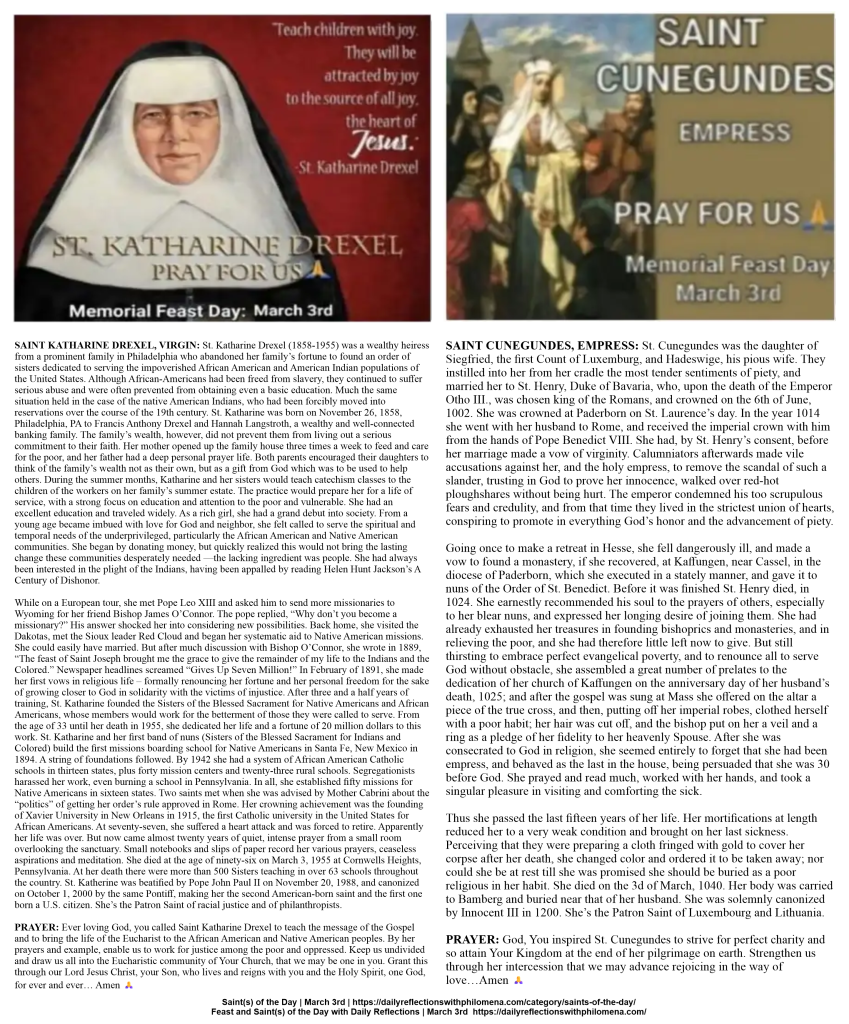
SAINT KATHARINE DREXEL, VIRGIN: St. Katharine Drexel (1858-1955) was a wealthy heiress from a prominent family in Philadelphia who abandoned her family’s fortune to found an order of sisters dedicated to serving the impoverished African American and American Indian populations of the United States. Although African-Americans had been freed from slavery, they continued to suffer serious abuse and were often prevented from obtaining even a basic education. Much the same situation held in the case of the native American Indians, who had been forcibly moved into reservations over the course of the 19th century. St. Katharine was born on November 26, 1858, Philadelphia, PA to Francis Anthony Drexel and Hannah Langstroth, a wealthy and well-connected banking family. The family’s wealth, however, did not prevent them from living out a serious commitment to their faith. Her mother opened up the family house three times a week to feed and care for the poor, and her father had a deep personal prayer life. Both parents encouraged their daughters to think of the family’s wealth not as their own, but as a gift from God which was to be used to help others. During the summer months, Katharine and her sisters would teach catechism classes to the children of the workers on her family’s summer estate. The practice would prepare her for a life of service, with a strong focus on education and attention to the poor and vulnerable. She had an excellent education and traveled widely. As a rich girl, she had a grand debut into society. From a young age became imbued with love for God and neighbor, she felt called to serve the spiritual and temporal needs of the underprivileged, particularly the African American and Native American communities. She began by donating money, but quickly realized this would not bring the lasting change these communities desperately needed —the lacking ingredient was people. She had always been interested in the plight of the Indians, having been appalled by reading Helen Hunt Jackson’s A Century of Dishonor.
While on a European tour, she met Pope Leo XIII and asked him to send more missionaries to Wyoming for her friend Bishop James O’Connor. The pope replied, “Why don’t you become a missionary?” His answer shocked her into considering new possibilities. Back home, she visited the Dakotas, met the Sioux leader Red Cloud and began her systematic aid to Native American missions. She could easily have married. But after much discussion with Bishop O’Connor, she wrote in 1889, “The feast of Saint Joseph brought me the grace to give the remainder of my life to the Indians and the Colored.” Newspaper headlines screamed “Gives Up Seven Million!” In February of 1891, she made her first vows in religious life – formally renouncing her fortune and her personal freedom for the sake of growing closer to God in solidarity with the victims of injustice. After three and a half years of training, St. Katharine founded the Sisters of the Blessed Sacrament for Native Americans and African Americans, whose members would work for the betterment of those they were called to serve. From the age of 33 until her death in 1955, she dedicated her life and a fortune of 20 million dollars to this work. St. Katharine and her first band of nuns (Sisters of the Blessed Sacrament for Indians and Colored) build the first missions boarding school for Native Americans in Santa Fe, New Mexico in 1894. A string of foundations followed. By 1942 she had a system of African American Catholic schools in thirteen states, plus forty mission centers and twenty-three rural schools. Segregationists harassed her work, even burning a school in Pennsylvania. In all, she established fifty missions for Native Americans in sixteen states. Two saints met when she was advised by Mother Cabrini about the “politics” of getting her order’s rule approved in Rome. Her crowning achievement was the founding of Xavier University in New Orleans in 1915, the first Catholic university in the United States for African Americans. At seventy-seven, she suffered a heart attack and was forced to retire. Apparently her life was over. But now came almost twenty years of quiet, intense prayer from a small room overlooking the sanctuary. Small notebooks and slips of paper record her various prayers, ceaseless aspirations and meditation. She died at the age of ninety-six on March 3, 1955 at Cornwells Heights, Pennsylvania. At her death there were more than 500 Sisters teaching in over 63 schools throughout the country. St. Katherine was beatified by Pope John Paul II on November 20, 1988, and canonized on October 1, 2000 by the same Pontiff, making her the second American-born saint and the first one born a U.S. citizen. She’s the Patron Saint of racial justice and of philanthropists.
PRAYER: Ever loving God, you called Saint Katharine Drexel to teach the message of the Gospel and to bring the life of the Eucharist to the African American and Native American peoples. By her prayers and example, enable us to work for justice among the poor and oppressed. Keep us undivided and draw us all into the Eucharistic community of Your Church, that we may be one in you. Grant this through our Lord Jesus Christ, your Son, who lives and reigns with you and the Holy Spirit, one God, for ever and ever… Amen🙏
SAINT CUNEGUNDES, EMPRESS: St. Cunegundes was the daughter of Siegfried, the first Count of Luxemburg, and Hadeswige, his pious wife. They instilled into her from her cradle the most tender sentiments of piety, and married her to St. Henry, Duke of Bavaria, who, upon the death of the Emperor Otho III., was chosen king of the Romans, and crowned on the 6th of June, 1002. She was crowned at Paderborn on St. Laurence’s day. In the year 1014 she went with her husband to Rome, and received the imperial crown with him from the hands of Pope Benedict VIII. She had, by St. Henry’s consent, before her marriage made a vow of virginity. Calumniators afterwards made vile accusations against her, and the holy empress, to remove the scandal of such a slander, trusting in God to prove her innocence, walked over red-hot ploughshares without being hurt. The emperor condemned his too scrupulous fears and credulity, and from that time they lived in the strictest union of hearts, conspiring to promote in everything God’s honor and the advancement of piety.
Going once to make a retreat in Hesse, she fell dangerously ill, and made a vow to found a monastery, if she recovered, at Kaffungen, near Cassel, in the diocese of Paderborn, which she executed in a stately manner, and gave it to nuns of the Order of St. Benedict. Before it was finished St. Henry died, in 1024. She earnestly recommended his soul to the prayers of others, especially to her blear nuns, and expressed her longing desire of joining them. She had already exhausted her treasures in founding bishoprics and monasteries, and in relieving the poor, and she had therefore little left now to give. But still thirsting to embrace perfect evangelical poverty, and to renounce all to serve God without obstacle, she assembled a great number of prelates to the dedication of her church of Kaffungen on the anniversary day of her husband’s death, 1025; and after the gospel was sung at Mass she offered on the altar a piece of the true cross, and then, putting off her imperial robes, clothed herself with a poor habit; her hair was cut off, and the bishop put on her a veil and a ring as a pledge of her fidelity to her heavenly Spouse. After she was consecrated to God in religion, she seemed entirely to forget that she had been empress, and behaved as the last in the house, being persuaded that she was 30 before God. She prayed and read much, worked with her hands, and took a singular pleasure in visiting and comforting the sick.
Thus she passed the last fifteen years of her life. Her mortifications at length reduced her to a very weak condition and brought on her last sickness. Perceiving that they were preparing a cloth fringed with gold to cover her corpse after her death, she changed color and ordered it to be taken away; nor could she be at rest till she was promised she should be buried as a poor religious in her habit. She died on the 3rd of March, 1040. Her body was carried to Bamberg and buried near that of her husband. She was solemnly canonized by Innocent III in 1200. She’s the Patron Saint of Luxembourg and Lithuania.
PRAYER: God, You inspired St. Cunegundes to strive for perfect charity and so attain Your Kingdom at the end of her pilgrimage on earth. Strengthen us through her intercession that we may advance rejoicing in the way of love…Amen🙏
Discover more from DailyReflections
Subscribe to get the latest posts sent to your email.