MEMORIAL OF SAINT DAVID OF WALES, BISHOP AND SAINT ALBINUS OF ANGERS, BISHOP – FEAST DAY ~ MARCH 1ST: Today, we celebrate the Memorial of Saint David of Wales, Bishop (Patron Saint of Wales; Pembrokeshire; Naas; vegetarians; poets; newborns) and Saint Albinus of Angers, Bishop and miracle-worker (Patron Saint invoked for children in danger of death; invoked against pirate attacks). Through the intercession of our Blessed Mother Mary and the Saints on this feast day, we humbly pray for poets who speak the Word and for the safety and well-being of our children and children all over the world. Amen 🙏🏽
Saint David of Wales, Bishop and Saint Albinus of Angers, Bishop and miracle-worker ~ Pray for us 🙏🏽
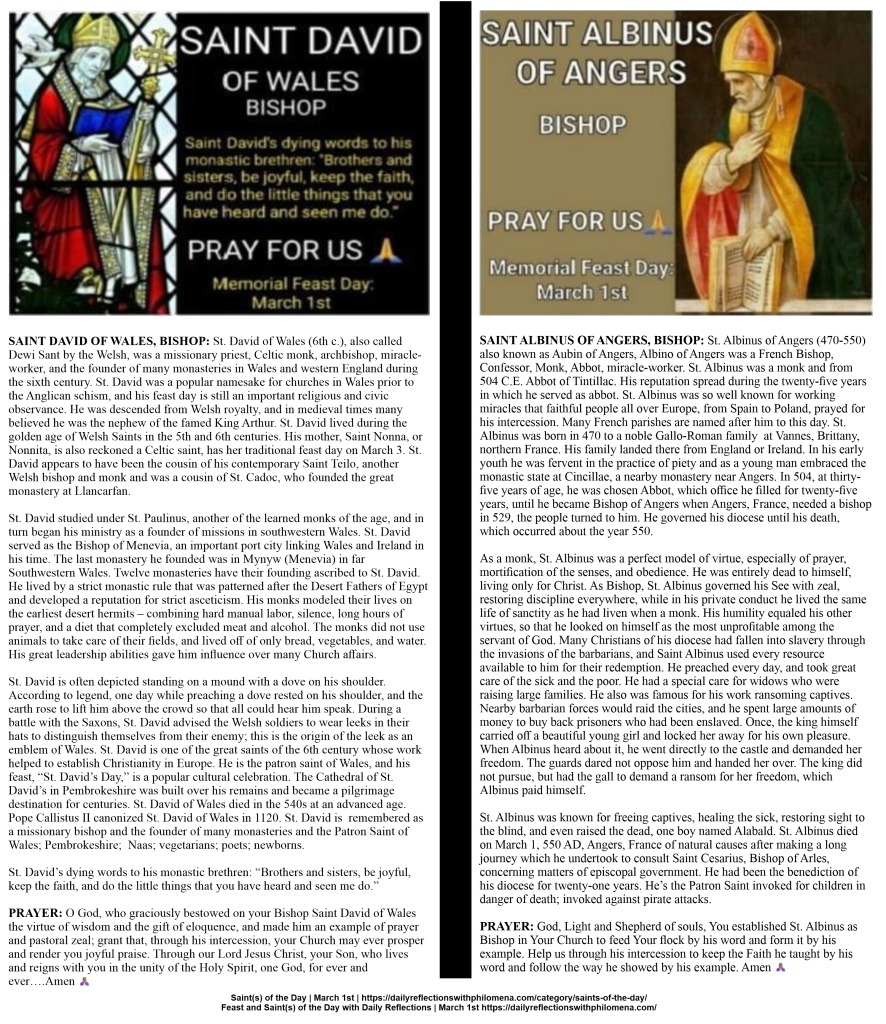
SAINT DAVID OF WALES, BISHOP: St. David of Wales (6th c.), also called Dewi Sant by the Welsh, was a missionary priest, Celtic monk, archbishop, miracle-worker, and the founder of many monasteries in Wales and western England during the sixth century. St. David was a popular namesake for churches in Wales prior to the Anglican schism, and his feast day is still an important religious and civic observance. He was descended from Welsh royalty, and in medieval times many believed he was the nephew of the famed King Arthur. St. David lived during the golden age of Welsh Saints in the 5th and 6th centuries. His mother, Saint Nonna, or Nonnita, is also reckoned a Celtic saint, has her traditional feast day on March 3. St. David appears to have been the cousin of his contemporary Saint Teilo, another Welsh bishop and monk and was a cousin of St. Cadoc, who founded the great monastery at Llancarfan.
St. David studied under St. Paulinus, another of the learned monks of the age, and in turn began his ministry as a founder of missions in southwestern Wales. St. David served as the Bishop of Menevia, an important port city linking Wales and Ireland in his time. The last monastery he founded was in Mynyw (Menevia) in far Southwestern Wales. Twelve monasteries have their founding ascribed to St. David. He lived by a strict monastic rule that was patterned after the Desert Fathers of Egypt and developed a reputation for strict asceticism. His monks modeled their lives on the earliest desert hermits – combining hard manual labor, silence, long hours of prayer, and a diet that completely excluded meat and alcohol. The monks did not use animals to take care of their fields, and lived off of only bread, vegetables, and water. His great leadership abilities gave him influence over many Church affairs.
St. David is often depicted standing on a mound with a dove on his shoulder. According to legend, one day while preaching a dove rested on his shoulder, and the earth rose to lift him above the crowd so that all could hear him speak. During a battle with the Saxons, St. David advised the Welsh soldiers to wear leeks in their hats to distinguish themselves from their enemy; this is the origin of the leek as an emblem of Wales. St. David is one of the great saints of the 6th century whose work helped to establish Christianity in Europe. He is the patron saint of Wales, and his feast, “St. David’s Day,” is a popular cultural celebration. The Cathedral of St. David’s in Pembrokeshire was built over his remains and became a pilgrimage destination for centuries. St. David of Wales died in the 540s at an advanced age. Pope Callistus II canonized St. David of Wales in 1120. St. David is remembered as a missionary bishop and the founder of many monasteries and the Patron Saint of Wales; Pembrokeshire; Naas; vegetarians; poets; newborns.
St. David’s dying words to his monastic brethren: “Brothers and sisters, be joyful, keep the faith, and do the little things that you have heard and seen me do.”
PRAYER: O God, who graciously bestowed on your Bishop Saint David of Wales the virtue of wisdom and the gift of eloquence, and made him an example of prayer and pastoral zeal; grant that, through his intercession, your Church may ever prosper and render you joyful praise. Through our Lord Jesus Christ, your Son, who lives and reigns with you in the unity of the Holy Spirit, one God, for ever and ever….Amen🙏
SAINT ALBINUS OF ANGERS, BISHOP: St. Albinus of Angers (470-550) also known as Aubin of Angers, Albino of Angers was a French Bishop, Confessor, Monk, Abbot, miracle-worker. St. Albinus was a monk and from 504 C.E. Abbot of Tintillac. His reputation spread during the twenty-five years in which he served as abbot. St. Albinus was so well known for working miracles that faithful people all over Europe, from Spain to Poland, prayed for his intercession. Many French parishes are named after him to this day. St. Albinus was born in 470 to a noble Gallo-Roman family at Vannes, Brittany, northern France. His family landed there from England or Ireland. In his early youth he was fervent in the practice of piety and as a young man embraced the monastic state at Cincillae, a nearby monastery near Angers. In 504, at thirty-five years of age, he was chosen Abbot, which office he filled for twenty-five years, until he became Bishop of Angers when Angers, France, needed a bishop in 529, the people turned to him. He governed his diocese until his death, which occurred about the year 550.
As a monk, St. Albinus was a perfect model of virtue, especially of prayer, mortification of the senses, and obedience. He was entirely dead to himself, living only for Christ. As Bishop, St. Albinus governed his See with zeal, restoring discipline everywhere, while in his private conduct he lived the same life of sanctity as he had liven when a monk. His humility equaled his other virtues, so that he looked on himself as the most unprofitable among the servant of God. Many Christians of his diocese had fallen into slavery through the invasions of the barbarians, and Saint Albinus used every resource available to him for their redemption. He preached every day, and took great care of the sick and the poor. He had a special care for widows who were raising large families. He also was famous for his work ransoming captives. Nearby barbarian forces would raid the cities, and he spent large amounts of money to buy back prisoners who had been enslaved. Once, the king himself carried off a beautiful young girl and locked her away for his own pleasure. When Albinus heard about it, he went directly to the castle and demanded her freedom. The guards dared not oppose him and handed her over. The king did not pursue, but had the gall to demand a ransom for her freedom, which Albinus paid himself.
St. Albinus was known for freeing captives, healing the sick, restoring sight to the blind, and even raised the dead, one boy named Alabald. St. Albinus died on March 1, 550 AD, Angers, France of natural causes after making a long journey which he undertook to consult Saint Cesarius, Bishop of Arles, concerning matters of episcopal government. He had been the benediction of his diocese for twenty-one years. He’s the Patron Saint invoked for children in danger of death; invoked against pirate attacks.
PRAYER: God, Light and Shepherd of souls, You established St. Albinus as Bishop in Your Church to feed Your flock by his word and form it by his example. Help us through his intercession to keep the Faith he taught by his word and follow the way he showed by his example. Amen🙏
Discover more from DailyReflections
Subscribe to get the latest posts sent to your email.