MEMORIAL OF POPE SAINT HILARY (HILARIUS); SAINT ROMANUS OF CONDAT, ABBOT AND BLESSED DANIEL BROTTIER, PRIEST – FEAST DAY ~ FEBRUARY 28TH: Today, we celebrate the Memorial of Pope Saint Hilary (Hilarius); Saint Romanus of Condat, Abbot (Patron Saint of drowning victims, insanity, mental illness, mentally ill people) and Blessed Daniel Brottier, Priest. Through the intercession of our Blessed Mother and the Saints on this feast day, we humbly pray for the repose of the souls of all the faithful departed; the sick and dying, we particularly pray for those suffering from mental illness, cancers and other terminal diseases. May God grant them His divine healing and intervention. Amen 🙏🏽
Pope Saint Hilary (Hilarius); Saint Romanus of Condat, Abbot and Blessed Daniel Brottier, Priest ~ Pray for us 🙏🏽
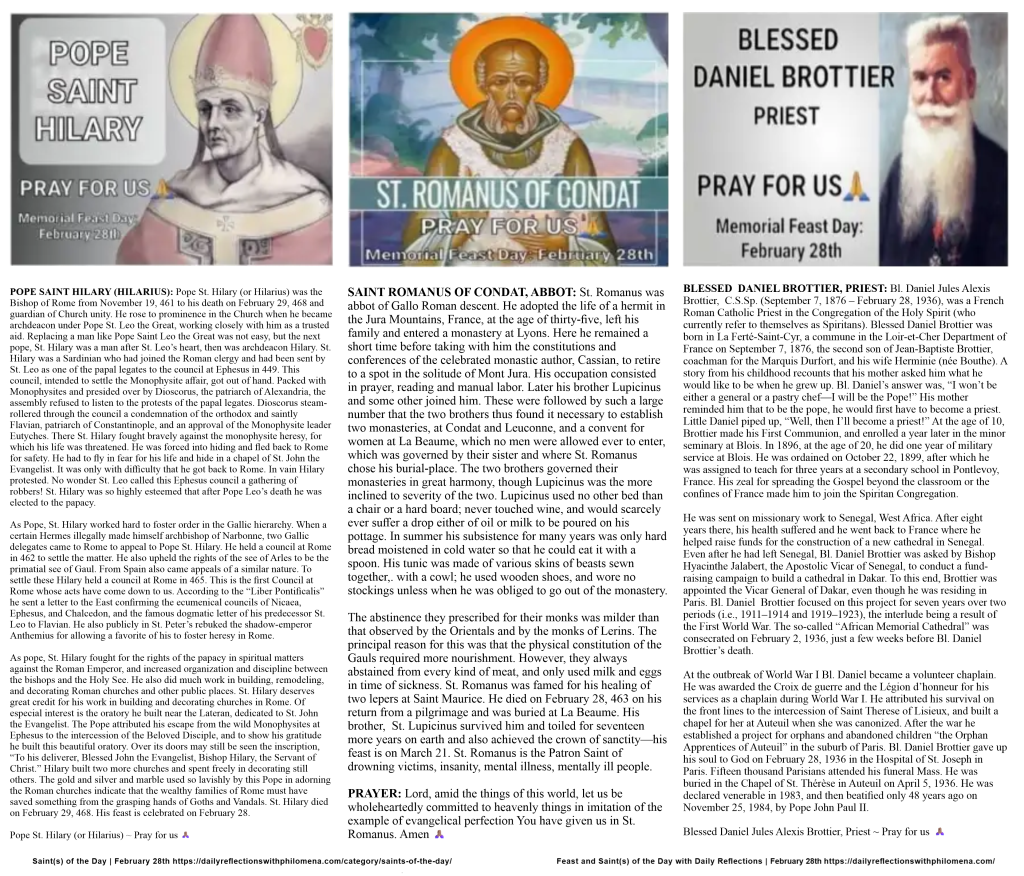
POPE SAINT HILARY (HILARIUS): Pope St. Hilary (or Hilarius) was the Bishop of Rome from November 19, 461 to his death on February 29, 468 and guardian of Church unity. He rose to prominence in the Church when he became archdeacon under Pope St. Leo the Great, working closely with him as a trusted aid. Replacing a man like Pope Saint Leo the Great was not easy, but the next pope, St. Hilary was a man after St. Leo’s heart, then was archdeacon Hilary. St. Hilary was a Sardinian who had joined the Roman clergy and had been sent by St. Leo as one of the papal legates to the council at Ephesus in 449. This council, intended to settle the Monophysite affair, got out of hand. Packed with Monophysites and presided over by Dioscorus, the patriarch of Alexandria, the assembly refused to listen to the protests of the papal legates. Dioscorus steam-rollered through the council a condemnation of the orthodox and saintly Flavian, patriarch of Constantinople, and an approval of the Monophysite leader Eutyches. There St. Hilary fought bravely against the monophysite heresy, for which his life was threatened. He was forced into hiding and fled back to Rome for safety. He had to fly in fear for his life and hide in a chapel of St. John the Evangelist. It was only with difficulty that he got back to Rome. In vain Hilary protested. No wonder St. Leo called this Ephesus council a gathering of robbers! St. Hilary was so highly esteemed that after Pope Leo’s death he was elected to the papacy.
As Pope, St. Hilary worked hard to foster order in the Gallic hierarchy. When a certain Hermes illegally made himself archbishop of Narbonne, two Gallic delegates came to Rome to appeal to Pope St. Hilary. He held a council at Rome in 462 to settle the matter. He also upheld the rights of the see of Arles to be the primatial see of Gaul. From Spain also came appeals of a similar nature. To settle these Hilary held a council at Rome in 465. This is the first Council at Rome whose acts have come down to us. According to the “Liber Pontificalis” he sent a letter to the East confirming the ecumenical councils of Nicaea, Ephesus, and Chalcedon, and the famous dogmatic letter of his predecessor St. Leo to Flavian. He also publicly in St. Peter’s rebuked the shadow-emperor Anthemius for allowing a favorite of his to foster heresy in Rome.
As pope, St. Hilary fought for the rights of the papacy in spiritual matters against the Roman Emperor, and increased organization and discipline between the bishops and the Holy See. He also did much work in building, remodeling, and decorating Roman churches and other public places. St. Hilary deserves great credit for his work in building and decorating churches in Rome. Of especial interest is the oratory he built near the Lateran, dedicated to St. John the Evangelist. The Pope attributed his escape from the wild Monophysites at Ephesus to the intercession of the Beloved Disciple, and to show his gratitude he built this beautiful oratory. Over its doors may still be seen the inscription, “To his deliverer, Blessed John the Evangelist, Bishop Hilary, the Servant of Christ.” Hilary built two more churches and spent freely in decorating still others. The gold and silver and marble used so lavishly by this Pope in adorning the Roman churches indicate that the wealthy families of Rome must have saved something from the grasping hands of Goths and Vandals. St. Hilary died on February 29, 468. His feast is celebrated on February 28.
Pope St. Hilary (or Hilarius) ~ Pray for us 🙏🏽
SAINT ROMANUS OF CONDAT, ABBOT: St. Romanus was abbot of Gallo Roman descent. He adopted the life of a hermit in the Jura Mountains, France, at the age of thirty-five, left his family and entered a monastery at Lyons. Here he remained a short time before taking with him the constitutions and conferences of the celebrated monastic author, Cassian, to retire to a spot in the solitude of Mont Jura. His occupation consisted in prayer, reading and manual labor. Later his brother Lupicinus and some other joined him. These were followed by such a large number that the two brothers thus found it necessary to establish two monasteries, at Condat and Leuconne, and a convent for women at La Beaume, which no men were allowed ever to enter, which was governed by their sister and where St. Romanus chose his burial-place. The two brothers governed their monasteries in great harmony, though Lupicinus was the more inclined to severity of the two. Lupicinus used no other bed than a chair or a hard board; never touched wine, and would scarcely ever suffer a drop either of oil or milk to be poured on his pottage. In summer his subsistence for many years was only hard bread moistened in cold water so that he could eat it with a spoon. His tunic was made of various skins of beasts sewn together,. with a cowl; he used wooden shoes, and wore no stockings unless when he was obliged to go out of the monastery.
The abstinence they prescribed for their monks was milder than that observed by the Orientals and by the monks of Lerins. The principal reason for this was that the physical constitution of the Gauls required more nourishment. However, they always abstained from every kind of meat, and only used milk and eggs in time of sickness. St. Romanus was famed for his healing of two lepers at Saint Maurice. He died on February 28, 463 on his return from a pilgrimage and was buried at La Beaume. His brother, St. Lupicinus survived him and toiled for seventeen more years on earth and also achieved the crown of sanctity—his feast is on March 21. St. Romanus is the Patron Saint of drowning victims, insanity, mental illness, mentally ill people.
PRAYER: Lord, amid the things of this world, let us be wholeheartedly committed to heavenly things in imitation of the example of evangelical perfection You have given us in St. Romanus. Amen🙏
BLESSED DANIEL BROTTIER, PRIEST: Bl. Daniel Jules Alexis Brottier, C.S.Sp. (September 7, 1876 – February 28, 1936), was a French Roman Catholic Priest in the Congregation of the Holy Spirit (who currently refer to themselves as Spiritans). Blessed Daniel Brottier was born in La Ferté-Saint-Cyr, a commune in the Loir-et-Cher Department of France on September 7, 1876, the second son of Jean-Baptiste Brottier, coachman for the Marquis Durfort, and his wife Herminie (née Bouthe). A story from his childhood recounts that his mother asked him what he would like to be when he grew up. Bl. Daniel’s answer was, “I won’t be either a general or a pastry chef—I will be the Pope!” His mother reminded him that to be the pope, he would first have to become a priest. Little Daniel piped up, “Well, then I’ll become a priest!” At the age of 10, Brottier made his First Communion, and enrolled a year later in the minor seminary at Blois. In 1896, at the age of 20, he did one year of military service at Blois. He was ordained on October 22, 1899, after which he was assigned to teach for three years at a secondary school in Pontlevoy, France. His zeal for spreading the Gospel beyond the classroom or the confines of France made him to join the Spiritan Congregation.
He was sent on missionary work to Senegal, West Africa. After eight years there, his health suffered and he went back to France where he helped raise funds for the construction of a new cathedral in Senegal. Even after he had left Senegal, Bl. Daniel Brottier was asked by Bishop Hyacinthe Jalabert, the Apostolic Vicar of Senegal, to conduct a fund-raising campaign to build a cathedral in Dakar. To this end, Brottier was appointed the Vicar General of Dakar, even though he was residing in Paris. Bl. Daniel Brottier focused on this project for seven years over two periods (i.e., 1911–1914 and 1919–1923), the interlude being a result of the First World War. The so-called “African Memorial Cathedral” was consecrated on February 2, 1936, just a few weeks before Bl. Daniel Brottier’s death.
At the outbreak of World War I Bl. Daniel became a volunteer chaplain. He was awarded the Croix de guerre and the Légion d’honneur for his services as a chaplain during World War I. He attributed his survival on the front lines to the intercession of Saint Therese of Lisieux, and built a chapel for her at Auteuil when she was canonized. After the war he established a project for orphans and abandoned children “the Orphan Apprentices of Auteuil” in the suburb of Paris. Bl. Daniel Brottier gave up his soul to God on February 28, 1936 in the Hospital of St. Joseph in Paris. Fifteen thousand Parisians attended his funeral Mass. He was buried in the Chapel of St. Thérèse in Auteuil on April 5, 1936. He was declared venerable in 1983, and then beatified only 48 years ago on November 25, 1984, by Pope John Paul II.
Blessed Daniel Jules Alexis Brottier, Priest ~ Pray for us 🙏🏽
Discover more from DailyReflections
Subscribe to get the latest posts sent to your email.