MEMORIAL OF SAINT CONRAD OF PIACENZA; HERMIT; SAINT BARBATUS OF BENEVENTO, BISHOP; SAINT GABINUS, MARTYR AND BLESSED ALVAREZ OF CORDOVA – FEAST DAY ~ FEBRUARY 19TH: Today, we celebrate the Memorial of Saint Conrad of Piacenza, Hermit (Patron Saint for the cure of hernias, Cities and Diocese of Noto and Calendasco, Sicily); Saint Barbatus (Patron Saint of Benevento); Saint Gabinus, Martyr and Blessed Alvarez of Cordova. Through the intercession of our Blessed Mother Mary and these Saints, we humbly pray for the sick and dying, particularly pray for those suffering from hernias, cancers and other terminal diseases, praying for God’s divine healing and intervention. We also pray for persecuted Christians, the conversion of sinners and all who have fallen away from the joy of living in God’s loving presence and grace… Amen 🙏
Saint Conrad of Piacenza, Hermit; Saint Barbatus; Saint Gabinus, Martyr and Blessed Alvarez of Cordova ~ Pray for us 🙏
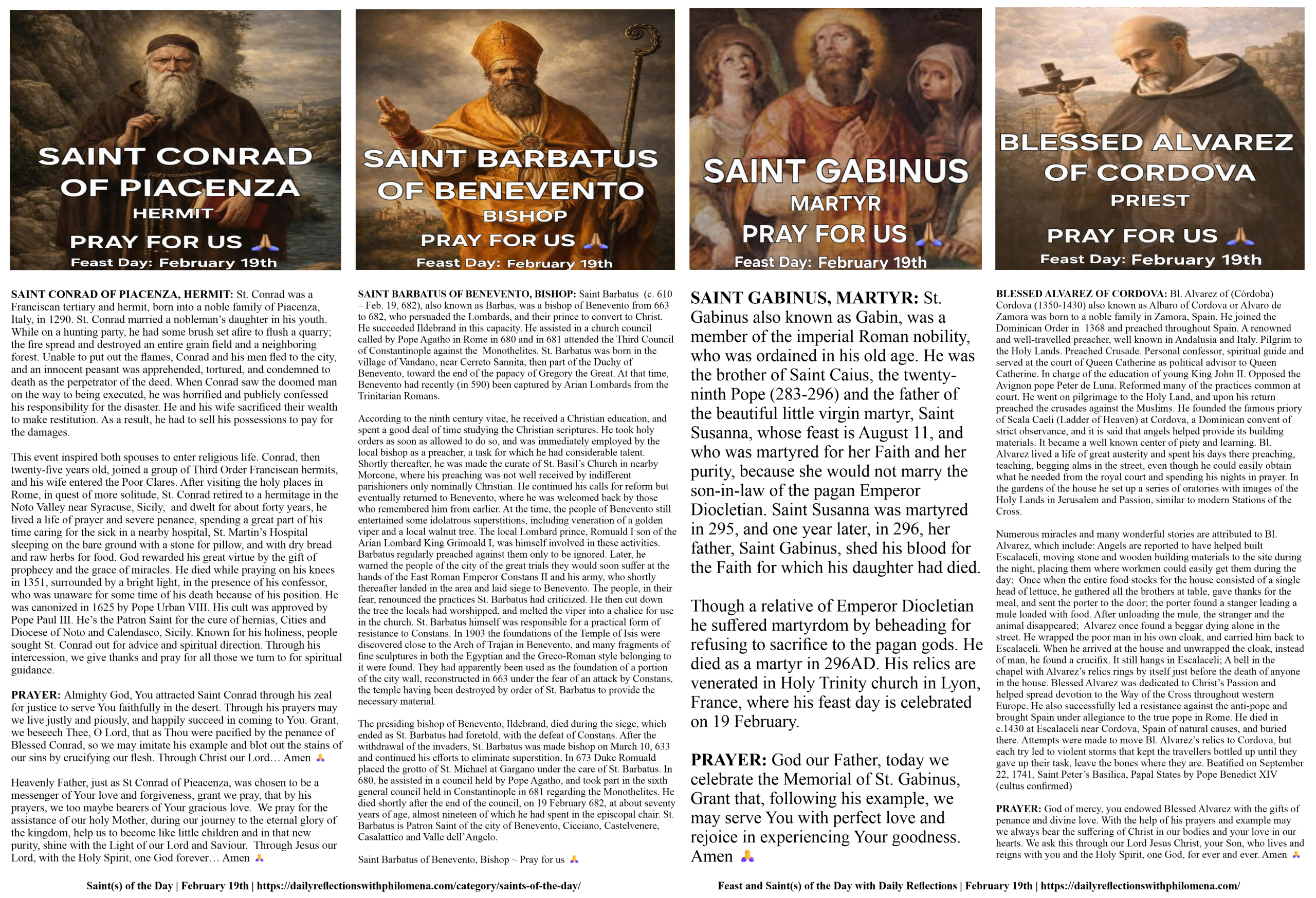
SAINT CONRAD OF PIACENZA, HERMIT: St. Conrad was a Franciscan tertiary and hermit, born into a noble family of Piacenza, Italy, in 1290. St. Conrad married a nobleman’s daughter in his youth. While on a hunting party, he had some brush set afire to flush a quarry; the fire spread and destroyed an entire grain field and a neighboring forest. Unable to put out the flames, Conrad and his men fled to the city, and an innocent peasant was apprehended, tortured, and condemned to death as the perpetrator of the deed. When Conrad saw the doomed man on the way to being executed, he was horrified and publicly confessed his responsibility for the disaster. He and his wife sacrificed their wealth to make restitution. As a result, he had to sell his possessions to pay for the damages.
This event inspired both spouses to enter religious life. Conrad, then twenty-five years old, joined a group of Third Order Franciscan hermits, and his wife entered the Poor Clares. After visiting the holy places in Rome, in quest of more solitude, St. Conrad retired to a hermitage in the Noto Valley near Syracuse, Sicily, and dwelt for about forty years, he lived a life of prayer and severe penance, spending a great part of his time caring for the sick in a nearby hospital, St. Martin’s Hospital sleeping on the bare ground with a stone for pillow, and with dry bread and raw herbs for food. God rewarded his great virtue by the gift of prophecy and the grace of miracles. He died while praying on his knees in 1351, surrounded by a bright light, in the presence of his confessor, who was unaware for some time of his death because of his position. He was canonized in 1625 by Pope Urban VIII. His cult was approved by Pope Paul III. He’s the Patron Saint for the cure of hernias, Cities and Diocese of Noto and Calendasco, Sicily. Known for his holiness, people sought St. Conrad out for advice and spiritual direction. Through his intercession, we give thanks and pray for all those we turn to for spiritual guidance.
PRAYER: Almighty God, You attracted Saint Conrad through his zeal for justice to serve You faithfully in the desert. Through his prayers may we live justly and piously, and happily succeed in coming to You. Grant, we beseech Thee, O Lord, that as Thou were pacified by the penance of Blessed Conrad, so we may imitate his example and blot out the stains of our sins by crucifying our flesh. Through Christ our Lord… Amen
Heavenly Father, just as St Conrad of Pieacenza, was chosen to be a messenger of Your love and forgiveness, grant we pray, that by his prayers, we too maybe bearers of Your gracious love. We pray for the assistance of our holy Mother, during our journey to the eternal glory of the kingdom, help us to become like little children and in that new purity, shine with the Light of our Lord and Saviour. Through Jesus our Lord, with the Holy Spirit, one God forever… Amen🙏
SAINT BARBATUS OF BENEVENTO, BISHOP: Saint Barbatus (c. 610 – Feb. 19, 682), also known as Barbas, was a bishop of Benevento from 663 to 682, who persuaded the Lombards, and their prince to convert to Christ. He succeeded Ildebrand in this capacity. He assisted in a church council called by Pope Agatho in Rome in 680 and in 681 attended the Third Council of Constantinople against the Monothelites. St. Barbatus was born in the village of Vandano, near Cerreto Sannita, then part of the Duchy of Benevento, toward the end of the papacy of Gregory the Great. At that time, Benevento had recently (in 590) been captured by Arian Lombards from the Trinitarian Romans.
According to the ninth century vitae, he received a Christian education, and spent a good deal of time studying the Christian scriptures. He took holy orders as soon as allowed to do so, and was immediately employed by the local bishop as a preacher, a task for which he had considerable talent. Shortly thereafter, he was made the curate of St. Basil’s Church in nearby Morcone, where his preaching was not well received by indifferent parishioners only nominally Christian. He continued his calls for reform but eventually returned to Benevento, where he was welcomed back by those who remembered him from earlier. At the time, the people of Benevento still entertained some idolatrous superstitions, including veneration of a golden viper and a local walnut tree. The local Lombard prince, Romuald I son of the Arian Lombard King Grimoald I, was himself involved in these activities. Barbatus regularly preached against them only to be ignored. Later, he warned the people of the city of the great trials they would soon suffer at the hands of the East Roman Emperor Constans II and his army, who shortly thereafter landed in the area and laid siege to Benevento. The people, in their fear, renounced the practices St. Barbatus had criticized. He then cut down the tree the locals had worshipped, and melted the viper into a chalice for use in the church. St. Barbatus himself was responsible for a practical form of resistance to Constans. In 1903 the foundations of the Temple of Isis were discovered close to the Arch of Trajan in Benevento, and many fragments of fine sculptures in both the Egyptian and the Greco-Roman style belonging to it were found. They had apparently been used as the foundation of a portion of the city wall, reconstructed in 663 under the fear of an attack by Constans, the temple having been destroyed by order of St. Barbatus to provide the necessary material.
The presiding bishop of Benevento, Ildebrand, died during the siege, which ended as St. Barbatus had foretold, with the defeat of Constans. After the withdrawal of the invaders, St. Barbatus was made bishop on March 10, 633 and continued his efforts to eliminate superstition. In 673 Duke Romuald placed the grotto of St. Michael at Gargano under the care of St. Barbatus. In 680, he assisted in a council held by Pope Agatho, and took part in the sixth general council held in Constantinople in 681 regarding the Monothelites. He died shortly after the end of the council, on 19 February 682, at about seventy years of age, almost nineteen of which he had spent in the episcopal chair. St. Barbatus is Patron Saint of the city of Benevento, Cicciano, Castelvenere, Casalattico and Valle dell’Angelo.
Saint Barbatus of Benevento, Bishop ~ Pray for us 🙏
SAINT GABINUS, MARTYR: St. Gabinus also known as Gabin, was a member of the imperial Roman nobility, who was ordained in his old age. He was the brother of Saint Caius, the twenty-ninth Pope (283-296) and the father of the beautiful little virgin martyr, Saint Susanna, whose feast is August 11, and who was martyred for her Faith and her purity, because she would not marry the son-in-law of the pagan Emperor Diocletian. Saint Susanna was martyred in 295, and one year later, in 296, her father, Saint Gabinus, shed his blood for the Faith for which his daughter had died.
Though a relative of Emperor Diocletian he suffered martyrdom by beheading for refusing to sacrifice to the pagan gods. He died as a martyr in 296AD. His relics are venerated in Holy Trinity church in Lyon, France, where his feast day is celebrated on 19 February.
PRAYER: God our Father, today we celebrate the Memorial of St. Gabinus, Grant that, following his example, we may serve You with perfect love and rejoice in experiencing Your goodness. Amen🙏
BLESSED ALVAREZ OF CORDOVA: Bl. Alvarez of (Córdoba) Cordova (1350-1430) also known as Albaro of Cordova or Alvaro de Zamora was born to a noble family in Zamora, Spain. He joined the Dominican Order in 1368 and preached throughout Spain. A renowned and well-travelled preacher, well known in Andalusia and Italy. Pilgrim to the Holy Lands. Preached Crusade. Personal confessor, spiritual guide and served at the court of Queen Catherine as political advisor to Queen Catherine. In charge of the education of young King John II. Opposed the Avignon pope Peter de Luna. Reformed many of the practices common at court. He went on pilgrimage to the Holy Land, and upon his return preached the crusades against the Muslims. He founded the famous priory of Scala Caeli (Ladder of Heaven) at Cordova, a Dominican convent of strict observance, and it is said that angels helped provide its building materials. It became a well known center of piety and learning. Bl. Alvarez lived a life of great austerity and spent his days there preaching, teaching, begging alms in the street, even though he could easily obtain what he needed from the royal court and spending his nights in prayer. In the gardens of the house he set up a series of oratories with images of the Holy Lands in Jerusalem and Passion, similar to modern Stations of the Cross.
Numerous miracles and many wonderful stories are attributed to Bl. Alvarez, which include: Angels are reported to have helped built Escalaceli, moving stone and wooden building materials to the site during the night, placing them where workmen could easily get them during the day; Once when the entire food stocks for the house consisted of a single head of lettuce, he gathered all the brothers at table, gave thanks for the meal, and sent the porter to the door; the porter found a stanger leading a mule loaded with food. After unloading the mule, the stranger and the animal disappeared; Alvarez once found a beggar dying alone in the street. He wrapped the poor man in his own cloak, and carried him back to Escalaceli. When he arrived at the house and unwrapped the cloak, instead of man, he found a crucifix. It still hangs in Escalaceli; A bell in the chapel with Alvarez’s relics rings by itself just before the death of anyone in the house. Blessed Alvarez was dedicated to Christ’s Passion and helped spread devotion to the Way of the Cross throughout western Europe. He also successfully led a resistance against the anti-pope and brought Spain under allegiance to the true pope in Rome. He died in c.1430 at Escalaceli near Cordova, Spain of natural causes, and buried there. Attempts were made to move Bl. Alvarez’s relics to Cordova, but each try led to violent storms that kept the travellers bottled up until they gave up their task, leave the bones where they are. Beatified on September 22, 1741, Saint Peter’s Basilica, Papal States by Pope Benedict XIV (cultus confirmed)
PRAYER: God of mercy, you endowed Blessed Alvarez with the gifts of penance and divine love. With the help of his prayers and example may we always bear the suffering of Christ in our bodies and your love in our hearts. We ask this through our Lord Jesus Christ, your Son, who lives and reigns with you and the Holy Spirit, one God, for ever and ever. Amen🙏
Discover more from DailyReflections
Subscribe to get the latest posts sent to your email.