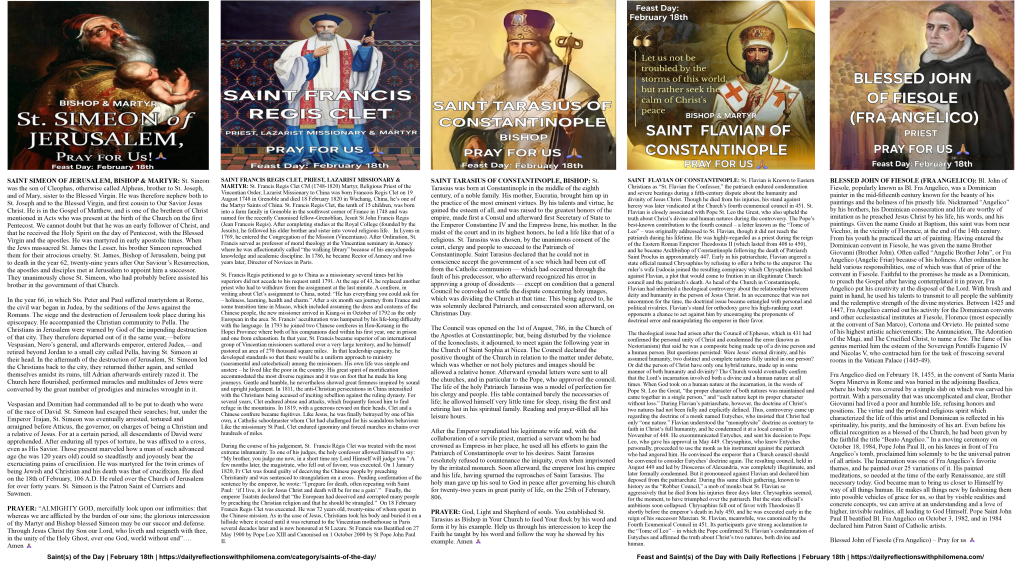
MEMORIAL OF SAINT SIMEON OF JERUSALEM, BISHOP & MARTYR; SAINT FRANCIS REGIS CLET, PRIEST, LAZARIST MISSIONARY & MARTYR; SAINT TARASIUS OF CONSTANTINOPLE, BISHOP; SAINT FLAVIAN OF CONSTANTINOPLE AND BLESSED JOHN OF FIESOLE (FRA ANGELICO) – FEAST DAY ~ FEBRUARY 18TH: Today, we celebrate the Memorial of Saint Simeon of Jerusalem, Bishop and Martyr; Saint Francis Regis Clet, Priest, Lazarist Missionary and Martyr; Saint Tarasius of Constantinople, Bishop; Saint Flavian of Constantinople and Blessed John of Fiesole (Fra Angelico). Blessed John of Fiesole is the Patron Saint of Catholic artists. Through the intercession of our Blessed Mother Mary and these Saints, we humbly pray for Catholic Artists and all Artists, for the Church, for persecuted Christians, the conversion of sinners and all who have fallen away from the joy of living in God’s loving presence and grace. Amen 🙏🏽
Saints Simeon, Saint Francis; Saint Tarasius; Saint Flavian, and Blessed John (Fra Angelico) ~ Pray for us 🙏🏽
SAINT SIMEON OF JERUSALEM, BISHOP & MARTYR: St. Sineon was the son of Cleophas, otherwise called Alpheus, brother to St. Joseph, and of Mary, sister to the Blessed Virgin. He was therefore nephew both to St. Joseph and to the Blessed Virgin, and first cousin to Our Savior Jesus Christ. He is in the Gospel of Matthew, and is one of the brethren of Christ mentioned in Acts who was present at the birth of the Church on the first Pentecost. We cannot doubt but that he was an early follower of Christ, and that he received the Holy Spirit on the day of Pentecost, with the Blessed Virgin and the apostles. He was martyred in early apostolic times. When the Jews massacred St. James the Lesser, his brother Simeon reproached them for their atrocious cruelty. St. James, Bishop of Jerusalem, being put to death in the year 62, twenty-nine years after Our Saviour’s Resurrection, the apostles and disciples met at Jerusalem to appoint him a successor. They unanimously chose St. Simeon, who had probably before assisted his brother in the government of that Church.
In the year 66, in which Sts. Peter and Paul suffered martyrdom at Rome, the civil war began in Judea, by the seditions of the Jews against the Romans. The siege and the destruction of Jerusalem took place during his episcopacy. He accompanied the Christian community to Pella. The Christians in Jerusalem were warned by God of the impending destruction of that city. They therefore departed out of it the same year,—before Vespasian, Nero’s general, and afterwards emperor, entered Judea,—and retired beyond Jordan to a small city called Pella, having St. Simeon at their head. In the aftermath of the destruction of Jerusalem, St. Simeon led the Christians back to the city, they returned thither again, and settled themselves amidst its ruins, till Adrian afterwards entirely razed it. The Church here flourished, performed miracles and multitudes of Jews were converted by the great number of prodigies and miracles wrought in it.
Vespasian and Domitian had commanded all to be put to death who were of the race of David. St. Simeon had escaped their searches; but, under the Emperor Trajan, St. Simeon was eventually arrested, tortured and arraigned before Atticus, the governor, on charges of being a Christian and a relative of Jesus. For at a certain period, all descendants of David were apprehended. After enduring all types of torture, he was affixed to a cross, even as His Savior. Those present marveled how a man of such advanced age (he was 120 years old) could so steadfastly and joyously bear the excruciating pains of crucifixion. He was martyred for the twin crimes of being Jewish and Christian and his death was that of crucifixion. He died on the 18th of February, 106 A.D. He ruled over the Church of Jerusalem for over forty years. St. Simeon is the Patron Saint of Curriers and Sawmen.
PRAYER: “ALMIGHTY GOD, mercifully look upon our infirmities: that whereas we are afflicted by the burden of our sins; the glorious intercession of thy Martyr and Bishop blessed Simeon may be our succor and defense. Through Jesus Christ thy Son our Lord, who liveth and reigneth with thee, in the unity of the Holy Ghost, ever one God, world without end”…. Amen🙏
SAINT FRANCIS REGIS CLET, PRIEST, LAZARIST MISSIONARY & MARTYR: St. Francis Regis Clet CM (1748-1820) Martyr, Religious Priest of the Vincentian Order, Lazarist Missionary to China was born Francois Regis Clet on 19 August 1748 in Grenoble and died 18 February 1820 in Wuchang, China, he’s one of the Martyr Saints of China. St. Francis Regis Clet, the tenth of 15 children, was born into a farm family in Grenoble in the southwest corner of France in 1748 and was named for the recently Canonised fellow-Grenoblian, Jesuit St John Francis Regis (Jean Francois Regis). After completing studies at the Royal College (founded by the Jesuits), he followed his elder brother and sister into vowed religious life. In Lyons in 1769, he entered the Congregation of the Mission (Vincentians). After Ordination, St. Francis served as professor of moral theology at the Vincentian seminary in Annecy where he was affectionately called “the walking library” because of his encyclopedic knowledge and academic discipline. In 1786, he became Rector of Annecy and two years later, Director of Novices in Paris.
St. Francis Regis petitioned to go to China as a missionary several times but his superiors did not accede to his request until 1791. At the age of 43, he replaced another priest who had to withdraw from the assignment at the last minute. A confrere, in writing about Clet’s assignment to China, noted: “He has everything you could ask for – holiness, learning, health and charm.” After a six month sea journey from France and some transition time in Macao, which included assuming the dress and customs of the Chinese people, the new missioner arrived in Kiang-si in October of 1792 as the only European in the area. St. Francis’ acculturation was hampered by his life-long difficulty with the language. In 1793 he joined two Chinese confreres in Hou-Kouang in the Hopei Province where both of his companions died within his first year, one in prison and one from exhaustion. In that year, St. Francis became superior of an international group of Vincentian missioners scattered over a very large territory, and he himself pastored an area of 270 thousand square miles. In that leadership capacity, he developed standards so that there would be a uniform approach to ministry (sacramental and catechetical) among the missioners. His own life was simple and austere – he lived like the poor in the country. His great spirit of mortification accommodated the most diverse regimes and it was on foot that he made his long journeys. Gentle and humble, he nevertheless showed great firmness inspired by sound and upright judgement. In 1811, the anti-Christian persecutions in China intensified with the Christians being accused of inciting rebellion against the ruling dynasty. For several years, Clet endured abuse and attacks, which frequently forced him to find refuge in the mountains. In 1819, with a generous reward on their heads, Clet and a Chinese confrere became fugitives. Like Jesus, he was finally betrayed by one of his own, a Catholic schoolmaster whom Clet had challenged for his scandalous behaviour. Like the missionary St Paul, Clet endured ignominy and forced marches in chains over hundreds of miles.
During the course of his judgement, St. Francis Régis Clet was treated with the most extreme inhumanity. To one of his judges, the holy confessor allowed himself to say: “My brother, you judge me now, in a short time my Lord Himself will judge you.” A few months later, the magistrate, who fell out of favour, was executed. On 1 January 1820, Fr Clet was found guilty of deceiving the Chinese people by preaching Christianity and was sentenced to strangulation on a cross. Pending confirmation of the sentence by the emperor, he wrote: “I prepare for death, often repeating with Saint Paul: ‘if I live, it is for Jesus Christ and death will be for me a gain’.” Finally, the emperor Tsiatsïn declared that “the European had deceived and corrupted many people by preaching the Christian religion and that he should be strangled.” On 18 February Francis Regis Clet was executed. He was 72 years old, twenty-nine of whom spent in the Chinese mission. As in the case of Jesus, Christians took his body and buried it on a hillside where it rested until it was returned to the Vincentian motherhouse in Paris several decades later and is now honoured at St Lazare. St Francis was Beatified on 27 May 1900 by Pope Leo XIII and Canonised on 1 October 2000 by St Pope John Paul II.
SAINT TARASIUS OF CONSTANTINOPLE, BISHOP: St. Tarasius was born at Constantinople in the middle of the eighth century, of a noble family. His mother, Eucratia, brought him up in the practice of the most eminent virtues. By his talents and virtue, he gained the esteem of all, and was raised to the greatest honors of the empire, made first a Consul and afterward first Secretary of State to the Emperor Constantine IV and the Empress Irene, his mother. In the midst of the court and in its highest honors, he led a life like that of a religious. St. Tarasius was chosen, by the unanimous consent of the court, clergy and people to succeed to the Patriarch of Constantinople. Saint Tarasius declared that he could not in conscience accept the government of a see which had been cut off from the Catholic communion — which had occurred through the fault of his predecessor, who afterward recognized his error in approving a group of dissidents — except on condition that a general Council be convoked to settle the dispute concerning holy images, which was dividing the Church at that time. This being agreed to, he was solemnly declared Patriarch, and consecrated soon afterward, on Christmas Day.
The Council was opened on the 1st of August, 786, in the Church of the Apostles at Constantinople; but, being disturbed by the violence of the Iconoclasts, it adjourned, to meet again the following year in the Church of Saint Sophia at Nicea. The Council declared the positive thought of the Church in relation to the matter under debate, which was whether or not holy pictures and images should be allowed a relative honor. Afterward synodal letters were sent to all the churches, and in particular to the Pope, who approved the council. The life of the holy Patriarch Tarasius was a model of perfection for his clergy and people. His table contained barely the necessaries of life; he allowed himself very little time for sleep, rising the first and retiring last in his spiritual family. Reading and prayer-filled all his leisure hours.
After the Emperor repudiated his legitimate wife and, with the collaboration of a servile priest, married a servant whom he had crowned as Empress in her place, he used all his efforts to gain the Patriarch of Constantinople over to his desires. Saint Tarasius resolutely refused to countenance the iniquity, even when imprisoned by the irritated monarch. Soon afterward, the emperor lost his empire and his life, having spurned the reproaches of Saint Tarasius. The holy man gave up his soul to God in peace after governing his church for twenty-two years in great purity of life, on the 25th of February, 806.
PRAYER: God, Light and Shepherd of souls. You established St. Tarasius as Bishop in Your Church to feed Your flock by his word and form it by his example. Help us through his intercession to keep the Faith he taught by his word and follow the way he showed by his example. Amen🙏
SAINT FLAVIAN OF CONSTANTINOPLE: St. Flavian is Known to Eastern Christians as “St. Flavian the Confessor,” the patriarch endured condemnation and severe beatings during a fifth-century dispute about the humanity and divinity of Jesus Christ. Though he died from his injuries, his stand against heresy was later vindicated at the Church’s fourth ecumenical council in 451. St. Flavian is closely associated with Pope St. Leo the Great, who also upheld the truth about Christ’s divine and human natures during the controversy. The Pope’s best-known contribution to the fourth council – a letter known as the “Tome of Leo” – was originally addressed to St. Flavian, though it did not reach the patriarch during his lifetime. He was highly-regarded as a priest during the reign of the Eastern Roman Emperor Theodosius II (which lasted from 408 to 450), and he became Archbishop of Constantinople following the death of Patriarch Saint Proclus in approximately 447. Early in his patriarchate, Flavian angered a state official named Chrysaphius by refusing to offer a bribe to the emperor. The ruler’s wife Eudocia joined the resulting conspiracy which Chrysaphius hatched against Flavian, a plot that would come to fruition in an illegitimate Church council and the patriarch’s death. As head of the Church in Constantinople, Flavian had inherited a theological controversy about the relationship between deity and humanity in the person of Jesus Christ. In an occurrence that was not uncommon for the time, the doctrinal issue became entangled with personal and political rivalries. Flavian’s stand for orthodoxy gave his high-ranking court opponents a chance to act against him by encouraging the proponents of doctrinal error and manipulating the emperor in their favor.
The theological issue had arisen after the Council of Ephesus, which in 431 had confirmed the personal unity of Christ and condemned the error (known as Nestorianism) that said he was a composite being made up of a divine person and a human person. But questions persisted: Were Jesus’ eternal divinity, and his assumed humanity, two distinct and complete natures fully united in one person? Or did the person of Christ have only one hybrid nature, made up in some manner of both humanity and divinity? The Church would eventually confirm that the Lord’s incarnation involved both a divine and a human nature at all times. When God took on a human nature at the incarnation, in the words of Pope St. Leo the Great, “the proper character of both natures was maintained and came together in a single person,” and “each nature kept its proper character without loss.” During Flavian’s patriarchate, however, the doctrine of Christ’s two natures had not been fully and explicitly defined. Thus, controversy came up regarding the doctrine of a monk named Eutyches, who insisted that Christ had only “one nature.” Flavian understood the “monophysite” doctrine as contrary to faith in Christ’s full humanity, and he condemned it at a local council in November of 448. He excommunicated Eutyches, and sent his decision to Pope Leo, who gave his approval in May 449. Chrysaphius, who knew Eutyches personally, proceeded to use the monk as his instrument against the patriarch who had angered him. He convinced the emperor that a Church council should be convened to consider Eutyches’ doctrine again. The resulting council, held in August 449 and led by Dioscorus of Alexandria, was completely illegitimate, and later formally condemned. But it pronounced against Flavian and declared him deposed from the patriarchate. During this same illicit gathering, known to history as the “Robber Council,” a mob of monks beat St. Flavian so aggressively that he died from his injuries three days later. Chrysaphius seemed, for the moment, to have triumphed over the patriarch. But the state official’s ambitions soon collapsed. Chrysaphius fell out of favor with Theodosius II shortly before the emperor’s death in July 450, and he was executed early in the reign of his successor Marcian. St. Flavian, meanwhile, was canonized by the Fourth Ecumenical Council in 451. Its participants gave strong acclamation to the “Tome of Leo” – in which the Pope confirmed St. Flavian’s condemnation of Eutyches and affirmed the truth about Christ’s two natures, both divine and human.
BLESSED JOHN OF FIESOLE (FRA ANGELICO): Bl. John of Fiesole, popularly known as Bl. Fra Angelico, was a Dominican painter in the mid-fifteenth century known for the beauty of his paintings and the holiness of his priestly life. Nicknamed “Angelico” by his brothers, his Dominican consecration and life are worthy of imitation as he preached Jesus Christ by his life, his words, and his paintings. Given the name Guido at Baptism, this saint was born near Vicchio, in the vicinity of Florence, at the end of the 14th century. From his youth he practiced the art of painting. Having entered the Dominican convent in Fiesole, he was given the name Brother Giovanni (Brother John). Often called “Angelic Brother John”, or Fra Angelico (Angelic Friar) because of his holiness. After ordination he held various responsibilities, one of which was that of prior of the convent in Fiesole. Faithful to the promises he made as a Dominican, to preach the Gospel after having contemplated it in prayer, Fra Angelico put his creativity at the disposal of the Lord. With brush and paint in hand, he used his talents to transmit to all people the sublimity and the redemptive strength of the divine mysteries. Between 1425 and 1447, Fra Angelico carried out his activity for the Dominican convents and other ecclesiastical institutes at Fiesole, Florence (most especially at the convent of San Marco), Cortona and Orvieto. He painted some of his highest artistic achievements; The Annunciation, The Adoration of the Magi, and The Crucified Christ, to name a few. The fame of his genius merited him the esteem of the Sovereign Pontiffs Eugenio IV and Nicolas V, who contracted him for the task of frescoing several rooms in the Vatican Palace (1445-49).
Fra Angelico died on February 18, 1455, in the convent of Santa Maria Sopra Minerva in Rome and was buried in the adjoining Basilica, where his body was covered by a simple slab on which was carved his portrait. With a personality that was uncomplicated and clear, Brother Giovanni had lived a poor and humble life, refusing honors and positions. The virtue and the profound religious spirit which characterized the life of this artist and Dominican is reflected in his spirituality, his purity, and the luminosity of his art. Even before his official recognition as a blessed of the Church, he had been given by the faithful the title “Beato Angelico.” In a moving ceremony on October 18, 1984, Pope John Paul II, on his knees in front of Fra Angelico’s tomb, proclaimed him solemnly to be the universal patron of all artists. The Incarnation was one of Fra Angelico’s favorite themes, and he painted over 25 variations of it. His painted meditations, so needed at the time of the early Renaissance, are still necessary today. God became man to bring us closer to Himself by way of all things human. He makes all things new by fashioning them into possible vehicles of grace for us, so that by visible realities and concrete concepts, we can arrive at an understanding and a love of higher, invisible realities, all leading to God Himself. Pope Saint John Paul II beatified Bl. Fra Angelico on October 3, 1982, and in 1984 declared him Patron Saint of Catholic artists.
Blessed John of Fiesole (Fra Angelico) ~ Pray for us 🙏🏽
Discover more from DailyReflections
Subscribe to get the latest posts sent to your email.