Today, we celebrate the Feast of the Presentation of the Lord. And on this special feast day we celebrate World Day of Prayer for Consecrated Life. Through the intercession of our Blessed Mother Mary and the Saints on this special feast of World Day of Consecrated Life, we humbly pray for our Holy Father, Pope Leo XIV, the Clergy – Bishops, Priests, all religious, for vocations to the priesthood and religious life. For those consecrated to God by the vows of chastity, poverty and obedience that they may seek to live their baptismal promises more intensely and have the grace to persevere in their commitment to the Lord and serve with open hearts and willing spirits… Amen 🙏
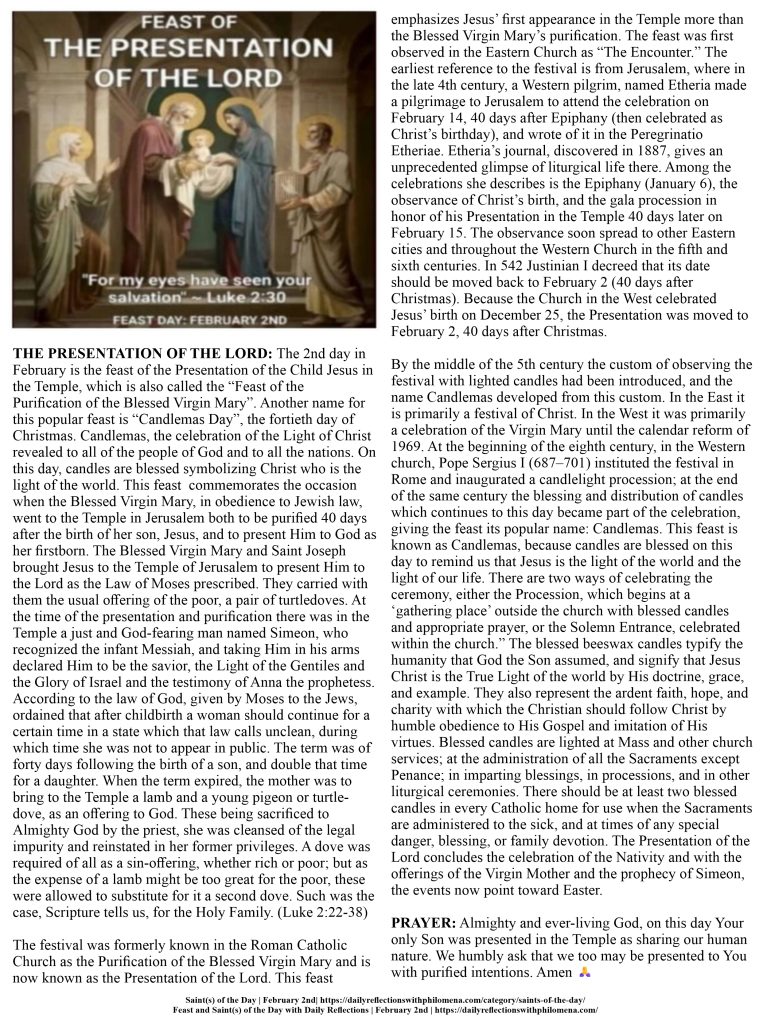
THE PRESENTATION OF THE LORD: The 2nd day in February is the feast of the Presentation of the Child Jesus in the Temple, which is also called the “Feast of the Purification of the Blessed Virgin Mary”. Another name for this popular feast is “Candlemas Day”, the fortieth day of Christmas. Candlemas, the celebration of the Light of Christ revealed to all of the people of God and to all the nations. On this day, candles are blessed symbolizing Christ who is the light of the world. This feast commemorates the occasion when the Blessed Virgin Mary, in obedience to Jewish law, went to the Temple in Jerusalem both to be purified 40 days after the birth of her son, Jesus, and to present Him to God as her firstborn. The Blessed Virgin Mary and Saint Joseph brought Jesus to the Temple of Jerusalem to present Him to the Lord as the Law of Moses prescribed. They carried with them the usual offering of the poor, a pair of turtledoves. At the time of the presentation and purification there was in the Temple a just and God-fearing man named Simeon, who recognized the infant Messiah, and taking Him in his arms declared Him to be the savior, the Light of the Gentiles and the Glory of Israel and the testimony of Anna the prophetess. According to the law of God, given by Moses to the Jews, ordained that after childbirth a woman should continue for a certain time in a state which that law calls unclean, during which time she was not to appear in public. The term was of forty days following the birth of a son, and double that time for a daughter. When the term expired, the mother was to bring to the Temple a lamb and a young pigeon or turtle-dove, as an offering to God. These being sacrificed to Almighty God by the priest, she was cleansed of the legal impurity and reinstated in her former privileges. A dove was required of all as a sin-offering, whether rich or poor; but as the expense of a lamb might be too great for the poor, these were allowed to substitute for it a second dove. Such was the case, Scripture tells us, for the Holy Family. (Luke 2:22-38)
The festival was formerly known in the Roman Catholic Church as the Purification of the Blessed Virgin Mary and is now known as the Presentation of the Lord. This feast emphasizes Jesus’ first appearance in the Temple more than the Blessed Virgin Mary’s purification. The feast was first observed in the Eastern Church as “The Encounter.” The earliest reference to the festival is from Jerusalem, where in the late 4th century, a Western pilgrim, named Etheria made a pilgrimage to Jerusalem to attend the celebration on February 14, 40 days after Epiphany (then celebrated as Christ’s birthday), and wrote of it in the Peregrinatio Etheriae. Etheria’s journal, discovered in 1887, gives an unprecedented glimpse of liturgical life there. Among the celebrations she describes is the Epiphany (January 6), the observance of Christ’s birth, and the gala procession in honor of his Presentation in the Temple 40 days later on February 15. The observance soon spread to other Eastern cities and throughout the Western Church in the fifth and sixth centuries. In 542 Justinian I decreed that its date should be moved back to February 2 (40 days after Christmas). Because the Church in the West celebrated Jesus’ birth on December 25, the Presentation was moved to February 2, 40 days after Christmas.
By the middle of the 5th century the custom of observing the festival with lighted candles had been introduced, and the name Candlemas developed from this custom. In the East it is primarily a festival of Christ. In the West it was primarily a celebration of the Virgin Mary until the calendar reform of 1969. At the beginning of the eighth century, in the Western church, Pope Sergius I (687–701) instituted the festival in Rome and inaugurated a candlelight procession; at the end of the same century the blessing and distribution of candles which continues to this day became part of the celebration, giving the feast its popular name: Candlemas. This feast is known as Candlemas, because candles are blessed on this day to remind us that Jesus is the light of the world and the light of our life. There are two ways of celebrating the ceremony, either the Procession, which begins at a ‘gathering place’ outside the church with blessed candles and appropriate prayer, or the Solemn Entrance, celebrated within the church.” The blessed beeswax candles typify the humanity that God the Son assumed, and signify that Jesus Christ is the True Light of the world by His doctrine, grace, and example. They also represent the ardent faith, hope, and charity with which the Christian should follow Christ by humble obedience to His Gospel and imitation of His virtues. Blessed candles are lighted at Mass and other church services; at the administration of all the Sacraments except Penance; in imparting blessings, in processions, and in other liturgical ceremonies. There should be at least two blessed candles in every Catholic home for use when the Sacraments are administered to the sick, and at times of any special danger, blessing, or family devotion. The Presentation of the Lord concludes the celebration of the Nativity and with the offerings of the Virgin Mother and the prophecy of Simeon, the events now point toward Easter.
PRAYER: Almighty and ever-living God, on this day Your only Son was presented in the Temple as sharing our human nature. We humbly ask that we too may be presented to You with purified intentions. Amen🙏
WORLD DAY OF PRAYER FOR CONSECRATED LIFE: World Day of Prayer for Consecrated Life – February 2nd: In 1997, Pope Saint John Paul II instituted a day of prayer for women and men in consecrated life. This celebration is attached to the Feast of the Presentation of the Lord on February 2nd. On this Feast of Candlemas Day; the day on which candles are blessed symbolizing Christ who is the light of the world. So too, those in consecrated life are called to reflect the light of Jesus Christ to all peoples. The celebration of World Day for Consecrated Life invites all the Church to reflect on the role of Consecrated Life within the Christian community. Those who choose to live a consecrated life do so for the sake of the Gospel. Some Christian women and men respond to God’s call to become followers of Jesus through profession of vows and a life dedicated to prayer and service. They live out the consecrated life in different ways. Religious sisters, nuns, brothers, religious priests and monks consecrate their lives through their profession of the evangelical vows and live as part of a community. Secular institutes are another form of living the consecrated life as single people. Those who become followers of Jesus through the consecrated life bless the Church. And so, as we think about the many ways in which we are called to love in ordinary ways and do it extraordinarily well, let us not forget those women and men who have responded to God’s call to serve as a consecrated religious. This day Mass is dedicated to them throughout the world. On this World Day for Consecrated Life, may the lives of consecrated women and men be blessed with God’s overwhelming grace of love! May their lives inspire us to hear God’s vocational call. May this tune be forever in our minds and transform our hearts to say boldly: “Here I am, Lord, send me!”
The celebration of World Day for Consecrated Life is transferred to the following Sunday in order to highlight the gift of consecrated persons for the whole Church. This year, the World Day for Consecrated Life is celebrated in the Church today, Monday, February 2, 2026, and was observed in many parishes over the past weekend. Please let us all pray for all those who have made commitments in the consecrated life, and let us appreciate them on their special day. May they continue to be inspired by Jesus Christ and respond generously to God’s gift of their vocation.
“BROTHERS AND SISTERS, GO FORTH! Remember the beauty of your first call. Jesus continues to call you today with the same full love and untamed grace. GO FORTH! There is always more to do, to encounter, to be grateful for, to be astonished by. Begin and end with the joy of prayer—the marrow of consecrated life. GO FORTH! Each of us has a role to play in the Church. Witness and sow well each day, and look to tomorrow with hope. GO FORTH! Grow in love for God so that others will be attracted by the divine light in you. Welcome the new vocations the Lord sends to continue the work of consecration. We ask this through the intercession of Mary, Mother of God and first disciple of her son, Jesus, our Lord. Amen.” ~ Pope Francis
PRAYER OF THE FAITHFUL: For those consecrated to God by the vows of chastity, poverty and obedience that they may seek to live their baptismal promises more intensely and have the grace to persevere in their commitment to the Lord and serve with open hearts and willing spirits. We pray to the Lord… Lord hear our prayers. For those who have responded to the prompting of the Holy Spirit to be a consecrated person that they may experience the support of the Church as they continue their growth in holiness. We pray to the Lord…Lord hear our prayers… Amen🙏
LET US PRAY: Loving God, You call all who believe in You to grow perfect in love by following in the footsteps of Christ Your Son. Call from among us more men and women who will serve You as religious. Open the hearts of many, raise up faithful servants of the Gospel, dedicated, holy priests, sisters, brothers and deacons, who will spend themselves for Your people and their needs. Bless those who are serving now with courage and perseverance. Grant that many will be inspired by their example and faith. By their way of life, may they provide a convincing sign of Your Kingdom for the Church and the whole world. We ask this through our Lord Jesus Christ. Amen 🙏
World Day of Prayer for Consecrated Life Link | https://www.usccb.org/committees/clergy-consecrated-life-vocations/world-day-consecrated-life
MEMORIAL OF SAINT LAWRENCE OF CANTERBURY, ARCHBISHOP: FEAST DAY ~ FEBRUARY 2ND: Today, we also celebrate the Memorial of Saint Lawrence of Canterbury, Archbishop.
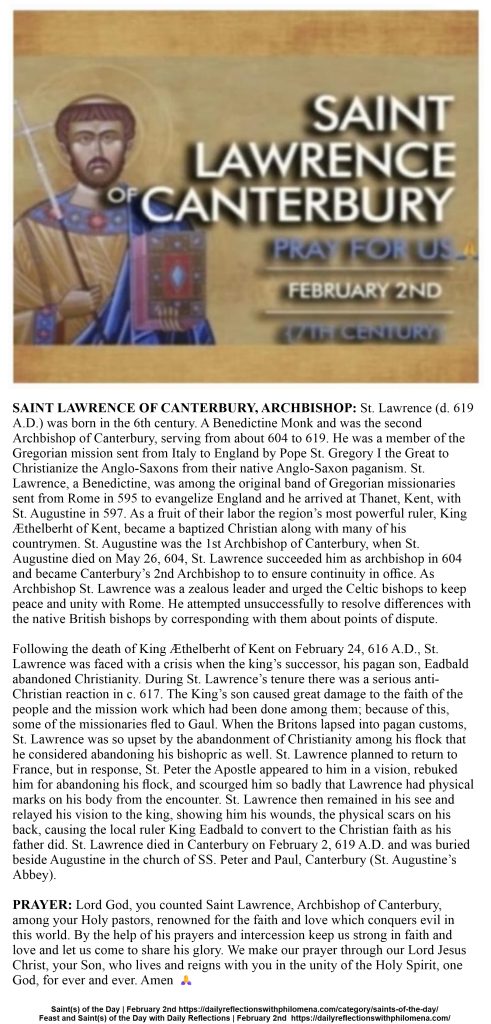
SAINT LAWRENCE OF CANTERBURY, ARCHBISHOP: St. Lawrence (d. 619 A.D.) was born in the 6th century. A Benedictine Monk and was the second Archbishop of Canterbury, serving from about 604 to 619. He was a member of the Gregorian mission sent from Italy to England by Pope St. Gregory I the Great to Christianize the Anglo-Saxons from their native Anglo-Saxon paganism. St. Lawrence, a Benedictine, was among the original band of Gregorian missionaries sent from Rome in 595 to evangelize England and he arrived at Thanet, Kent, with St. Augustine in 597. As a fruit of their labor the region’s most powerful ruler, King Æthelberht of Kent, became a baptized Christian along with many of his countrymen. St. Augustine was the 1st Archbishop of Canterbury, when St. Augustine died on May 26, 604, St. Lawrence succeeded him as archbishop in 604 and became Canterbury’s 2nd Archbishop to to ensure continuity in office. As Archbishop St. Lawrence was a zealous leader and urged the Celtic bishops to keep peace and unity with Rome. He attempted unsuccessfully to resolve differences with the native British bishops by corresponding with them about points of dispute.
Following the death of King Æthelberht of Kent on February 24, 616 A.D., St. Lawrence was faced with a crisis when the king’s successor, his pagan son, Eadbald abandoned Christianity. During St. Lawrence’s tenure there was a serious anti-Christian reaction in c. 617. The King’s son caused great damage to the faith of the people and the mission work which had been done among them; because of this, some of the missionaries fled to Gaul. When the Britons lapsed into pagan customs, St. Lawrence was so upset by the abandonment of Christianity among his flock that he considered abandoning his bishopric as well. St. Lawrence planned to return to France, but in response, St. Peter the Apostle appeared to him in a vision, rebuked him for abandoning his flock, and scourged him so badly that Lawrence had physical marks on his body from the encounter. St. Lawrence then remained in his see and relayed his vision to the king, showing him his wounds, the physical scars on his back, causing the local ruler King Eadbald to convert to the Christian faith as his father did. St. Lawrence died in Canterbury on February 2, 619 A.D. and was buried beside Augustine in the church of SS. Peter and Paul, Canterbury (St. Augustine’s Abbey).
PRAYER: Lord God, you counted Saint Lawrence, Archbishop of Canterbury, among your Holy pastors, renowned for the faith and love which conquers evil in this world. By the help of his prayers and intercession keep us strong in faith and love and let us come to share his glory. We make our prayer through our Lord Jesus Christ, your Son, who lives and reigns with you in the unity of the Holy Spirit, one God, for ever and ever. Amen🙏
Discover more from DailyReflections
Subscribe to get the latest posts sent to your email.