
MEMORIAL OF SAINT BRIGID OF IRELAND, ABBESS AND VIRGIN: FEAST DAY ~ FEBRUARY 1ST: Today, we celebrate the Memorial of Saint Brigid of Ireland, Abbess and Virgin.
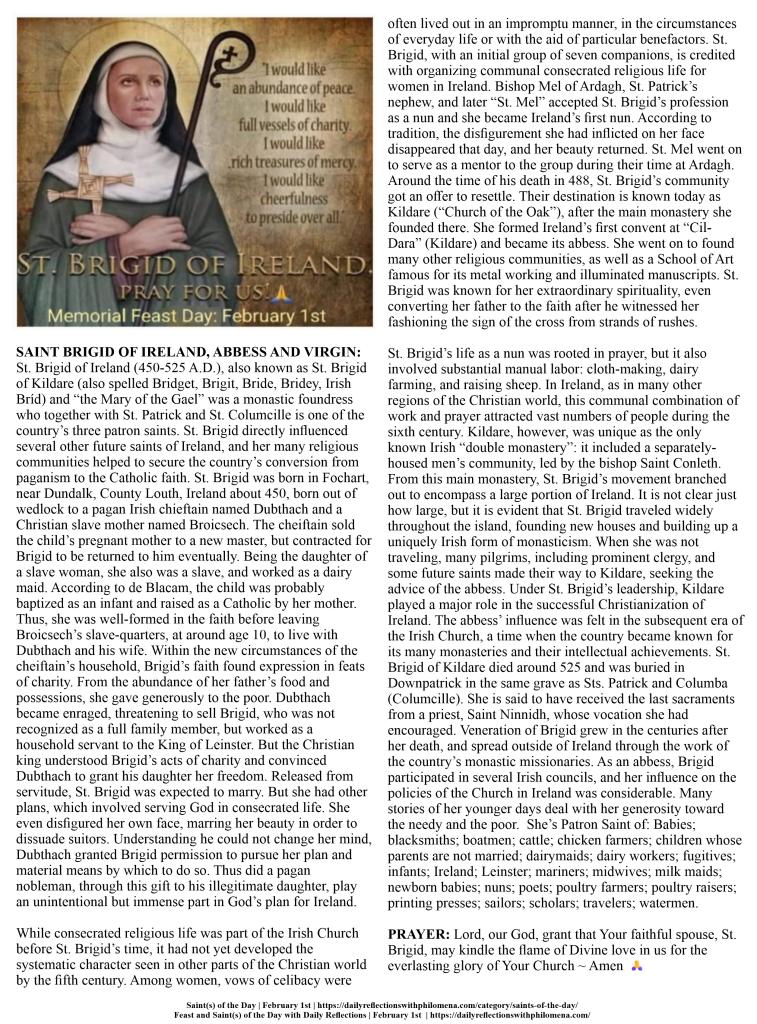
SAINT BRIGID OF IRELAND, ABBESS AND VIRGIN: St. Brigid of Ireland (450-525 A.D.), also known as St. Brigid of Kildare (also spelled Bridget, Brigit, Bride, Bridey, Irish Bríd) and “the Mary of the Gael” was a monastic foundress who together with St. Patrick and St. Columcille is one of the country’s three patron saints. St. Brigid directly influenced several other future saints of Ireland, and her many religious communities helped to secure the country’s conversion from paganism to the Catholic faith. St. Brigid was born in Fochart, near Dundalk, County Louth, Ireland about 450, born out of wedlock to a pagan Irish chieftain named Dubthach and a Christian slave mother named Broicsech. The cheiftain sold the child’s pregnant mother to a new master, but contracted for Brigid to be returned to him eventually. Being the daughter of a slave woman, she also was a slave, and worked as a dairy maid. According to de Blacam, the child was probably baptized as an infant and raised as a Catholic by her mother. Thus, she was well-formed in the faith before leaving Broicsech’s slave-quarters, at around age 10, to live with Dubthach and his wife. Within the new circumstances of the cheiftain’s household, Brigid’s faith found expression in feats of charity. From the abundance of her father’s food and possessions, she gave generously to the poor. Dubthach became enraged, threatening to sell Brigid, who was not recognized as a full family member, but worked as a household servant to the King of Leinster. But the Christian king understood Brigid’s acts of charity and convinced Dubthach to grant his daughter her freedom. Released from servitude, St. Brigid was expected to marry. But she had other plans, which involved serving God in consecrated life. She even disfigured her own face, marring her beauty in order to dissuade suitors. Understanding he could not change her mind, Dubthach granted Brigid permission to pursue her plan and material means by which to do so. Thus did a pagan nobleman, through this gift to his illegitimate daughter, play an unintentional but immense part in God’s plan for Ireland.
While consecrated religious life was part of the Irish Church before St. Brigid’s time, it had not yet developed the systematic character seen in other parts of the Christian world by the fifth century. Among women, vows of celibacy were often lived out in an impromptu manner, in the circumstances of everyday life or with the aid of particular benefactors. St. Brigid, with an initial group of seven companions, is credited with organizing communal consecrated religious life for women in Ireland. Bishop Mel of Ardagh, St. Patrick’s nephew, and later “St. Mel” accepted St. Brigid’s profession as a nun and she became Ireland’s first nun. According to tradition, the disfigurement she had inflicted on her face disappeared that day, and her beauty returned. St. Mel went on to serve as a mentor to the group during their time at Ardagh. Around the time of his death in 488, St. Brigid’s community got an offer to resettle. Their destination is known today as Kildare (“Church of the Oak”), after the main monastery she founded there. She formed Ireland’s first convent at “Cil-Dara” (Kildare) and became its abbess. She went on to found many other religious communities, as well as a School of Art famous for its metal working and illuminated manuscripts. St. Brigid was known for her extraordinary spirituality, even converting her father to the faith after he witnessed her fashioning the sign of the cross from strands of rushes.
St. Brigid’s life as a nun was rooted in prayer, but it also involved substantial manual labor: cloth-making, dairy farming, and raising sheep. In Ireland, as in many other regions of the Christian world, this communal combination of work and prayer attracted vast numbers of people during the sixth century. Kildare, however, was unique as the only known Irish “double monastery”: it included a separately-housed men’s community, led by the bishop Saint Conleth. From this main monastery, St. Brigid’s movement branched out to encompass a large portion of Ireland. It is not clear just how large, but it is evident that St. Brigid traveled widely throughout the island, founding new houses and building up a uniquely Irish form of monasticism. When she was not traveling, many pilgrims, including prominent clergy, and some future saints made their way to Kildare, seeking the advice of the abbess. Under St. Brigid’s leadership, Kildare played a major role in the successful Christianization of Ireland. The abbess’ influence was felt in the subsequent era of the Irish Church, a time when the country became known for its many monasteries and their intellectual achievements. St. Brigid of Kildare died around 525 and was buried in Downpatrick in the same grave as Sts. Patrick and Columba (Columcille). She is said to have received the last sacraments from a priest, Saint Ninnidh, whose vocation she had encouraged. Veneration of Brigid grew in the centuries after her death, and spread outside of Ireland through the work of the country’s monastic missionaries. As an abbess, Brigid participated in several Irish councils, and her influence on the policies of the Church in Ireland was considerable. Many stories of her younger days deal with her generosity toward the needy and the poor. She’s Patron Saint of: Babies; blacksmiths; boatmen; cattle; chicken farmers; children whose parents are not married; dairymaids; dairy workers; fugitives; infants; Ireland; Leinster; mariners; midwives; milk maids; newborn babies; nuns; poets; poultry farmers; poultry raisers; printing presses; sailors; scholars; travelers; watermen.
PRAYER: Lord, our God, grant that Your faithful spouse, St. Brigid, may kindle the flame of Divine love in us for the everlasting glory of Your Church ~ Amen🙏
Discover more from DailyReflections
Subscribe to get the latest posts sent to your email.