FEAST OF THE CONVERSION OF SAINT PAUL, APOSTLE | MEMORIAL OF SAINT DWYNWEN, RELIGIOUS – FEAST DAY ~ JANUARY 25TH: Today, we celebrate the Feast of the Conversion of Saint Paul, Apostle. We celebrate that extraordinary moment in the life of St. Paul when he was transformed from a fierce persecutor of the church to its great Apostle to the Gentiles. On this day, we also celebrate the Memorial of Saint Dwynwen, Religious.
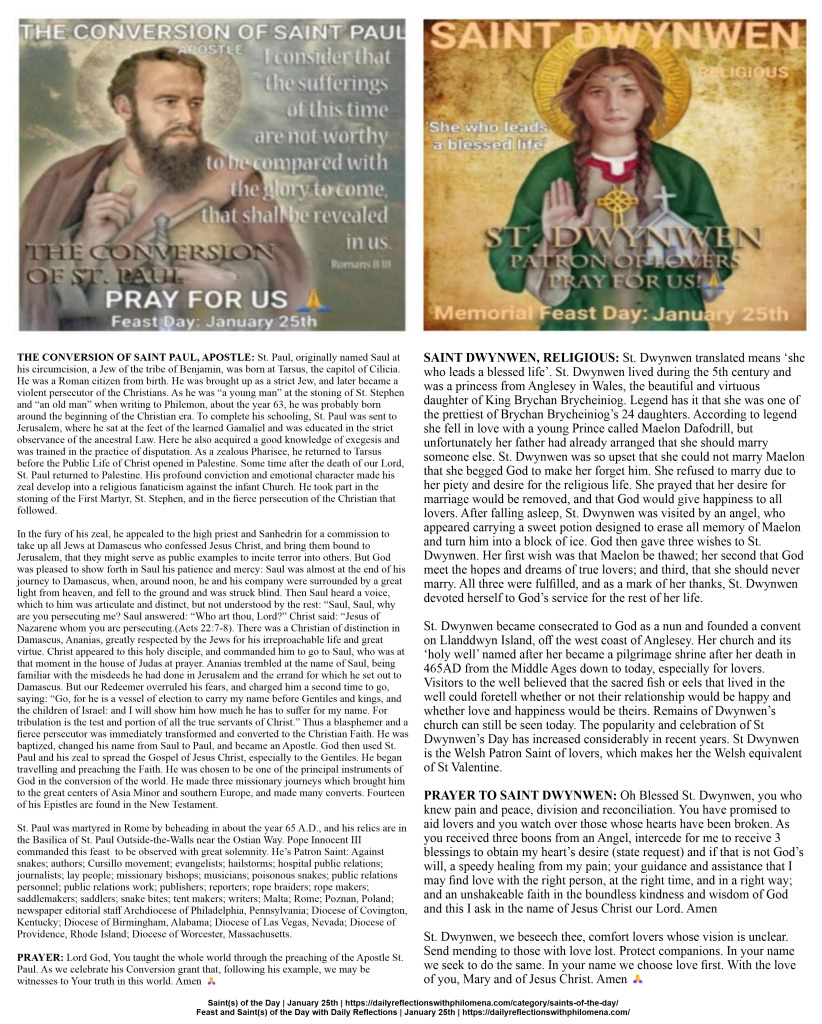
THE CONVERSION OF SAINT PAUL, APOSTLE: St. Paul, originally named Saul at his circumcision, a Jew of the tribe of Benjamin, was born at Tarsus, the capitol of Cilicia. He was a Roman citizen from birth. He was brought up as a strict Jew, and later became a violent persecutor of the Christians. As he was “a young man” at the stoning of St. Stephen and “an old man” when writing to Philemon, about the year 63, he was probably born around the beginning of the Christian era. To complete his schooling, St. Paul was sent to Jerusalem, where he sat at the feet of the learned Gamaliel and was educated in the strict observance of the ancestral Law. Here he also acquired a good knowledge of exegesis and was trained in the practice of disputation. As a zealous Pharisee, he returned to Tarsus before the Public Life of Christ opened in Palestine. Some time after the death of our Lord, St. Paul returned to Palestine. His profound conviction and emotional character made his zeal develop into a religious fanaticism against the infant Church. He took part in the stoning of the First Martyr, St. Stephen, and in the fierce persecution of the Christian that followed.
In the fury of his zeal, he appealed to the high priest and Sanhedrin for a commission to take up all Jews at Damascus who confessed Jesus Christ, and bring them bound to Jerusalem, that they might serve as public examples to incite terror into others. But God was pleased to show forth in Saul his patience and mercy: Saul was almost at the end of his journey to Damascus, when, around noon, he and his company were surrounded by a great light from heaven, and fell to the ground and was struck blind. Then Saul heard a voice, which to him was articulate and distinct, but not understood by the rest: “Saul, Saul, why are you persecuting me? Saul answered: “Who art thou, Lord?” Christ said: “Jesus of Nazarene whom you are persecuting.(Acts 22:7-8). There was a Christian of distinction in Damascus, Ananias, greatly respected by the Jews for his irreproachable life and great virtue. Christ appeared to this holy disciple, and commanded him to go to Saul, who was at that moment in the house of Judas at prayer. Ananias trembled at the name of Saul, being familiar with the misdeeds he had done in Jerusalem and the errand for which he set out to Damascus. But our Redeemer overruled his fears, and charged him a second time to go, saying: “Go, for he is a vessel of election to carry my name before Gentiles and kings, and the children of Israel: and I will show him how much he has to suffer for my name. For tribulation is the test and portion of all the true servants of Christ.” Thus a blasphemer and a fierce persecutor was immediately transformed and converted to the Christian Faith. He was baptized, changed his name from Saul to Paul, and became an Apostle. God then used St. Paul and his zeal to spread the Gospel of Jesus Christ, especially to the Gentiles. He began travelling and preaching the Faith. He was chosen to be one of the principal instruments of God in the conversion of the world. He made three missionary journeys which brought him to the great centers of Asia Minor and southern Europe, and made many converts. Fourteen of his Epistles are found in the New Testament.
St. Paul was martyred in Rome by beheading in about the year 65 A.D., and his relics are in the Basilica of St. Paul Outside-the-Walls near the Ostian Way. Pope Innocent III commanded this feast to be observed with great solemnity. He’s Patron Saint: Against snakes; authors; Cursillo movement; evangelists; hailstorms; hospital public relations; journalists; lay people; missionary bishops; musicians; poisonous snakes; public relations personnel; public relations work; publishers; reporters; rope braiders; rope makers; saddlemakers; saddlers; snake bites; tent makers; writers; Malta; Rome; Poznan, Poland; newspaper editorial staff Archdiocese of Philadelphia, Pennsylvania; Diocese of Covington, Kentucky; Diocese of Birmingham, Alabama; Diocese of Las Vegas, Nevada; Diocese of Providence, Rhode Island; Diocese of Worcester, Massachusetts.
PRAYER: Lord God, You taught the whole world through the preaching of the Apostle St. Paul. As we celebrate his Conversion grant that, following his example, we may be witnesses to Your truth in this world. Amen🙏
SAINT DWYNWEN, RELIGIOUS: St. Dwynwen translated means ‘she who leads a blessed life’. St. Dwynwen lived during the 5th century and was a princess from Anglesey in Wales, the beautiful and virtuous daughter of King Brychan Brycheiniog. Legend has it that she was one of the prettiest of Brychan Brycheiniog’s 24 daughters. According to legend she fell in love with a young Prince called Maelon Dafodrill, but unfortunately her father had already arranged that she should marry someone else. St. Dwynwen was so upset that she could not marry Maelon that she begged God to make her forget him. She refused to marry due to her piety and desire for the religious life. She prayed that her desire for marriage would be removed, and that God would give happiness to all lovers. After falling asleep, St. Dwynwen was visited by an angel, who appeared carrying a sweet potion designed to erase all memory of Maelon and turn him into a block of ice. God then gave three wishes to St. Dwynwen. Her first wish was that Maelon be thawed; her second that God meet the hopes and dreams of true lovers; and third, that she should never marry. All three were fulfilled, and as a mark of her thanks, St. Dwynwen devoted herself to God’s service for the rest of her life.
St. Dwynwen became consecrated to God as a nun and founded a convent on Llanddwyn Island, off the west coast of Anglesey. Her church and its ‘holy well’ named after her became a pilgrimage shrine after her death in 465AD from the Middle Ages down to today, especially for lovers. Visitors to the well believed that the sacred fish or eels that lived in the well could foretell whether or not their relationship would be happy and whether love and happiness would be theirs. Remains of Dwynwen’s church can still be seen today. The popularity and celebration of St Dwynwen’s Day has increased considerably in recent years. St Dwynwen is the Welsh Patron Saint of lovers, which makes her the Welsh equivalent of St Valentine.
PRAYER TO SAINT DWYNWEN: Oh Blessed St. Dwynwen, you who knew pain and peace, division and reconciliation. You have promised to aid lovers and you watch over those whose hearts have been broken. As you received three boons from an Angel, intercede for me to receive 3 blessings to obtain my heart’s desire (state request) and if that is not God’s will, a speedy healing from my pain; your guidance and assistance that I may find love with the right person, at the right time, and in a right way; and an unshakeable faith in the boundless kindness and wisdom of God and this I ask in the name of Jesus Christ our Lord. Amen 🙏
St. Dwynwen, we beseech thee, comfort lovers whose vision is unclear. Send mending to those with love lost. Protect companions. In your name we seek to do the same. In your name we choose love first. With the love of you, Mary and of Jesus Christ. Amen🙏
Discover more from DailyReflections
Subscribe to get the latest posts sent to your email.