FEAST OF OUR LADY QUEEN OF PEACE | MEMORIAL OF SAINT FRANCIS DE SALES, BISHOP AND DOCTOR OF THE CHURCH – FEAST DAY ~ JANUARY 24TH: Today, we celebrate the Feast of Our Lady Queen of Peace and the Memorial of Saint Francis de Sales, Bishop and Doctor of the Church.
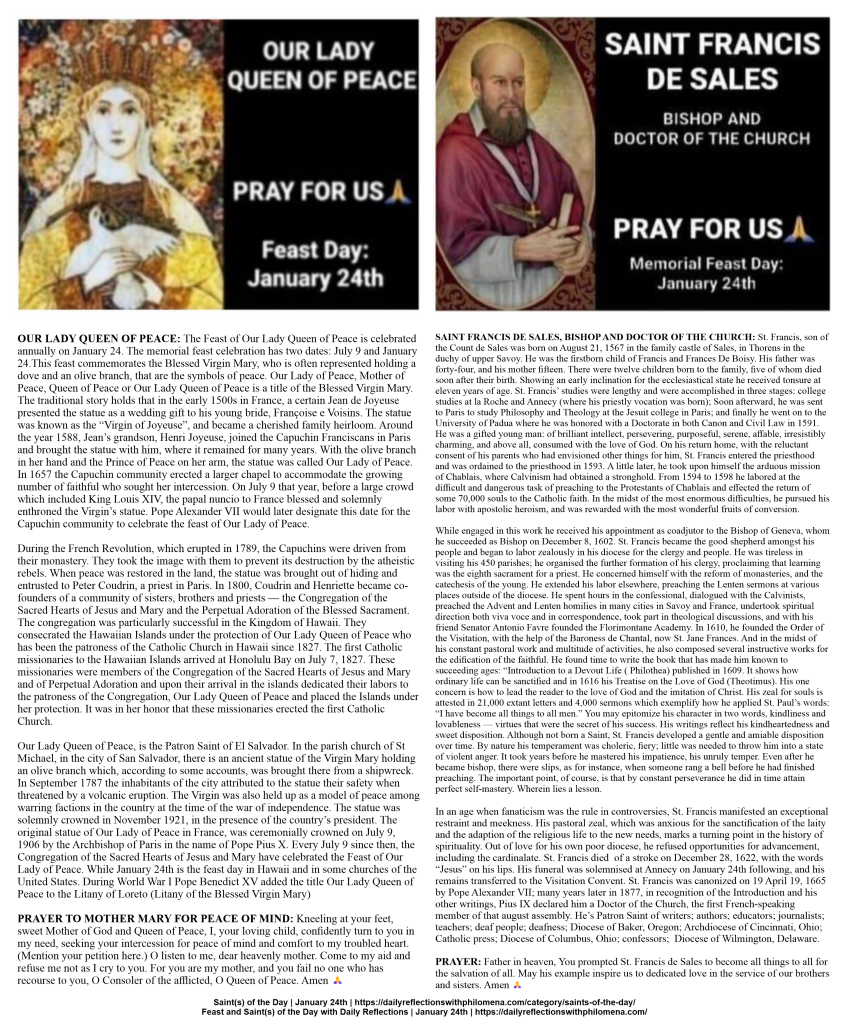
OUR LADY QUEEN OF PEACE: The Feast of Our Lady Queen of Peace is celebrated annually on January 24. The memorial feast celebration has two dates: July 9 and January 24.This feast commemorates the Blessed Virgin Mary, who is often represented holding a dove and an olive branch, that are the symbols of peace. Our Lady of Peace, Mother of Peace, Queen of Peace or Our Lady Queen of Peace is a title of the Blessed Virgin Mary. The traditional story holds that in the early 1500s in France, a certain Jean de Joyeuse presented the statue as a wedding gift to his young bride, Françoise e Voisins. The statue was known as the “Virgin of Joyeuse”, and became a cherished family heirloom. Around the year 1588, Jean’s grandson, Henri Joyeuse, joined the Capuchin Franciscans in Paris and brought the statue with him, where it remained for many years. With the olive branch in her hand and the Prince of Peace on her arm, the statue was called Our Lady of Peace. In 1657 the Capuchin community erected a larger chapel to accommodate the growing number of faithful who sought her intercession. On July 9 that year, before a large crowd which included King Louis XIV, the papal nuncio to France blessed and solemnly enthroned the Virgin’s statue. Pope Alexander VII would later designate this date for the Capuchin community to celebrate the feast of Our Lady of Peace.
During the French Revolution, which erupted in 1789, the Capuchins were driven from their monastery. They took the image with them to prevent its destruction by the atheistic rebels. When peace was restored in the land, the statue was brought out of hiding and entrusted to Peter Coudrin, a priest in Paris. In 1800, Coudrin and Henriette became co-founders of a community of sisters, brothers and priests — the Congregation of the Sacred Hearts of Jesus and Mary and the Perpetual Adoration of the Blessed Sacrament. The congregation was particularly successful in the Kingdom of Hawaii. They consecrated the Hawaiian Islands under the protection of Our Lady Queen of Peace who has been the patroness of the Catholic Church in Hawaii since 1827. The first Catholic missionaries to the Hawaiian Islands arrived at Honolulu Bay on July 7, 1827. These missionaries were members of the Congregation of the Sacred Hearts of Jesus and Mary and of Perpetual Adoration and upon their arrival in the islands dedicated their labors to the patroness of the Congregation, Our Lady Queen of Peace and placed the Islands under her protection. It was in her honor that these missionaries erected the first Catholic Church.
Our Lady Queen of Peace, is the Patron Saint of El Salvador. In the parish church of St Michael, in the city of San Salvador, there is an ancient statue of the Virgin Mary holding an olive branch which, according to some accounts, was brought there from a shipwreck. In September 1787 the inhabitants of the city attributed to the statue their safety when threatened by a volcanic eruption. The Virgin was also held up as a model of peace among warring factions in the country at the time of the war of independence. The statue was solemnly crowned in November 1921, in the presence of the country’s president. The original statue of Our Lady of Peace in France, was ceremonially crowned on July 9, 1906 by the Archbishop of Paris in the name of Pope Pius X. Every July 9 since then, the Congregation of the Sacred Hearts of Jesus and Mary have celebrated the Feast of Our Lady of Peace. While January 24th is the feast day in Hawaii and in some churches of the United States. During World War I Pope Benedict XV added the title Our Lady Queen of Peace to the Litany of Loreto (Litany of the Blessed Virgin Mary)
PRAYER TO MOTHER MARY FOR PEACE OF MIND: Kneeling at your feet, sweet Mother of God and Queen of Peace, I, your loving child, confidently turn to you in my need, seeking your intercession for peace of mind and comfort to my troubled heart. (Mention your petition here.) O listen to me, dear heavenly mother. Come to my aid and refuse me not as I cry to you. For you are my mother, and you fail no one who has recourse to you, O Consoler of the afflicted, O Queen of Peace. Amen🙏
SAINT FRANCIS DE SALES, BISHOP AND DOCTOR OF THE CHURCH: St. Francis, son of the Count de Sales was born on August 21, 1567 in the family castle of Sales, in Thorens in the duchy of upper Savoy. He was the firstborn child of Francis and Frances De Boisy. His father was forty-four, and his mother fifteen. There were twelve children born to the family, five of whom died soon after their birth. Showing an early inclination for the ecclesiastical state he received tonsure at eleven years of age. St. Francis’ studies were lengthy and were accomplished in three stages: college studies at la Roche and Annecy (where his priestly vocation was born); Soon afterward, he was sent to Paris to study Philosophy and Theology at the Jesuit college in Paris; and finally he went on to the University of Padua where he was honored with a Doctorate in both Canon and Civil Law in 1591. He was a gifted young man: of brilliant intellect, persevering, purposeful, serene, affable, irresistibly charming, and above all, consumed with the love of God. On his return home, with the reluctant consent of his parents who had envisioned other things for him, St. Francis entered the priesthood and was ordained to the priesthood in 1593. A little later, he took upon himself the arduous mission of Chablais, where Calvinism had obtained a stronghold. From 1594 to 1598 he labored at the difficult and dangerous task of preaching to the Protestants of Chablais and effected the return of some 70,000 souls to the Catholic faith. In the midst of the most enormous difficulties, he pursued his labor with apostolic heroism, and was rewarded with the most wonderful fruits of conversion.
While engaged in this work he received his appointment as coadjutor to the Bishop of Geneva, whom he succeeded as Bishop on December 8, 1602. St. Francis became the good shepherd amongst his people and began to labor zealously in his diocese for the clergy and people. He was tireless in visiting his 450 parishes; he organised the further formation of his clergy, proclaiming that learning was the eighth sacrament for a priest. He concerned himself with the reform of monasteries, and the catechesis of the young. He extended his labor elsewhere, preaching the Lenten sermons at various places outside of the diocese. He spent hours in the confessional, dialogued with the Calvinists, preached the Advent and Lenten homilies in many cities in Savoy and France, undertook spiritual direction both viva voce and in correspondence, took part in theological discussions, and with his friend Senator Antonio Favre founded the Florimontane Academy. In 1610, he founded the Order of the Visitation, with the help of the Baroness de Chantal, now St. Jane Frances. And in the midst of his constant pastoral work and multitude of activities, he also composed several instructive works for the edification of the faithful. He found time to write the book that has made him known to succeeding ages: “Introduction to a Devout Life ( Philothea) published in 1609. It shows how ordinary life can be sanctified and in 1616 his Treatise on the Love of God (Theotimus). His one concern is how to lead the reader to the love of God and the imitation of Christ. His zeal for souls is attested in 21,000 extant letters and 4,000 sermons which exemplify how he applied St. Paul’s words: “I have become all things to all men.” You may epitomize his character in two words, kindliness and lovableness — virtues that were the secret of his success. His writings reflect his kindheartedness and sweet disposition. Although not born a Saint, St. Francis developed a gentle and amiable disposition over time. By nature his temperament was choleric, fiery; little was needed to throw him into a state of violent anger. It took years before he mastered his impatience, his unruly temper. Even after he became bishop, there were slips, as for instance, when someone rang a bell before he had finished preaching. The important point, of course, is that by constant perseverance he did in time attain perfect self-mastery. Wherein lies a lesson.
In an age when fanaticism was the rule in controversies, St. Francis manifested an exceptional restraint and meekness. His pastoral zeal, which was anxious for the sanctification of the laity and the adaption of the religious life to the new needs, marks a turning point in the history of spirituality. Out of love for his own poor diocese, he refused opportunities for advancement, including the cardinalate. St. Francis died of a stroke on December 28, 1622, with the words “Jesus” on his lips. His funeral was solemnised at Annecy on January 24th following, and his remains transferred to the Visitation Convent. St. Francis was canonized on 19 April 19, 1665 by Pope Alexander VII; many years later in 1877, in recognition of the Introduction and his other writings, Pius IX declared him a Doctor of the Church, the first French-speaking member of that august assembly. He’s Patron Saint of writers; authors; educators; journalists; teachers; deaf people; deafness; Diocese of Baker, Oregon; Archdiocese of Cincinnati, Ohio; Catholic press; Diocese of Columbus, Ohio; confessors; Diocese of Wilmington, Delaware.
PRAYER: Father in heaven, You prompted St. Francis de Sales to become all things to all for the salvation of all. May his example inspire us to dedicated love in the service of our brothers and sisters. Amen🙏
Discover more from DailyReflections
Subscribe to get the latest posts sent to your email.