MEMORIAL OF SAINT JOHN THE ALMSGIVER, PATRIARCH OF ALEXANDRIA AND SAINT ILDEFONSUS, BISHOP AND SAINT MARIANNE COPE, RELIGIOUS – FEAST DAY ~ JANUARY 23RD: Today, we celebrate the Memorial of Saint John the Almsgiver, Patriarch of Alexandria and Saint Ildefonsus, Bishop and Saint Marianne Cope, Religious.
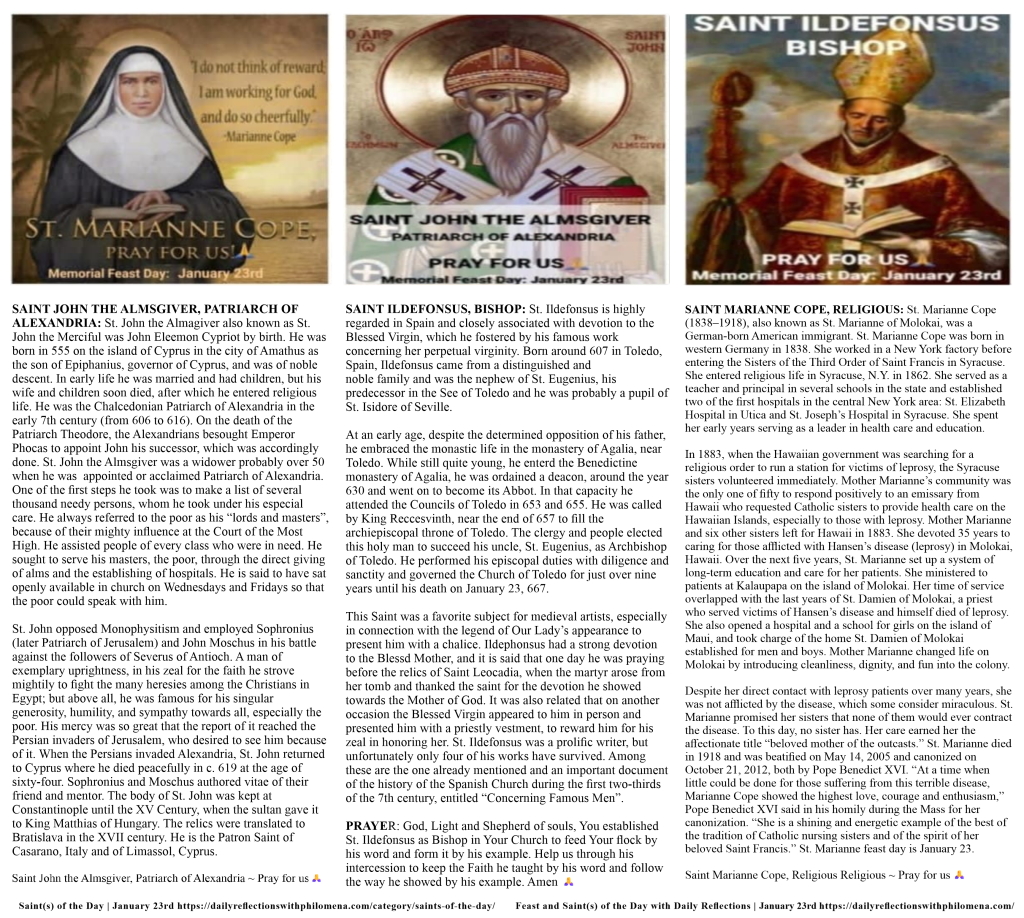
SAINT JOHN THE ALMSGIVER, PATRIARCH OF ALEXANDRIA: St. John the Almagiver also known as St. John the Merciful was John Eleemon Cypriot by birth. He was born in 555 on the island of Cyprus in the city of Amathus as the son of Epiphanius, governor of Cyprus, and was of noble descent. In early life he was married and had children, but his wife and children soon died, after which he entered religious life. He was the Chalcedonian Patriarch of Alexandria in the early 7th century (from 606 to 616). On the death of the Patriarch Theodore, the Alexandrians besought Emperor Phocas to appoint John his successor, which was accordingly done. St. John the Almsgiver was a widower probably over 50 when he was appointed or acclaimed Patriarch of Alexandria. One of the first steps he took was to make a list of several thousand needy persons, whom he took under his especial care. He always referred to the poor as his “lords and masters”, because of their mighty influence at the Court of the Most High. He assisted people of every class who were in need. He sought to serve his masters, the poor, through the direct giving of alms and the establishing of hospitals. He is said to have sat openly available in church on Wednesdays and Fridays so that the poor could speak with him.
St. John opposed Monophysitism and employed Sophronius (later Patriarch of Jerusalem) and John Moschus in his battle against the followers of Severus of Antioch. A man of exemplary uprightness, in his zeal for the faith he strove mightily to fight the many heresies among the Christians in Egypt; but above all, he was famous for his singular generosity, humility, and sympathy towards all, especially the poor. His mercy was so great that the report of it reached the Persian invaders of Jerusalem, who desired to see him because of it. When the Persians invaded Alexandria, St. John returned to Cyprus where he died peacefully in c. 619 at the age of sixty-four. Sophronius and Moschus authored vitae of their friend and mentor. The body of St. John was kept at Constantinople until the XV Century, when the sultan gave it to King Matthias of Hungary. The relics were translated to Bratislava in the XVII century. He is the Patron Saint of Casarano, Italy and of Limassol, Cyprus.
Saint John the Almsgiver, Patriarch of Alexandria ~ Pray for us 🙏
SAINT ILDEFONSUS, BISHOP: St. Ildefonsus is highly regarded in Spain and closely associated with devotion to the Blessed Virgin, which he fostered by his famous work concerning her perpetual virginity. Born around 607 in Toledo, Spain, Ildefonsus came from a distinguished and
noble family and was the nephew of St. Eugenius, his predecessor in the See of Toledo and he was probably a pupil of St. Isidore of Seville.
At an early age, despite the determined opposition of his father, he embraced the monastic life in the monastery of Agalia, near Toledo. While still quite young, he enterd the Benedictine monastery of Agalia, he was ordained a deacon, around the year 630 and went on to become its Abbot. In that capacity he attended the Councils of Toledo in 653 and 655. He was called by King Reccesvinth, near the end of 657 to fill the archiepiscopal throne of Toledo. The clergy and people elected this holy man to succeed his uncle, St. Eugenius, as Archbishop of Toledo. He performed his episcopal duties with diligence and sanctity and governed the Church of Toledo for just over nine years until his death on January 23, 667.
This Saint was a favorite subject for medieval artists, especially in connection with the legend of Our Lady’s appearance to present him with a chalice. Ildephonsus had a strong devotion to the Blessd Mother, and it is said that one day he was praying before the relics of Saint Leocadia, when the martyr arose from her tomb and thanked the saint for the devotion he showed towards the Mother of God. It was also related that on another occasion the Blessed Virgin appeared to him in person and presented him with a priestly vestment, to reward him for his zeal in honoring her. St. Ildefonsus was a prolific writer, but unfortunately only four of his works have survived. Among these are the one already mentioned and an important document of the history of the Spanish Church during the first two-thirds of the 7th century, entitled “Concerning Famous Men”.
PRAYER: God, Light and Shepherd of souls, You established St. Ildefonsus as Bishop in Your Church to feed Your flock by his word and form it by his example. Help us through his intercession to keep the Faith he taught by his word and follow the way he showed by his example. Amen🙏
SAINT MARIANNE COPE, RELIGIOUS: St. Marianne Cope (1838–1918), also known as St. Marianne of Molokai, was a German-born American immigrant. St. Marianne Cope was born in western Germany in 1838. She worked in a New York factory before entering the Sisters of the Third Order of Saint Francis in Syracuse. She entered religious life in Syracuse, N.Y. in 1862. She served as a teacher and principal in several schools in the state and established two of the first hospitals in the central New York area: St. Elizabeth Hospital in Utica and St. Joseph’s Hospital in Syracuse. She spent her early years serving as a leader in health care and education.
In 1883, when the Hawaiian government was searching for a religious order to run a station for victims of leprosy, the Syracuse sisters volunteered immediately. Mother Marianne’s community was the only one of fifty to respond positively to an emissary from Hawaii who requested Catholic sisters to provide health care on the Hawaiian Islands, especially to those with leprosy. Mother Marianne and six other sisters left for Hawaii in 1883. She devoted 35 years to caring for those afflicted with Hansen’s disease (leprosy) in Molokai, Hawaii. Over the next five years, St. Marianne set up a system of long-term education and care for her patients. She ministered to patients at Kalaupapa on the island of Molokai. Her time of service overlapped with the last years of St. Damien of Molokai, a priest who served victims of Hansen’s disease and himself died of leprosy. She also opened a hospital and a school for girls on the island of Maui, and took charge of the home St. Damien of Molokai established for men and boys. Mother Marianne changed life on Molokai by introducing cleanliness, dignity, and fun into the colony.
Despite her direct contact with leprosy patients over many years, she was not afflicted by the disease, which some consider miraculous. St. Marianne promised her sisters that none of them would ever contract the disease. To this day, no sister has. Her care earned her the affectionate title “beloved mother of the outcasts.” St. Marianne died in 1918 and was beatified on May 14, 2005 and canonized on October 21, 2012, both by Pope Benedict XVI. “At a time when little could be done for those suffering from this terrible disease, Marianne Cope showed the highest love, courage and enthusiasm,” Pope Benedict XVI said in his homily during the Mass for her canonization. “She is a shining and energetic example of the best of the tradition of Catholic nursing sisters and of the spirit of her beloved Saint Francis.” St. Marianne feast day is January 23.
Saint Marianne Cope, Religious Religious ~ Pray for us 🙏
Discover more from DailyReflections
Subscribe to get the latest posts sent to your email.