MEMORIAL OF SAINT FABIAN, POPE AND MARTYR; SAINT SEBASTIAN, MARTYR AND BLESSED CYPRIAN MICHAEL IWENE TANSI, PRIEST: Today, we celebrate the Memorial of Saint Fabian, Pope and Martyr; Saint Sebastian, Martyr and Blessed Cyprian Micbael Iwene Tansi, Priest. On this feast day, through the intercession of St. Fabian (Patron Saint of Rome) St. Sebastian (Patron Saint of athletes, soldiers, and victims of the plague.) and Blessed Cyprian Michael Iwene Tansi (Patron of Nigerian priests), we humbly pray for peace and unity in our divided and conflicted world and pray for all places where the Church suffers persecution and for all who face death, danger, or isolation for their faith. Most especially for all who live where the Church is accepted and thrives in peace that this peace will not make their faith flabby and weak, we ask this through Christ our Lord…Amen🙏
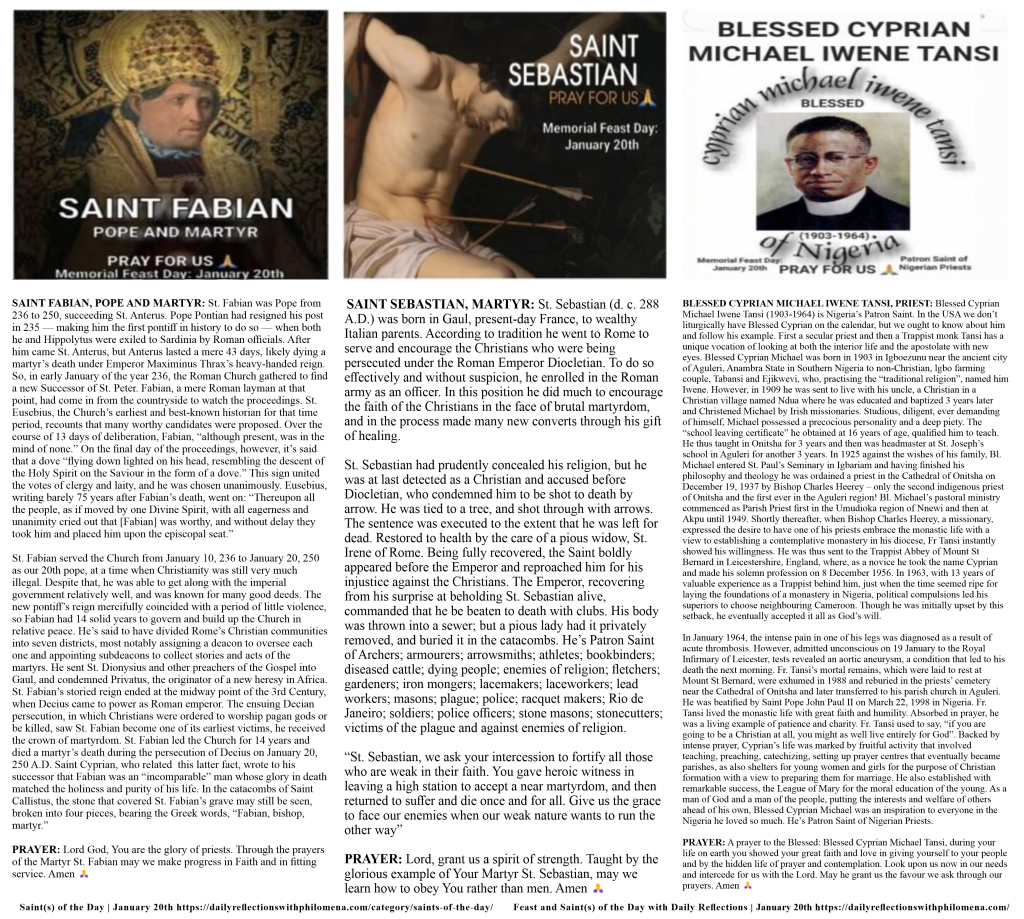
SAINT FABIAN, POPE AND MARTYR: St. Fabian was Pope from 236 to 250, succeeding St. Anterus. Pope Pontian had resigned his post in 235 — making him the first pontiff in history to do so — when both he and Hippolytus were exiled to Sardinia by Roman officials. After him came St. Anterus, but Anterus lasted a mere 43 days, likely dying a martyr’s death under Emperor Maximinus Thrax’s heavy-handed reign. So, in early January of the year 236, the Roman Church gathered to find a new Successor of St. Peter. Fabian, a mere Roman layman at that point, had come in from the countryside to watch the proceedings. St. Eusebius, the Church’s earliest and best-known historian for that time period, recounts that many worthy candidates were proposed. Over the course of 13 days of deliberation, Fabian, “although present, was in the mind of none.” On the final day of the proceedings, however, it’s said that a dove “flying down lighted on his head, resembling the descent of the Holy Spirit on the Saviour in the form of a dove.” This sign united the votes of clergy and laity, and he was chosen unanimously. Eusebius, writing barely 75 years after Fabian’s death, went on: “Thereupon all the people, as if moved by one Divine Spirit, with all eagerness and unanimity cried out that [Fabian] was worthy, and without delay they took him and placed him upon the episcopal seat.”
St. Fabian served the Church from January 10, 236 to January 20, 250 as our 20th pope, at a time when Christianity was still very much illegal. Despite that, he was able to get along with the imperial government relatively well, and was known for many good deeds. The new pontiff’s reign mercifully coincided with a period of little violence, so Fabian had 14 solid years to govern and build up the Church in relative peace. He’s said to have divided Rome’s Christian communities into seven districts, most notably assigning a deacon to oversee each one and appointing subdeacons to collect stories and acts of the martyrs. He sent St. Dionysius and other preachers of the Gospel into Gaul, and condemned Privatus, the originator of a new heresy in Africa. St. Fabian’s storied reign ended at the midway point of the 3rd Century, when Decius came to power as Roman emperor. The ensuing Decian persecution, in which Christians were ordered to worship pagan gods or be killed, saw St. Fabian become one of its earliest victims, he received the crown of martyrdom. St. Fabian led the Church for 14 years and died a martyr’s death during the persecution of Decius on January 20, 250 A.D. Saint Cyprian, who related this latter fact, wrote to his successor that Fabian was an “incomparable” man whose glory in death matched the holiness and purity of his life. In the catacombs of Saint Callistus, the stone that covered St. Fabian’s grave may still be seen, broken into four pieces, bearing the Greek words, “Fabian, bishop, martyr.”
PRAYER: Lord God, You are the glory of priests. Through the prayers of the Martyr St. Fabian may we make progress in Faith and in fitting service. Amen🙏
SAINT SEBASTIAN, MARTYR: St. Sebastian (d. c. 288 A.D.) was born in Gaul, present-day France, to wealthy Italian parents. According to tradition he went to Rome to serve and encourage the Christians who were being persecuted under the Roman Emperor Diocletian. To do so effectively and without suspicion, he enrolled in the Roman army as an officer. In this position he did much to encourage the faith of the Christians in the face of brutal martyrdom, and in the process made many new converts through his gift of healing.
St. Sebastian had prudently concealed his religion, but he was at last detected as a Christian and accused before Diocletian, who condemned him to be shot to death by arrow. He was tied to a tree, and shot through with arrows. The sentence was executed to the extent that he was left for dead. Restored to health by the care of a pious widow, St. Irene of Rome. Being fully recovered, the Saint boldly appeared before the Emperor and reproached him for his injustice against the Christians. The Emperor, recovering from his surprise at beholding St. Sebastian alive, commanded that he be beaten to death with clubs. His body was thrown into a sewer; but a pious lady had it privately removed, and buried it in the catacombs. He’s Patron Saint of Archers; armourers; arrowsmiths; athletes; bookbinders; diseased cattle; dying people; enemies of religion; fletchers; gardeners; iron mongers; lacemakers; laceworkers; lead workers; masons; plague; police; racquet makers; Rio de Janeiro; soldiers; police officers; stone masons; stonecutters; victims of the plague and against enemies of religion.
“St. Sebastian, we ask your intercession to fortify all those who are weak in their faith. You gave heroic witness in leaving a high station to accept a near martyrdom, and then returned to suffer and die once and for all. Give us the grace to face our enemies when our weak nature wants to run the other way”
PRAYER: Lord, grant us a spirit of strength. Taught by the glorious example of Your Martyr St. Sebastian, may we learn how to obey You rather than men. Amen🙏
BLESSED CYPRIAN MICHAEL IWENE TANSI, PRIEST: Blessed Cyprian Michael Iwene Tansi (1903-1964) is Nigeria’s Patron Saint. In the USA we don’t liturgically have Blessed Cyprian on the calendar, but we ought to know about him and follow his example. First a secular priest and then a Trappist monk Tansi has a unique vocation of looking at both the interior life and the apostolate with new eyes. Blessed Cyprian Michael was born in 1903 in Igboezunu near the ancient city of Aguleri, Anambra State in Southern Nigeria to non-Christian, lgbo farming couple, Tabansi and Ejikwevi, who, practising the “traditional religion”, named him Iwene. However, in 1909 he was sent to live with his uncle, a Christian in a Christian village named Ndua where he was educated and baptized 3 years later and Christened Michael by Irish missionaries. Studious, diligent, ever demanding of himself, Michael possessed a precocious personality and a deep piety. The “school leaving certificate” he obtained at 16 years of age, qualified him to teach. He thus taught in Onitsha for 3 years and then was headmaster at St. Joseph’s school in Aguleri for another 3 years. In 1925 against the wishes of his family, Bl. Michael entered St. Paul’s Seminary in Igbariam and having finished his philosophy and theology he was ordained a priest in the Cathedral of Onitsha on December 19, 1937 by Bishop Charles Heerey – only the second indigenous priest of Onitsha and the first ever in the Aguleri region! Bl. Michael’s pastoral ministry commenced as Parish Priest first in the Umudioka region of Nnewi and then at Akpu until 1949. Shortly thereafter, when Bishop Charles Heerey, a missionary, expressed the desire to have one of his priests embrace the monastic life with a view to establishing a contemplative monastery in his diocese, Fr Tansi instantly showed his willingness. He was thus sent to the Trappist Abbey of Mount St Bernard in Leicestershire, England, where, as a novice he took the name Cyprian and made his solemn profession on 8 December 1956. In 1963, with 13 years of valuable experience as a Trappist behind him, just when the time seemed ripe for laying the foundations of a monastery in Nigeria, political compulsions led his superiors to choose neighbouring Cameroon. Though he was initially upset by this setback, he eventually accepted it all as God’s will.
In January 1964, the intense pain in one of his legs was diagnosed as a result of acute thrombosis. However, admitted unconscious on 19 January to the Royal Infirmary of Leicester, tests revealed an aortic aneurysm, a condition that led to his death the next morning. Fr. Tansi’s mortal remains, which were laid to rest at Mount St Bernard, were exhumed in 1988 and reburied in the priests’ cemetery near the Cathedral of Onitsha and later transferred to his parish church in Aguleri. He was beatified by Saint Pope John Paul II on March 22, 1998 in Nigeria. Fr. Tansi lived the monastic life with great faith and humility. Absorbed in prayer, he was a living example of patience and charity. Fr. Tansi used to say, “if you are going to be a Christian at all, you might as well live entirely for God”. Backed by intense prayer, Cyprian’s life was marked by fruitful activity that involved teaching, preaching, catechizing, setting up prayer centres that eventually became parishes, as also shelters for young women and girls for the purpose of Christian formation with a view to preparing them for marriage. He also established with remarkable success, the League of Mary for the moral education of the young. As a man of God and a man of the people, putting the interests and welfare of others ahead of his own, Blessed Cyprian Michael was an inspiration to everyone in the Nigeria he loved so much. He’s Patron Saint of Nigerian Priests.
PRAYER: A prayer to the Blessed: Blessed Cyprian Michael Tansi, during your life on earth you showed your great faith and love in giving yourself to your people and by the hidden life of prayer and contemplation. Look upon us now in our needs and intercede for us with the Lord. May he grant us the favour we ask through our prayers. Amen🙏
Discover more from DailyReflections
Subscribe to get the latest posts sent to your email.