MEMORIAL OF SAINT JOHN NEUMANN, BISHOP; SAINT SIMEON STYLITES, HERMIT AND SAINT TELESPHORUS, POPE AND MARTYR: Today, we celebrate the Memorial of Saint John Neumann, Bishop; Saint Simeon Stylites, Hermit and Saint Telesphorus, Pope, Martyr.
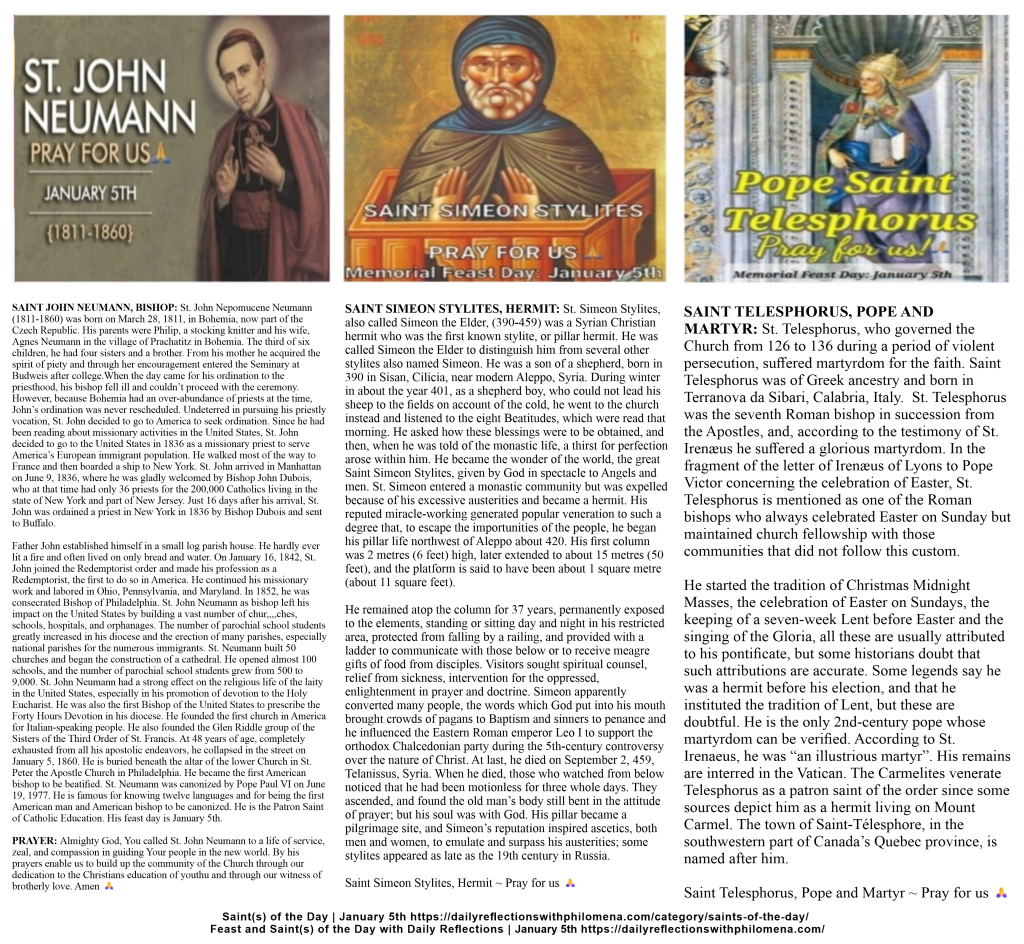
SAINT JOHN NEUMANN, BISHOP: St. John Nepomucene Neumann (1811-1860) was born on March 28, 1811, in Bohemia, now part of the Czech Republic. His parents were Philip, a stocking knitter and his wife, Agnes Neumann in the village of Prachatitz in Bohemia. The third of six children, he had four sisters and a brother. From his mother he acquired the spirit of piety and through her encouragement entered the Seminary at Budweis after college.When the day came for his ordination to the priesthood, his bishop fell ill and couldn’t proceed with the ceremony. However, because Bohemia had an over-abundance of priests at the time, John’s ordination was never rescheduled. Undeterred in pursuing his priestly vocation, St. John decided to go to America to seek ordination. Since he had been reading about missionary activities in the United States, St. John decided to go to the United States in 1836 as a missionary priest to serve America’s European immigrant population. He walked most of the way to France and then boarded a ship to New York. St. John arrived in Manhattan on June 9, 1836, where he was gladly welcomed by Bishop John Dubois, who at that time had only 36 priests for the 200,000 Catholics living in the state of New York and part of New Jersey. Just 16 days after his arrival, St. John was ordained a priest in New York in 1836 by Bishop Dubois and sent to Buffalo.
Father John established himself in a small log parish house. He hardly ever lit a fire and often lived on only bread and water. On January 16, 1842, St. John joined the Redemptorist order and made his profession as a Redemptorist, the first to do so in America. He continued his missionary work and labored in Ohio, Pennsylvania, and Maryland. In 1852, he was consecrated Bishop of Philadelphia. St. John Neumann as bishop left his impact on the United States by building a vast number of churches, schools, hospitals, and orphanages. The number of parochial school students greatly increased in his diocese and the erection of many parishes, especially national parishes for the numerous immigrants. St. Neumann built 50 churches and began the construction of a cathedral. He opened almost 100 schools, and the number of parochial school students grew from 500 to 9,000. St. John Neumann had a strong effect on the religious life of the laity in the United States, especially in his promotion of devotion to the Holy Eucharist. He was also the first Bishop of the United States to prescribe the Forty Hours Devotion in his diocese. He founded the first church in America for Italian-speaking people. He also founded the Glen Riddle group of the Sisters of the Third Order of St. Francis. At 48 years of age, completely exhausted from all his apostolic endeavors, he collapsed in the street on January 5, 1860. He is buried beneath the altar of the lower Church in St. Peter the Apostle Church in Philadelphia. He became the first American bishop to be beatified. St. Neumann was canonized by Pope Paul VI on June 19, 1977. He is famous for knowing twelve languages and for being the first American man and American bishop to be canonized. He is the Patron Saint of Catholic Education. His feast day is January 5th.
PRAYER: Almighty God, You called St. John Neumann to a life of service, zeal, and compassion in guiding Your people in the new world. By his prayers enable us to build up the community of the Church through our dedication to the Christians education of youthu and through our witness of brotherly love. Amen.🙏
SAINT SIMEON STYLITES, HERMIT: St. Simeon Stylites, also called Simeon the Elder, (390-459) was a Syrian Christian hermit who was the first known stylite, or pillar hermit. He was called Simeon the Elder to distinguish him from several other stylites also named Simeon. He was a son of a shepherd, born in 390 in Sisan, Cilicia, near modern Aleppo, Syria. During winter in about the year 401, as a shepherd boy, who could not lead his sheep to the fields on account of the cold, he went to the church instead and listened to the eight Beatitudes, which were read that morning. He asked how these blessings were to be obtained, and then, when he was told of the monastic life, a thirst for perfection arose within him. He became the wonder of the world, the great Saint Simeon Stylites, given by God in spectacle to Angels and men. St. Simeon entered a monastic community but was expelled because of his excessive austerities and became a hermit. His reputed miracle-working generated popular veneration to such a degree that, to escape the importunities of the people, he began his pillar life northwest of Aleppo about 420. His first column was 2 metres (6 feet) high, later extended to about 15 metres (50 feet), and the platform is said to have been about 1 square metre (about 11 square feet).
He remained atop the column for 37 years, permanently exposed to the elements, standing or sitting day and night in his restricted area, protected from falling by a railing, and provided with a ladder to communicate with those below or to receive meagre gifts of food from disciples. Visitors sought spiritual counsel, relief from sickness, intervention for the oppressed, enlightenment in prayer and doctrine. Simeon apparently converted many people, the words which God put into his mouth brought crowds of pagans to Baptism and sinners to penance and he influenced the Eastern Roman emperor Leo I to support the orthodox Chalcedonian party during the 5th-century controversy over the nature of Christ. At last, he died on September 2, 459, Telanissus, Syria. When he died, those who watched from below noticed that he had been motionless for three whole days. They ascended, and found the old man’s body still bent in the attitude of prayer; but his soul was with God. His pillar became a pilgrimage site, and Simeon’s reputation inspired ascetics, both men and women, to emulate and surpass his austerities; some stylites appeared as late as the 19th century in Russia.
Saint Simeon Stylites, Hermit ~ Pray for us 🙏
SAINT TELESPHORUS, POPE AND MARTYR: St. Telesphorus, who governed the Church from 126 to 136 during a period of violent persecution, suffered martyrdom for the faith. Saint Telesphorus was of Greek ancestry and born in Terranova da Sibari, Calabria, Italy. St. Telesphorus was the seventh Roman bishop in succession from the Apostles, and, according to the testimony of St. Irenæus he suffered a glorious martyrdom. In the fragment of the letter of Irenæus of Lyons to Pope Victor concerning the celebration of Easter, St. Telesphorus is mentioned as one of the Roman bishops who always celebrated Easter on Sunday but maintained church fellowship with those communities that did not follow this custom.
He started the tradition of Christmas Midnight Masses, the celebration of Easter on Sundays, the keeping of a seven-week Lent before Easter and the singing of the Gloria, all these are usually attributed to his pontificate, but some historians doubt that such attributions are accurate. Some legends say he was a hermit before his election, and that he instituted the tradition of Lent, but these are doubtful. He is the only 2nd-century pope whose martyrdom can be verified. According to St. Irenaeus, he was “an illustrious martyr”. His remains are interred in the Vatican. The Carmelites venerate Telesphorus as a patron saint of the order since some sources depict him as a hermit living on Mount Carmel. The town of Saint-Télesphore, in the southwestern part of Canada’s Quebec province, is named after him.
Saint Telesphorus, Pope and Martyr ~ Pray for us 🙏
Discover more from DailyReflections
Subscribe to get the latest posts sent to your email.