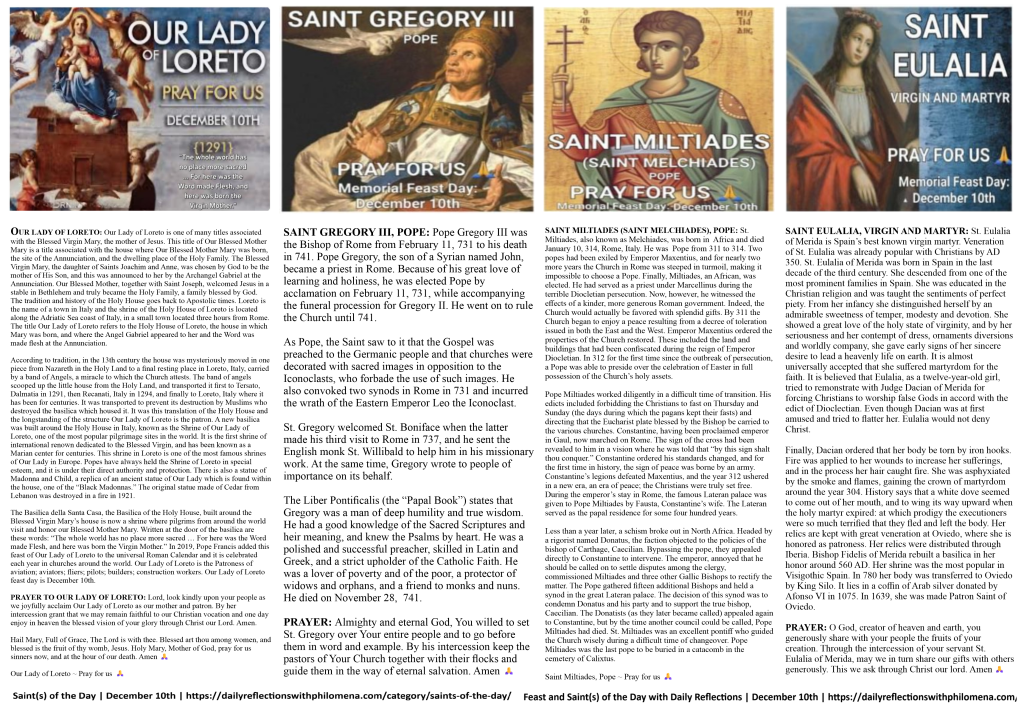
FEAST OF OUR LADY OF LORETO; SAINT GREGORY III, POPE; SAINT MILTIADES (SAINT MELCHIADES), POPE AND SAINT EULALIA, VIRGIN AND MARTYR ~ FEAST DAY – DECEMBER 10TH: Today, we celebrate the Feast of Our Lady of Loreto; Saint Gregory III, Pope; Saint Miltiades, (St. Melchiades) and Saint Eulalia, Virgin and Martyr. Through the intercession of our Blessed Mother Mary and all the Saints during this special season of Advent, we humbly pray for God’s grace and mercy as we prepare for the coming of Our Lord Jesus Christ. Praying for hope, faith, love, joy and peace in our world today, as we face these incredibly challenging times. We pray for God’s deliverance from impossible causes or situations. Amen🙏
OUR LADY OF LORETO: Our Lady of Loreto is one of many titles associated with the Blessed Virgin Mary, the mother of Jesus. This title of Our Blessed Mother Mary is a title associated with the house where Our Blessed Mother Mary was born, the site of the Annunciation, and the dwelling place of the Holy Family. The Blessed Virgin Mary, the daughter of Saints Joachim and Anne, was chosen by God to be the mother of His Son, and this was announced to her by the Archangel Gabriel at the Annunciation. Our Blessed Mother, together with Saint Joseph, welcomed Jesus in a stable in Bethlehem and truly became the Holy Family, a family blessed by God. The tradition and history of the Holy House goes back to Apostolic times. Loreto is the name of a town in Italy and the shrine of the Holy House of Loreto is located along the Adriatic Sea coast of Italy, in a small town located three hours from Rome. The title Our Lady of Loreto refers to the Holy House of Loreto, the house in which Mary was born, and where the Angel Gabriel appeared to her and the Word was made flesh at the Annunciation.
According to tradition, in the 13th century the house was mysteriously moved in one piece from Nazareth in the Holy Land to a final resting place in Loreto, Italy, carried by a band of Angels, a miracle to which the Church attests. The band of angels scooped up the little house from the Holy Land, and transported it first to Tersato, Dalmatia in 1291, then Recanati, Italy in 1294, and finally to Loreto, Italy where it has been for centuries. It was transported to prevent its destruction by Muslims who destroyed the basilica which housed it. It was this translation of the Holy House and the longstanding of the structure Our Lady of Loreto is the patron. A new basilica was built around the Holy House in Italy, known as the Shrine of Our Lady of Loreto, one of the most popular pilgrimage sites in the world. It is the first shrine of international renown dedicated to the Blessed Virgin, and has been known as a Marian center for centuries. This shrine in Loreto is one of the most famous shrines of Our Lady in Europe. Popes have always held the Shrine of Loreto in special esteem, and it is under their direct authority and protection. There is also a statue of Madonna and Child, a replica of an ancient statue of Our Lady which is found within the house, one of the “Black Madonnas.” The original statue made of Cedar from Lebanon was destroyed in a fire in 1921.
The Basilica della Santa Casa, the Basilica of the Holy House, built around the Blessed Virgin Mary’s house is now a shrine where pilgrims from around the world visit and honor our Blessed Mother Mary. Written at the door of the basilica are these words: “The whole world has no place more sacred … For here was the Word made Flesh, and here was born the Virgin Mother.” In 2019, Pope Francis added this feast of Our Lady of Loreto to the universal Roman Calendar and it is celebrated each year in churches around the world. Our Lady of Loreto is the Patroness of aviation; aviators; fliers; pilots; builders; construction workers. Our Lady of Loreto feast day is December 10th.
PRAYER TO OUR LADY OF LORETO: Lord, look kindly upon your people as we joyfully acclaim Our Lady of Loreto as our mother and patron. By her intercession grant that we may remain faithful to our Christian vocation and one day enjoy in heaven the blessed vision of your glory through Christ our Lord. Amen.
Hail Mary, Full of Grace, The Lord is with thee. Blessed art thou among women, and blessed is the fruit of thy womb, Jesus. Holy Mary, Mother of God, pray for us sinners now, and at the hour of our death. Amen🙏
Our Lady of Loreto ~ Pray for us🙏
SAINT GREGORY III, POPE: Pope Gregory III was the Bishop of Rome from February 11, 731 to his death in 741. Pope Gregory, the son of a Syrian named John, became a priest in Rome. Because of his great love of learning and holiness, he was elected Pope by acclamation on February 11, 731, while accompanying the funeral procession for Gregory II. He went on to rule the Church until 741.
As Pope, the Saint saw to it that the Gospel was preached to the Germanic people and that churches were decorated with sacred images in opposition to the Iconoclasts, who forbade the use of such images. He also convoked two synods in Rome in 731 and incurred the wrath of the Eastern Emperor Leo the Iconoclast.
St. Gregory welcomed St. Boniface when the latter made his third visit to Rome in 737, and he sent the English monk St. Willibald to help him in his missionary work. At the same time, Gregory wrote to people of importance on its behalf.
The Liber Pontificalis (the “Papal Book”) states that Gregory was a man of deep humility and true wisdom. He had a good knowledge of the Sacred Scriptures and heir meaning, and knew the Psalms by heart. He was a polished and successful preacher, skilled in Latin and Greek, and a strict upholder of the Catholic Faith. He was a lover of poverty and of the poor, a protector of widows and orphans, and a friend to monks and nuns. He died on November 28, 741.
PRAYER: Almighty and eternal God, You willed to set St. Gregory over Your entire people and to go before them in word and example. By his intercession keep the pastors of Your Church together with their flocks and guide them in the way of eternal salvation. Amen 🙏
SAINT MILTIADES (SAINT MELCHIADES), POPE: St. Miltiades, also known as Melchiades, was born in Africa and died January 10, 314, Rome, Italy. He was Pope from 311 to 314. Two popes had been exiled by Emperor Maxentius, and for nearly two more years the Church in Rome was steeped in turmoil, making it impossible to choose a Pope. Finally, Miltiades, an African, was elected. He had served as a priest under Marcellinus during the terrible Diocletian persecution. Now, however, he witnessed the effects of a kinder, more generous Roman government. Indeed, the Church would actually be favored with splendid gifts. By 311 the Church began to enjoy a peace resulting from a decree of toleration issued in both the East and the West. Emperor Maxentius ordered the properties of the Church restored. These included the land and buildings that had been confiscated during the reign of Emperor Diocletian. In 312 for the first time since the outbreak of persecution, a Pope was able to preside over the celebration of Easter in full possession of the Church’s holy assets.
Pope Miltiades worked diligently in a difficult time of transition. His edicts included forbidding the Christians to fast on Thursday and Sunday (the days during which the pagans kept their fasts) and directing that the Eucharist plate blessed by the Bishop be carried to the various churches. Constantine, having been proclaimed emperor in Gaul, now marched on Rome. The sign of the cross had been revealed to him in a vision where he was told that “by this sign shalt thou conquer.” Constantine ordered his standards changed, and for the first time in history, the sign of peace was borne by an army. Constantine’s legions defeated Maxentius, and the year 312 ushered in a new era, an era of peace; the Christians were truly set free. During the emperor’s stay in Rome, the famous Lateran palace was given to Pope Miltiades by Fausta, Constantine’s wife. The Lateran served as the papal residence for some four hundred years.
Less than a year later, a schism broke out in North Africa. Headed by a rigorist named Donatus, the faction objected to the policies of the bishop of Carthage, Caecilian. Bypassing the pope, they appealed directly to Constantine to intervene. The emperor, annoyed that he should be called on to settle disputes among the clergy, commissioned Miltiades and three other Gallic Bishops to rectify the matter. The Pope gathered fifteen additional Bishops and held a synod in the great Lateran palace. The decision of this synod was to condemn Donatus and his party and to support the true bishop, Caecilian. The Donatists (as they later became called) appealed again to Constantine, but by the time another council could be called, Pope Miltiades had died. St. Miltiades was an excellent pontiff who guided the Church wisely during a difficult time of changeover. Pope Miltiades was the last pope to be buried in a catacomb in the cemetery of Calixtus.
Saint Miltiades, Pope ~ Pray for us 🙏
SAINT EULALIA, VIRGIN AND MARTYR: St. Eulalia of Merida is Spain’s best known virgin martyr. Veneration of St. Eulalia was already popular with Christians by AD 350. St. Eulalia of Merida was born in Spain in the last decade of the third century. She descended from one of the most prominent families in Spain. She was educated in the Christian religion and was taught the sentiments of perfect piety. From her infancy she distinguished herself by an admirable sweetness of temper, modesty and devotion. She showed a great love of the holy state of virginity, and by her seriousness and her contempt of dress, ornaments diversions and worldly company, she gave early signs of her sincere desire to lead a heavenly life on earth. It is almost universally accepted that she suffered martyrdom for the faith. It is believed that Eulalia, as a twelve-year-old girl, tried to remonstrate with Judge Dacian of Merida for forcing Christians to worship false Gods in accord with the edict of Dioclectian. Even though Dacian was at first amused and tried to flatter her. Eulalia would not deny Christ.
Finally, Dacian ordered that her body be torn by iron hooks. Fire was applied to her wounds to increase her sufferings, and in the process her hair caught fire. She was asphyxiated by the smoke and flames, gaining the crown of martyrdom around the year 304. History says that a white dove seemed to come out of her mouth, and to wing its way upward when the holy martyr expired: at which prodigy the executioners were so much terrified that they fled and left the body. Her relics are kept with great veneration at Oviedo, where she is honored as patroness. Her relics were distributed through Iberia. Bishop Fidelis of Merida rebuilt a basilica in her honor around 560 AD. Her shrine was the most popular in Visigothic Spain. In 780 her body was transferred to Oviedo by King Silo. It lies in a coffin of Arab silver donated by Afonso VI in 1075. In 1639, she was made Patron Saint of Oviedo.
PRAYER: O God, creator of heaven and earth, you generously share with your people the fruits of your creation. Through the intercession of your servant St. Eulalia of Merida, may we in turn share our gifts with others generously. This we ask through Christ our lord. Amen 🙏
Discover more from DailyReflections
Subscribe to get the latest posts sent to your email.