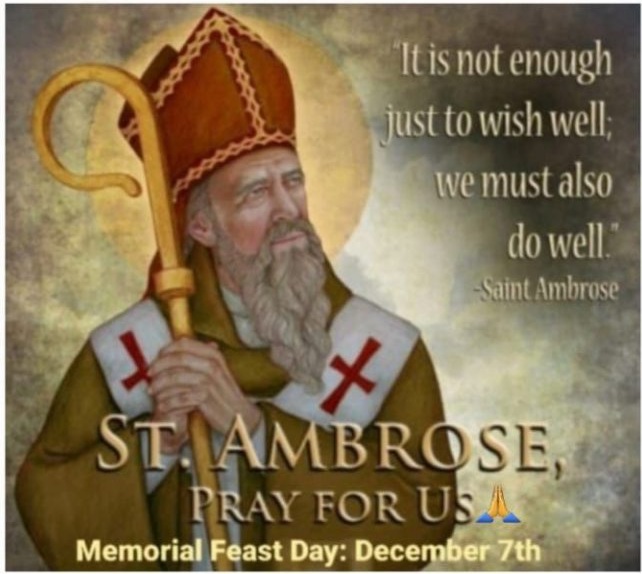
MEMORIAL OF SAINT AMBROSE, BISHOP AND DOCTOR OF THE CHURCH – FEAST DAY ~ DECEMBER 7TH: Today, we celebrate the Memorial of Saint Ambrose, Bishop and Doctor of the Church. Through the intercession of our Blessed Mother Mary and Saint Ambrose during this special season of Advent, we humbly pray for God’s grace and mercy as we prepare for the coming of Our Lord Jesus Christ. Praying for hope, faith, love, joy and peace in our world today, as we face these incredibly challenging times. We pray for God’s deliverance from impossible causes or situations. Amen🙏
SAINT AMBROSE, BISHOP AND DOCTOR OF THE CHURCH: St. Ambrose of Milan (c. 340–397 A.D.), an early “Father” and Doctor of the Church, was an educated and successful lawyer and a Roman governor of Milan, Italy with wealth and prestige. St. Ambrose was a child of a noble Roman family, born at Treves in Gaul (modern day France), where his father exercised the office of Prefect of the Praetorium, about the year 340. Gaul is a territory which embraced modern France, Britain, Spain, and part of Africa. His father died while he was still an infant, and with his mother he returned to Rome, where he enjoyed a good education, learned the Greek language, and a good poet and orator. Later he moved to Milan with his brother. Probus, Praetorian Prefect of Italy, appointed Ambrose Governor of Liguria and Aemilia. His virtues in this office, and the voice of a child who proclaimed him Bishop, marked him out to the people of Milan as their Bishop on the vacancy of the See. When the bishop of Milan died in 374 A.D., a movement arose among the people to demand that St. Ambrose take his place. Both Catholics and Arians elected him to the first dignity in the diocese, a dignity that he reluctantly accepted. At the time St. Ambrose was only a catechumen preparing for baptism; he was not yet a Christian. He went into hiding in an attempt to escape the ecclesiastical appointment. His attempts to hide were unsuccessful; the emperor forbade anyone to gave him shelter, which forced him to give himself up and submit to the will of the people to be their bishop. St. Ambrose quickly received the sacraments, the Sacrament of Baptism, including Holy Orders, and was ordained the Bishop of Milan a week later. Eight days after his baptism, St. Ambrose received episcopal consecration on December 7, 374. The date would eventually become his liturgical feast. He was consecrated Bishop at the age of thirty-four. He became a very holy leader, giving his property to the poor and his land to the Church, and making himself directly available to the needs of all people.
After giving his fortune to the Church and the poor, St. Ambrose applied himself to study the Scriptures and ecclesiastical writes, placing himself under the instruction of Simplicianus, a priest of the Church of Rome, who succeeded him in the Archbishopric of Milan. St. Ambrose worked tirelessly to defend orthodox doctrine, especially against the pervasive Arian heresy which denied the divinity of Christ. His warfare against the Arians was such that by the year 385 very few still professed that heresy in the diocese. In 381, he had a Council at Milan against the heresy of Apolinaris, and assisted at that of Aquileia; the next year, he assisted at one held in Rome. When Maximus assumed the purple in Gaul, St. Ambrose was sent there, and he succeeded in concluding a treaty with the Emperor. But a second embassy, in 387, was not so successful: Maximus invaded Italy and was defeated by the Emperor Theodosius. St. Ambrose at a later date had occasion to reprehend Theodosius and did so with the greatest Apostolical freedom.
St. Ambrose was the saint who introduced lectio divina, the practice of prayerfully meditating on the Sacred Scriptures, into the Latin Church. This informed his eloquent writing, preaching, and teaching, earning him the nickname “honey-tongued doctor.” He was an illustrious preacher. He composed many hymns, promoted sacred chant, and took a great interest in the Liturgy. He wrote much on the Scriptures and Fathers, preached a homily every Sunday, resisted the interference of the secular powers with the rights of the Church, opposed the heretics. St. Ambrose was the bishop who converted and baptized St. Augustine of Hippo. He was instrumental in bringing about the conversion of St. Augustine. Through his sermons he brought St. Augustine to the faith and baptized him in 387. One of his last actions was the ordination of St. Honoratus. After a life of labor and prayer the holy Bishop of Milan died in 397. His 23 years of diligent service had turned a deeply troubled diocese into an exemplary outpost for the faith. His writings remained an important point of reference for the Church, well into the medieval era and beyond. St. Ambrose has been named one of the “holy fathers” of the Church, whose teaching all bishops should “in every way follow.” He is one of the four great Latin Doctors of the Church, and his statue is one of four that upholds the Chair of St. Peter inside St. Peter’s Basilica in Rome. St. Ambrose is the Patron Saint of bee keepers; bees; candlemakers; chandlers; domestic animals; French Commissariat; learning; Milan, Italy; schoolchildren; students; wax melters; wax refiners. St. Ambrose’s feast day is December 7th.
QUOTES OF SAINT AMBROSE, BISHOP
☆”It is not enough just to wish well; we must also do well.”
☆”When in Rome, live as the Romans do; when elsewhere, live as they live elsewhere.”
☆”A good youth ought to have a fear of God, to be subject to his parents, to give honor to his elders, to preserve his purity; he ought not to despise humility, but should love forbearance and modesty. All these are an ornament to youthful years.”
PRAYER: God, by Your grace St. Ambrose, Your Bishop, became a great teacher of the Catholic Faith and an example of apostolic fortitude. Raise up Bishops in Your Church today who will give strong and wise leadership. Amen🙏
Discover more from DailyReflections
Subscribe to get the latest posts sent to your email.