MEMORIAL OF SAINT GERALD, BISHOP OF BRAGA AND SAINT SABAS, ABBOT ~ FEAST DAY ~ DECEMBER 5TH: Today, we celebrate the Memorial of Saint Gerald, Bishop of Braga and Saint Sabas, Abbot. Through the intercession of our Blessed Mother Mary and all the Saints during this special season of Advent, we humbly pray for God’s grace and mercy as we prepare for the coming of Our Lord Jesus Christ. Praying for hope, faith, love, joy and peace in our world today, as we face these incredibly challenging times. We pray for God’s deliverance from impossible causes or situations. We pray for the sick and dying, especially sick children, those who are mentally and physically ill, strokes, heart diseases, and those suffering from cancers and other terminal diseases. We pray for the souls in Purgatory and the repose of the souls of the faithful departed and we pray for all widows and widowers. We pray for torture victims, the poor, the needy and the most vulnerable in our communities and around the world. We pray for all parents and children, for peace, love, justice and unity in our marriages, our families and our world. And we continue to pray for our Holy Father, Pope Leo XIV, the Bishops, the Clergy, for vocations to the priesthood and religious life, for the Church, for persecuted Christians, for the conversion of sinners, and Christians all over the world… Amen🙏
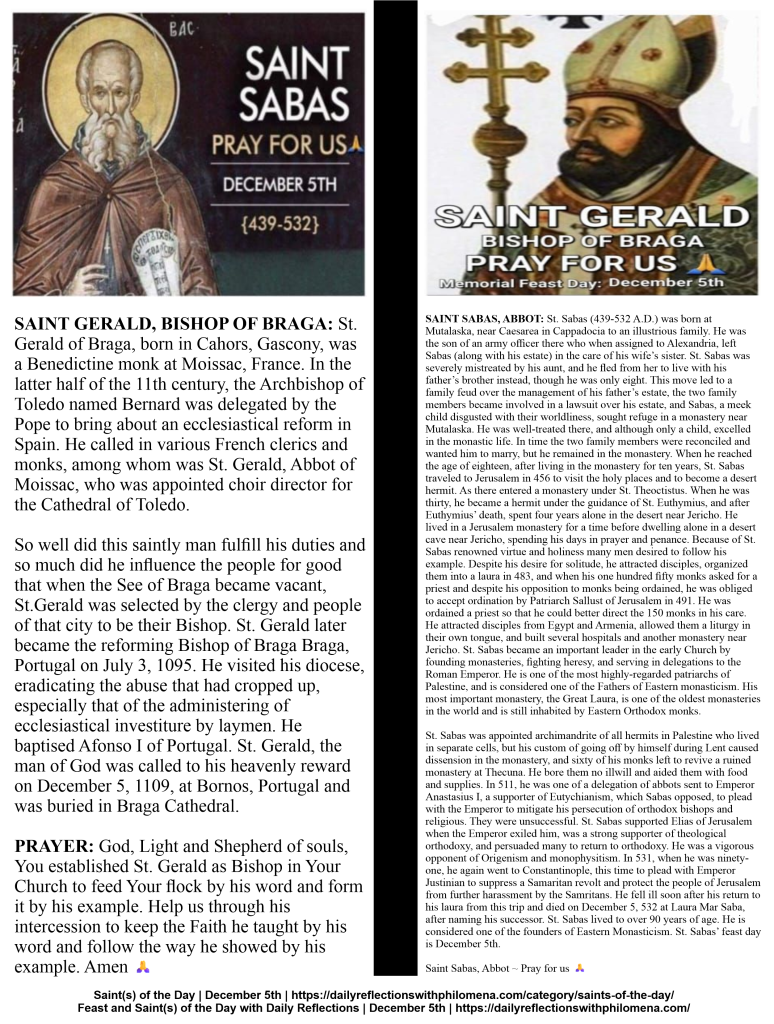
SAINT GERALD, BISHOP OF BRAGA: St. Gerald of Braga, born in Cahors, Gascony, was a Benedictine monk at Moissac, France. In the latter half of the 11th century, the Archbishop of Toledo named Bernard was delegated by the Pope to bring about an ecclesiastical reform in Spain. He called in various French clerics and monks, among whom was St. Gerald, Abbot of Moissac, who was appointed choir director for the Cathedral of Toledo.
So well did this saintly man fulfill his duties and so much did he influence the people for good that when the See of Braga became vacant, St.Gerald was selected by the clergy and people of that city to be their Bishop. St. Gerald later became the reforming Bishop of Braga Braga, Portugal on July 3, 1095. He visited his diocese, eradicating the abuse that had cropped up, especially that of the administering of ecclesiastical investiture by laymen. He baptised Afonso I of Portugal. St. Gerald, the man of God was called to his heavenly reward on December 5, 1109, at Bornos, Portugal and was buried in Braga Cathedral.
PRAYER: God, Light and Shepherd of souls, You established St. Gerald as Bishop in Your Church to feed Your flock by his word and form it by his example. Help us through his intercession to keep the Faith he taught by his word and follow the way he showed by his example. Amen 🙏
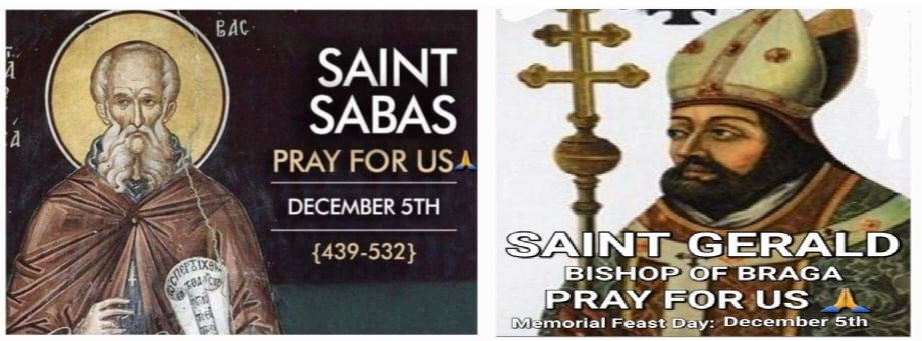
SAINT SABAS, ABBOT: St. Sabas (439-532 A.D.) was born at Mutalaska, near Caesarea in Cappadocia to an illustrious family. He was the son of an army officer there who when assigned to Alexandria, left Sabas (along with his estate) in the care of his wife’s sister. St. Sabas was severely mistreated by his aunt, and he fled from her to live with his father’s brother instead, though he was only eight. This move led to a family feud over the management of his father’s estate, the two family members became involved in a lawsuit over his estate, and Sabas, a meek child disgusted with their worldliness, sought refuge in a monastery near Mutalaska. He was well-treated there, and although only a child, excelled in the monastic life. In time the two family members were reconciled and wanted him to marry, but he remained in the monastery. When he reached the age of eighteen, after living in the monastery for ten years, St. Sabas traveled to Jerusalem in 456 to visit the holy places and to become a desert hermit. As there entered a monastery under St. Theoctistus. When he was thirty, he became a hermit under the guidance of St. Euthymius, and after Euthymius’ death, spent four years alone in the desert near Jericho. He lived in a Jerusalem monastery for a time before dwelling alone in a desert cave near Jericho, spending his days in prayer and penance. Because of St. Sabas renowned virtue and holiness many men desired to follow his example. Despite his desire for solitude, he attracted disciples, organized them into a laura in 483, and when his one hundred fifty monks asked for a priest and despite his opposition to monks being ordained, he was obliged to accept ordination by Patriarch Sallust of Jerusalem in 491. He was ordained a priest so that he could better direct the 150 monks in his care. He attracted disciples from Egypt and Armenia, allowed them a liturgy in their own tongue, and built several hospitals and another monastery near Jericho. St. Sabas became an important leader in the early Church by founding monasteries, fighting heresy, and serving in delegations to the Roman Emperor. He is one of the most highly-regarded patriarchs of Palestine, and is considered one of the Fathers of Eastern monasticism. His most important monastery, the Great Laura, is one of the oldest monasteries in the world and is still inhabited by Eastern Orthodox monks.
St. Sabas was appointed archimandrite of all hermits in Palestine who lived in separate cells, but his custom of going off by himself during Lent caused dissension in the monastery, and sixty of his monks left to revive a ruined monastery at Thecuna. He bore them no illwill and aided them with food and supplies. In 511, he was one of a delegation of abbots sent to Emperor Anastasius I, a supporter of Eutychianism, which Sabas opposed, to plead with the Emperor to mitigate his persecution of orthodox bishops and religious. They were unsuccessful. St. Sabas supported Elias of Jerusalem when the Emperor exiled him, was a strong supporter of theological orthodoxy, and persuaded many to return to orthodoxy. He was a vigorous opponent of Origenism and monophysitism. In 531, when he was ninety-one, he again went to Constantinople, this time to plead with Emperor Justinian to suppress a Samaritan revolt and protect the people of Jerusalem from further harassment by the Samritans. He fell ill soon after his return to his laura from this trip and died on December 5, 532 at Laura Mar Saba, after naming his successor. St. Sabas lived to over 90 years of age. He is considered one of the founders of Eastern Monasticism. St. Sabas’ feast day is December 5th.
Saint Sabas, Abbot ~ Pray for us 🙏
Discover more from DailyReflections
Subscribe to get the latest posts sent to your email.