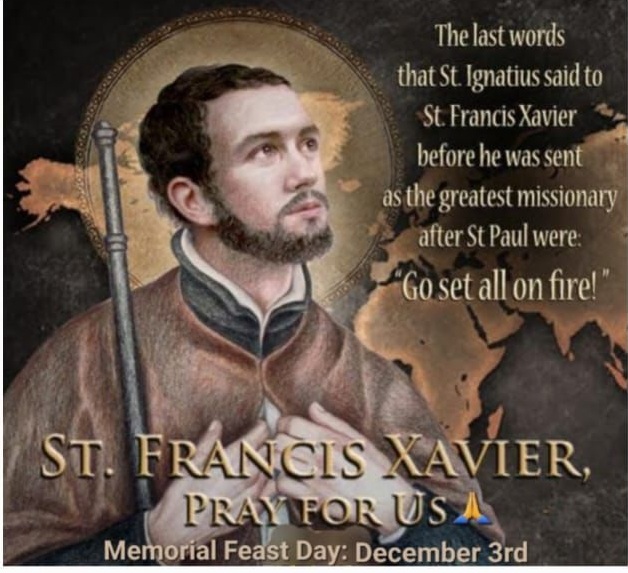
MEMORIAL OF SAINT FRANCIS XAVIER, PRIEST – FEAST DAY ~ DECEMBER 3RD: Today, we celebrate the Memorial of Saint Francis Xavier, Priest. Through the intercession of our Blessed Mother Mary and all the Saints during this special season of Advent, we humbly pray for God’s grace and mercy as we prepare for the coming of Our Lord Jesus Christ. Praying for hope, faith, love, joy and peace in our world today, as we face these incredibly challenging times. We pray for God’s deliverance from impossible causes or situations. We pray for the sick and dying, especially sick children, those who are mentally and physically ill, strokes, heart diseases, and those suffering from cancers and other terminal diseases. We pray for the souls in Purgatory and the repose of the souls of the faithful departed and we pray for all widows and widowers. We pray for torture victims, the poor, the needy and the most vulnerable in our communities and around the world. We pray for all parents and children, for peace, love, justice and unity in our marriages, our families and our world. And we continue to pray for our Holy Father, Pope Leo XIV, the Bishops, the Clergy, for vocations to the priesthood and religious life, for the Church, for persecuted christians, for the conversion of sinners, and Christians all over the world… Amen🙏
SAINT FRANCIS XAVIER, PRIEST: St. Francis (1506-1552) is one of the Church’s most illustrious missionaries. He was born in a castle of Xavier in the Kingdom of Navarre, Spain on April 7, 1506 into a noble, aristocratic Spanish family of the Kingdom, and the youngest son of his parents. His mother, Dona was an esteemed heiress, sole heiress of two noble Navarrese families and his father, Juan, an adviser or counselor to King John III of Navarre. In 1512, King Ferdinand of Spain invaded the Kingdom of Navarre. Three years later St. Francis’s father died when he was only nine. In 1516, after a failed attempt to expel the Spanish invaders from the Kingdom, the Spanish invaders ordered the family lands to be confiscated, demolition of the outer wall, the gates and two towers of the family castle torn down, and the moat was filled in. Only the family residence inside the castle was left. For the following years with his family until he left for his studies in Paris, life in Navarre – partially occupied with Spain, was surrounded with war that lasted over 18 years. It ended with Navarre being partitioned into two territories; the king and his loyalists abandoned the south and moved to the northern part, now France. While St. Francis brothers entered the military, St. Francis followed an intellectual path to a college in Paris. In 1525 he went to Paris and studied at the University of Paris, where he taught philosophy after obtaining his degree of master of arts. Here he met Ignatius of Loyola with whom he received Holy Orders in Venice in 1537 and was enrolled as one of the first seven Jesuits. They decided to go to the Holy Land, but the war between the Turks and Venice prevented this, so for a time Francis labored at Padua, Bologna, and Rome.
In 1540, St. Ignatius chose St. Francis as the first missionary to the Portuguese East Indies to evangelize. St. Francis sailed from Lisbon armed with four papal briefs making him nuncio with full powers and recommending him to the Eastern princes. He landed at Goa in India and began a vast apostolate lasting over ten years. Here he instructed the adults, gathered the children by ringing a bell in the streets, catechized them, and also visited the hospitals and prisons. He then turned to the native Indians, teaching the simple folk by versifying Catholic doctrine and fitting the verses to popular tunes. He then went on to Cape Comorin and began the conversion of the Paravas, some days baptizing so many that at night he could not raise his arm from fatigue. Then to Travencore where he founded forty-five churches in various villages. Then to Malacca in Malaya, and for eighteen months from island to island, preaching, instructing, baptizing. On his return to Goa he heard of the vast harvest of souls awaiting the laborers in Japan and he set out for this field with several companions, arriving at Kagoshima in 1549. St. Francis carried the light of Faith to Japan, of which he became the first missionary, and where a flourishing Christian community soon arose. He set himself to learn the language and started to preach and teach with such success that twelve years later his converts were found still retaining their first fervor. He remained in Japan two years and four months, and returned to India in 1551. He returned to Malacca to revisit his converts in India. Now a new goal loomed up before his eyes—pagan China, but he was not to reach it. After visiting Goa, he set sail, in 1552, to carry out his resolve, but God was satisfied with his will. On the twenty-third day after his departure from Malacca he arrived at Sancian. Arriving on the island of Sancian at the mouth of the Canton river, St. Francis became ill of a fever and would have died abandoned on the burning sands of the shore if a poor man named Alvarez had not taken him to his hut. Here he lingered for two weeks, praying between spells of delirium, and finally died with his eyes fixed with great tenderness on his crucifix on Friday, December 3, 1552, at the age of forty-six. He died while seeking a way to enter the closely-guarded kingdom of China. He was buried in a shallow grave and his body covered with quicklime, but when exhumed three months later it was found fresh and incorrupt. It was taken to Goa where it is still enshrined. In 1622, both St. Francis Xavier and St. Ignatius Loyola were canonized on the same day by Pope Gregory XV. St. Francis Xavier was proclaimed patron of foreign missions and of all missionary works by Pope St. Pius X.
St. Francis Xavier is best known for his missionary work, both as an organizer and as a pioneer. He was known throughout the Far East for his humility, care of the poor, and miracles including healings, speaking in tongues, and prophetic powers. His passion for Christ and zeal for souls won him many converts to the faith. It is said that during his missionary journeys he baptized over 40,000 people. He is considered by many to be one of the Church’s greatest missionaries since St. Paul the Apostle. In his travels he left behind flourishing churches that were the foundations of the Catholic Church in Asia. His work was also noteworthy to Christians in the propagation of Christianity in China and Japan. India, to this day, has numerous Jesuit missions and many more schools because of this great saints work. St. Francis is the Patron Saint of African missions; navigators; missionaries; India, Japan, China, and New Zealand. Apostleship of Prayer; Kottar, India; Agartala, India; Ahmedabad, india; Alexandria, Louisiana; Apostleship of Prayer; Foreign Missions; Parish Missions; Plague; Australia; Bengaluru, India; Bombay, India, Bomeo, Cape Town, South Africa; China; Dinajpur, Bangladesh; East Indies; Fathers of the Precious Blood; foreign missions; Freising, Germany; Goa, India; Fiji; Green Bay, Wisconsin Wisconsin; India; Indianapolis, Indiana; Japan; Key West, Florida; Sophia University, Tokyo, Japan; University of Saint Francis Xavier, Sucre, Bolivia; Joliet, Illinois; Kabankalan, India; Kollam, Philippines; Nasugbu, Batangas, Philippines; Abuyog, Leyte, Philippines; Alegria, Cebu, Philippines; Hong Kong Macau; Antananarivo, Madagascar; Diocese of Malindi, Kenya; missionaries; Missioners of the Precious Blood; Navarre, Spain; navigators New Zealand; parish missions; plague epidemics; Propagation of the Faith; Zagreb, Croatia; Indonesia; Malacca, Malaysia; Brunei; Pakistan; Philippines; Singapore; Sri Lanka. St. Francis Xavier’s feast day is December 3rd.
PRAYER: Lord, You won many peoples for Your Church through the preaching of St. Francis. Inspire the faithful today with the same zeal for spreading the Faith, so that everywhere the Church may rejoice in her many children. Amen 🙏
Discover more from DailyReflections
Subscribe to get the latest posts sent to your email.