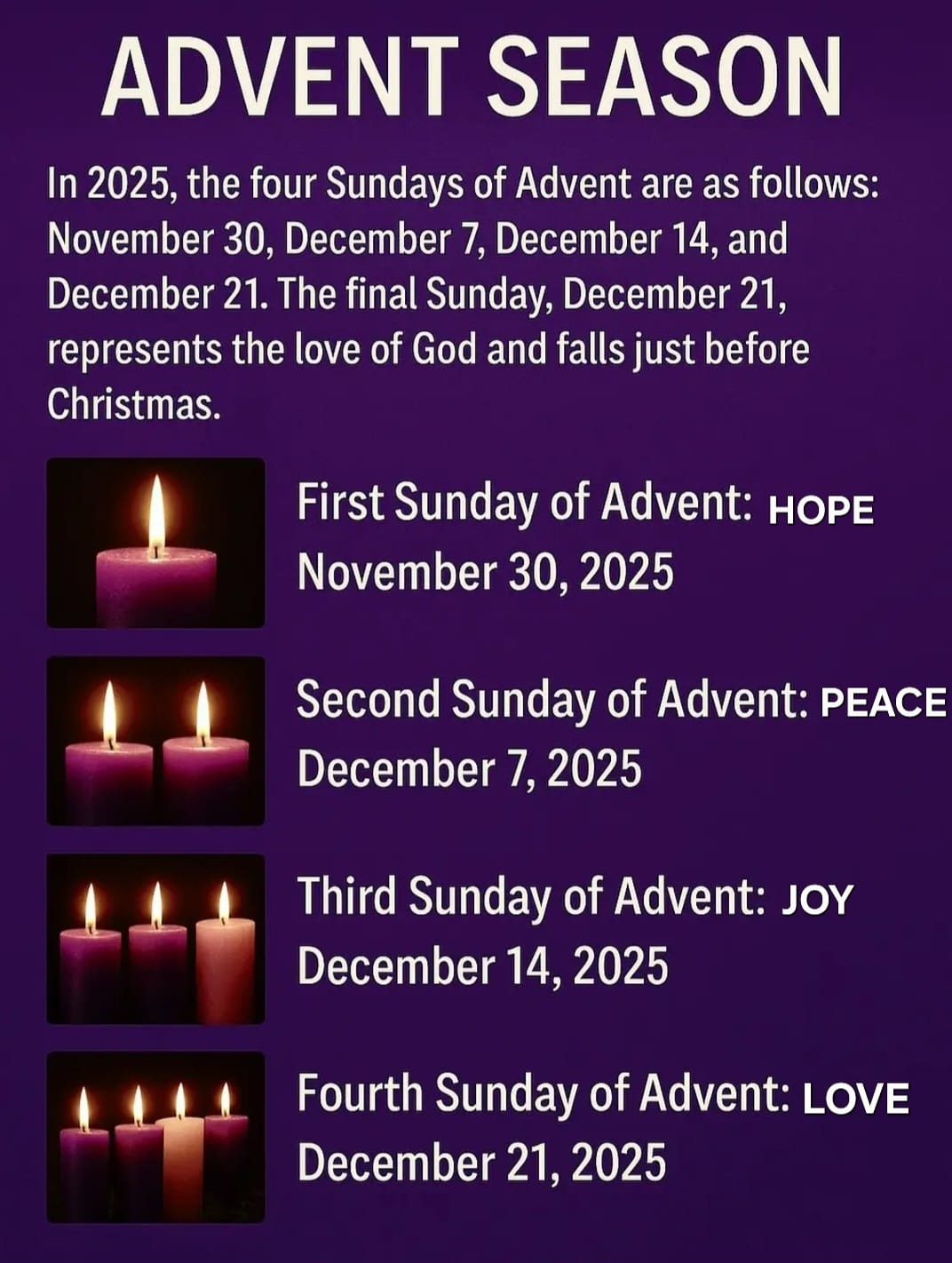
Happy New Year! Today, November 30, 2025 is the First Sunday of Advent. While a month yet remains in the civil year, the Church is celebrating the beginning of a new Liturgical year. Advent is the time of year we prepare and celebrate the arrival of Christ on earth and His salvation for mankind. There are two main focus of the season. The first is the preparation to celebrate the first coming of Christ in history. That first coming of Christ was His birth. We prepare with joy to celebrate the birthday of our Savior on December 25th. The second focus of the season is the Second coming of Jesus at the end of the time. Jesus promised to come back. Advent is a kind of wake-up call to us for the second coming of Christ. Advent from the Latin word ad venio, means “to come”. It is the liturgical season anticipating the Adventus Domini, that is the “coming of the Lord.” While the days grow shorter and colder, we prepare for the “Sun of Justice” who comes to kindle our hearts with His light and his love.
There are always four Sundays in Advent, though not necessarily four full weeks. The liturgical color of the season is violet or purple, except on the Third Sunday of Advent, called Gaudete or Rejoice Sunday, when optional rose vestments may be worn. The Gloria is not recited during Advent liturgies, but the Alleluia is retained. The prophecies of Isaiah are read often during the Advent season, but all of the readings of Advent focus on the key figures of the Old and New Testaments who were prepared and chosen by God to make the Incarnation possible: the Blessed Virgin Mary, St. John the Baptist, St. Joseph, Sts. Elizabeth and Zechariah. The expectancy heightens from December 17 to December 24 when the Liturgy resounds with the seven magnificent Messianic titles of the O Antiphons. The Advent season also has a Marian and pro-life focus. We meditate on this wonderful mystery of the Word Made Flesh with as much eagerness as his Mother, Mary prepared and awaited the birth of her son. In the USA and many countries around the world, we celebrate the special feasts of the Immaculate Conception, the patroness of the United States of America, on December 8, and Our Lady of Guadalupe, patroness of the Americas, on December 12. Other saints’ days traditionally associated in with our preparation for Christmas include St. Nicholas, patron saint of children whose feast falls on December 6, and the saint of light, St. Lucy on December 13. Advent season is an invitation to set your mind off of the stresses of the year. We can take our focus off of the crazy hustle that can be associated with the Christmas season that often threatens to produce more hassle than delight. Advent is a chance to focus our thoughts on the gift God has given us in His son Jesus who stepped down from Heaven and took the form of a man so that we might believe.
First Sunday of Advent Symbolism and Wreath Candle: The word “Advent” comes from the Latin word adventus, which means “coming.” Advent in the 4th and 5th centuries was a time of preparation for the baptism of new Christians. Christians would spend 40 days in prayer and fasting to prepare for the celebration that accompanied the baptism of new believers. Over time, advent was connected to the coming of Christ. Originally Christians used this term to reference Christ’s second coming, but by the Middle Ages, Advent was connected to Christ’s first coming that we celebrate at Christmas. Today, we celebrate Advent over the four weeks leading up to Christmas each year. This year we begin advent today, November 30th and end this season of prayerful anticipation on December 24th.
The tradition for the first Sunday of Advent includes lighting the candle of hope: “The Light of Hope” (Hope Promised – 1 Corinthians 13:13; Hope Lost – Luke 24; Hope Restored – Hebrews 6:19). The first candle is called the “Candle of Hope. It symbolizes our faith in God keeping His promises to humanity through the long awaited hope of The Messiah and Our Lord – Jesus Christ. We light this candle of hope, and dare to express our longing for His continued anointing, for love, for healing upon all mankind. The lighting of the first of our Advent candles in this dark time of the year reminds us of that hope-filled truth. This first Sunday of Advent we read, pray, and reflect on the hope God’s plan gives us (foretold by the prophets and fulfilled by the life and death of Christ), and we meditate on the promise of Christ’s coming glory-filled return. On this first Sunday of Advent, as we prepare our hearts to celebrate Jesus’ arrival as a gift to all humanity; let’s stir up in our hearts and homes a sense of anticipation. Over this Advent, we pray that hope would rise up in our spirits in a tangible and life-giving way.
A PRAYER FOR THE FIRST SUNDAY OF ADVENT: Father, let your hope arise in our hearts! Lift our eyes up to see that you alone are where our hope comes from. Help us to shake off the anxiety, discouragements, and distractions that have filled this year. May we pause to remember that we have hope in you. You know the end of our stories, and we give thanks because you have promised that it will be a victorious ending. Give us the grace we need to wrap up this year joyfully. We invite your Spirit into this beautiful Advent season. Renew our sense of holy anticipation! Let us be those who are waiting eagerly for Jesus to come again. More than anything, we ask that you be glorified in this season of expectation… Amen.🙏
BLESSING OF THE ADVENT WREATH: It starts at the evening meal on the Saturday before the first Sunday in Advent with the blessing of the wreath. (The head of the household is the one designated to say the prayers, following which various members of his family light the candles. If the group is not a family, then a leader may be selected to say the prayers and others appointed to light the candles.) The following prayer can be used.
LEADER: Our help is in the name of the Lord.
ALL: Who made heaven and earth.
LEADER: O God, by whose Word all things are sanctified, pour forth Your blessing upon this wreath and grant that we who use it may prepare our hearts for the coming of Christ and may receive from You abundant graces. We ask this through Christ our Lord.
ALL: Amen.🙏
The wreath would then be sprinkled with Holy water. Then follows the prayer which is said before the evening meal each night of the first week in Advent.
FIRST WEEK: The following prayer should be repeated each day during the first week. After the prayer, the family’s youngest child lights the first purple candle. (Family members can also take turns lighting and blowing out the candles on each night.)
LEADER: O Lord, stir up Thy might, we beg Thee, and come, That by Thy protection we may deserve to be rescued from the threatening dangers of our sins and saved by Thy deliverance. Through Christ our Lord. ALL: Amen.🙏
(The candle is allowed to burn during evening meals for the first week.)
SECOND WEEK: The prayer that follows is to be repeated each day of the second week. After the prayer, the oldest child lights the first and second purple candles.
LEADER: O Lord, stir up our hearts that we may prepare for Thy only begotten Son, that through His coming we may be made worthy to serve Thee with pure minds. Through Christ our Lord.
ALL: Amen.🙏
(The two candles are allowed to burn during the evening meals of the second week.)
THIRD WEEK: The joyful Sunday in Advent (known as “Gaudete”) is represented by rose (or pink) instead of the penitential purple color. Each night during the third week the mother of the family lights the pink, as well as the two previously burned purple candles, after the following prayer has been said.
LEADER: O Lord, we beg Thee, incline Thy ear to our prayers and enlighten the darkness of our minds by the grace of Thy visitation. Through Christ our Lord.
ALL: Amen.🙏
(The three candles are allowed to burn during the evening meals of the third week.)
FOURTH WEEK: The prayer that follows is to be repeated each day of the fourth week. After the prayer, the father lights all four candles.
LEADER: O Lord, stir up Thy power, we pray Thee, and come; and with great might help us, that with the help of Thy Grace, Thy merciful forgiveness may hasten what our sins impede. Through Christ our Lord. ALL: Amen.🙏
(The four candles are allowed to burn during the evening meals of the fourth week.)
After the fourth week, the penitential season of Advent is over and the time to rejoice is at hand. The Advent wreath is transformed into a Christmas wreath. Ribbon and candles are replaced with red ribbon and long red or white tapers (to be lighted at breakfast on Christmas morning) and, if desired, other festive decorations can be added.
Our relationship with the Lord is not a relationship of equals. He alone is Lord. His will takes priority over our will. We grow in our relationship with the Lord, when we grow in our freedom to do what he wants, to live as he desires us to live. St. Paul in the second reading today calls on us, ‘to make more and more progress in the kind of life that you are meant to live, the life that God wants’. Advent is a season that calls on us to let God be God in our lives, so that what God wants shapes what we do and say. Mary, the great Advent saint, shows us the way. She was truly watchful; she was awake to what was most important, to what God wanted. Her prayer, ‘Let it be to me according to your word’, captures that spirit of attentiveness to what God wants which the season of Advent puts before us.
ADVENT SEASON AND IT’S SIGNIFICANCE IN THE LITURGICAL YEAR | https://dailyreflectionswithphilomena.com/advent-season-and-its-significance-in-the-liturgical-year/
THE LITURGICAL YEAR IN THE CATHOLIC CHURCH | https://dailyreflectionswithphilomena.com/the-liturgical-year-in-the-catholic-church/
Daily Reflections with Philomena | https://dailyreflectionswithphilomena.com/
Discover more from DailyReflections
Subscribe to get the latest posts sent to your email.