SAINT ANDREW PRAYER: Beginning today, on this Feast of St. Andrew (November 30th), the following beautiful prayer is traditionally recited fifteen times a day until Christmas. This is a very meditative prayer that helps us increase our awareness of the real focus of Christmas and helps us prepare ourselves spiritually for the coming of our Lord Jesus Christ.
“Hail and blessed be the hour and moment in which the Son of God was born of the most pure Virgin Mary, at midnight, in Bethlehem, in piercing cold. In that hour vouchsafe, O my God! to hear my prayer and grant my desires, [here mention your request] through the merits of Our Saviour Jesus Christ, and of His blessed Mother. Amen.”🙏
FEAST OF SAINT ANDREW, APOSTLE AND MARTYR – FEAST DAY ~ NOVEMBER 30TH: Today, we celebrate the Feast of Saint Andrew, Apostle and Martyr. Through the intercession of our Blessed Mother Mary and all the Saints on this special Feast day, we humbly pray for God’s grace and mercy as we prepare for the coming of Our Lord Jesus Christ. Praying for hope, faith, love, joy and peace in our world today, as we face these incredibly challenging times. We pray for God’s deliverance from impossible causes or situations. We pray for the sick and dying, especially sick children, those who are sick with mental illness, stroke, heart diseases, and those suffering from cancers and other terminal diseases. Amen🙏
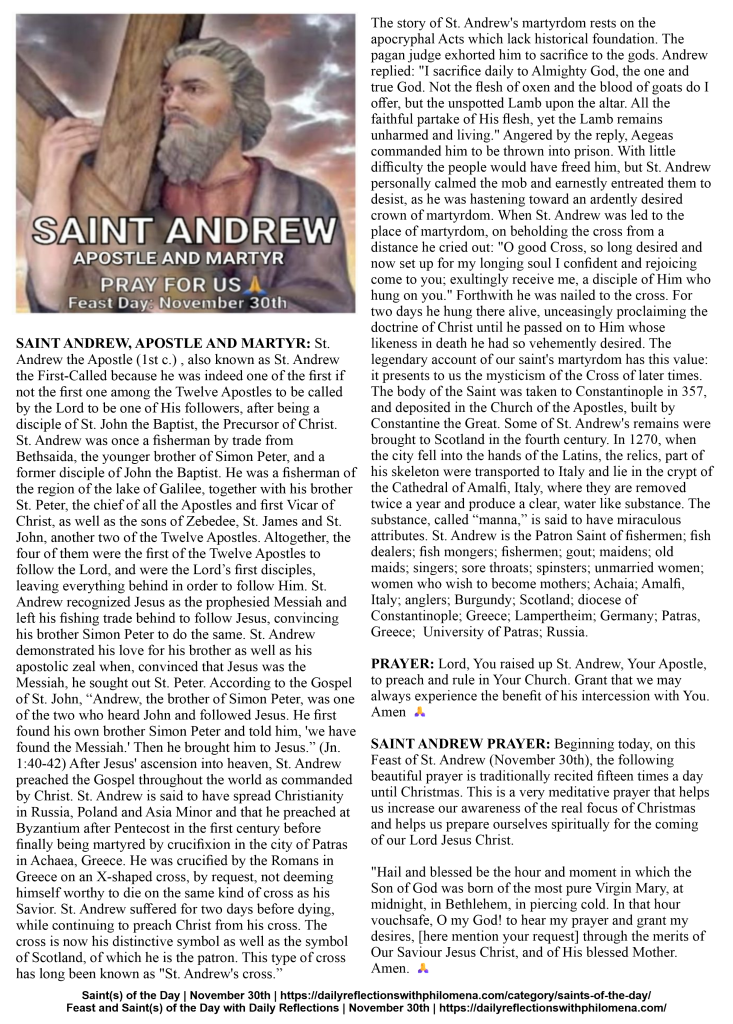
SAINT ANDREW, APOSTLE AND MARTYR: St. Andrew the Apostle (1st c.) , also known as St. Andrew the First-Called because he was indeed one of the first if not the first one among the Twelve Apostles to be called by the Lord to be one of His followers, after being a disciple of St. John the Baptist, the Precursor of Christ. St. Andrew was once a fisherman by trade from Bethsaida, the younger brother of Simon Peter, and a former disciple of John the Baptist. He was a fisherman of the region of the lake of Galilee, together with his brother St. Peter, the chief of all the Apostles and first Vicar of Christ, as well as the sons of Zebedee, St. James and St. John, another two of the Twelve Apostles. Altogether, the four of them were the first of the Twelve Apostles to follow the Lord, and were the Lord’s first disciples, leaving everything behind in order to follow Him. St. Andrew recognized Jesus as the prophesied Messiah and left his fishing trade behind to follow Jesus, convincing his brother Simon Peter to do the same. St. Andrew demonstrated his love for his brother as well as his apostolic zeal when, convinced that Jesus was the Messiah, he sought out St. Peter. According to the Gospel of St. John, “Andrew, the brother of Simon Peter, was one of the two who heard John and followed Jesus. He first found his own brother Simon Peter and told him, ‘we have found the Messiah.’ Then he brought him to Jesus.” (Jn. 1:40-42) After Jesus’ ascension into heaven, St. Andrew preached the Gospel throughout the world as commanded by Christ. St. Andrew is said to have spread Christianity in Russia, Poland and Asia Minor and that he preached at Byzantium after Pentecost in the first century before finally being martyred by crucifixion in the city of Patras in Achaea, Greece. He was crucified by the Romans in Greece on an X-shaped cross, by request, not deeming himself worthy to die on the same kind of cross as his Savior. St. Andrew suffered for two days before dying, while continuing to preach Christ from his cross. The cross is now his distinctive symbol as well as the symbol of Scotland, of which he is the patron. This type of cross has long been known as “St. Andrew’s cross.”
The story of St. Andrew’s martyrdom rests on the apocryphal Acts which lack historical foundation. The pagan judge exhorted him to sacrifice to the gods. Andrew replied: “I sacrifice daily to Almighty God, the one and true God. Not the flesh of oxen and the blood of goats do I offer, but the unspotted Lamb upon the altar. All the faithful partake of His flesh, yet the Lamb remains unharmed and living.” Angered by the reply, Aegeas commanded him to be thrown into prison. With little difficulty the people would have freed him, but St. Andrew personally calmed the mob and earnestly entreated them to desist, as he was hastening toward an ardently desired crown of martyrdom. When St. Andrew was led to the place of martyrdom, on beholding the cross from a distance he cried out: “O good Cross, so long desired and now set up for my longing soul I confident and rejoicing come to you; exultingly receive me, a disciple of Him who hung on you.” Forthwith he was nailed to the cross. For two days he hung there alive, unceasingly proclaiming the doctrine of Christ until he passed on to Him whose likeness in death he had so vehemently desired. The legendary account of our saint’s martyrdom has this value: it presents to us the mysticism of the Cross of later times. The body of the Saint was taken to Constantinople in 357, and deposited in the Church of the Apostles, built by Constantine the Great. Some of St. Andrew’s remains were brought to Scotland in the fourth century. In 1270, when the city fell into the hands of the Latins, the relics, part of his skeleton were transported to Italy and lie in the crypt of the Cathedral of Amalfi, Italy, where they are removed twice a year and produce a clear, water like substance. The substance, called “manna,” is said to have miraculous attributes. St. Andrew is the Patron Saint of fishermen; fish dealers; fish mongers; fishermen; gout; maidens; old maids; singers; sore throats; spinsters; unmarried women; women who wish to become mothers; Achaia; Amalfi, Italy; anglers; Burgundy; Scotland; diocese of Constantinople; Greece; Lampertheim; Germany; Patras, Greece; University of Patras; Russia.
PRAYER: Lord, You raised up St. Andrew, Your Apostle, to preach and rule in Your Church. Grant that we may always experience the benefit of his intercession with You. Amen 🙏
Discover more from DailyReflections
Subscribe to get the latest posts sent to your email.