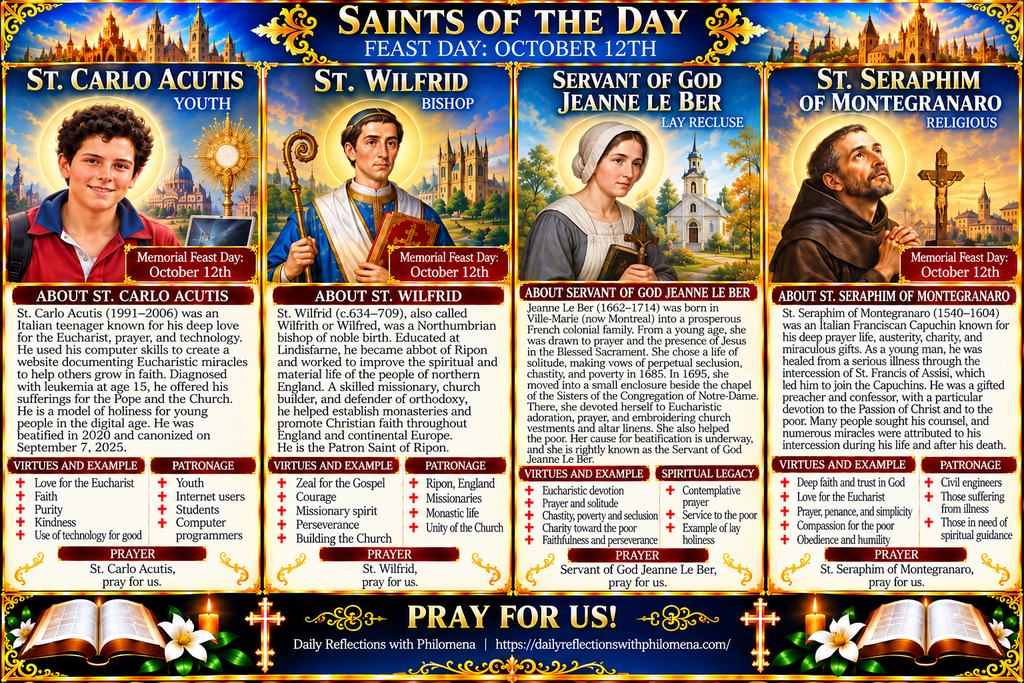
MEMORIAL OF SAINT WILFRID, BISHOP; SERVANT OF GOD JEANNE LE BER, RECLUSE, SAINT CARLO ACUTIS, AND SAINT SERAPHIM OF MONTEGRANARO, RELIGIOUS – FEAST DAY: OCTOBER 12TH: Today, we celebrate the Memorial of Saint Felix IV, Pope; Saint Wilfrid, Bishop; Servant of God Jeanne Leber, Recluse and Saint Carlo Acutis. Through the intercession of our Blessed Mother Mary and the Saints on this feast day, we humbly pray for God’s Divine Grace and Mercy upon us all. We pray for peace, love, and unity in our marriages, our families and our world. We pray for the poor, the needy and the most vulnerable. We pray for the sick and dying, especially those who are mentally and physically ill and those suffering from cancers and other terminal diseases. We pray for the souls in Purgatory and the repose of the souls of the faithful departed. We pray for all widows and widowers. And we continue to pray for our Holy Father, the Bishops, the Clergy, for vocations to the priesthood and religious life, for the Church, for persecuted christians, for the conversion of sinners, and Christians all over the world…. Amen🙏
SAINT WILFRID, BISHOP: St. Wilfrid (c.634-709) also called Wilfrith and Wilfred was a Northumbrian of noble birth in 634. He was educated at Lindesfarne and then spent some time in Lyons and Rome. Returning to England, he was elected abbot of Ripon in 658 and introduced the Roman rules and practices in opposition to the celtic ways of northern England. In 664, he was the architect of the definitive victory of the Roman party at the Conference of Whitby. He was appointed Bishop of York and after some difficulty finally took possession of his See in 669. He labored zealously and founded many monasteries of the Benedictine Order, but he was obliged to appeal to Rome in order to prevent the subdivision of his diocese by St. Theodore, Archbishop of Canterbury. While waiting for the case to be decided, he was forced to go into exile, and worked hard and long to evangelize the heathen south Saxons until his recall in 686. In 691, he had to retire again to the Midlands until Rome once again vindicated him. In 703, he resigned his post and retired to his monastery at Ripon where he spent his remaining time in prayer and penitential practices, until his death in 709. St. Wilfrid was an outstanding personage of his day, extremely capable and possessed of unbounded courage, remaining firm in his convictions despite running afoul of civil and ecclesiastical authorities. He helped bring the discipline of the English Church into line with that of Rome. He was also a dedicated pastor and a zealous and skilled missionary; his brief time spent in Friesland in 678-679 was the starting point for the great English mission to the Germanic peoples of continental Europe. He’s the Patron Saint of Ripon, England.
Saint Wilfrid, Bishop ~ Pray for us 🙏
SERVANT OF GOD JEANNE LE BER, RECLUSE: Servant of God Jeanne Le Ber was born on January 4, 1662 in Ville-Marie (Montreal). She is baptized the same day and Paul de Chomedey de Maisonneuve is her godfather and Jeanne Mance her godmother. At an early age she feels attracted by the presence of Jesus in the Blessed Sacrament and enjoys silence and prayer. To complete her formal education she spends three years, 1674 to 1677, as a boarder with the Ursulines in Quebec, where her aunt teaches. The Ursulines are impressed by her many acts of self-denial and are disappointed when, at the age of fifteen, she returns to her family in Montreal. She is a pensive, withdrawn, and introverted young lady, who daily spends much time in prayer and in adoration of the Sacrament. In accordance with her confessor, when she turns eighteen, she decides to live a secluded life. With her parents’ permission she retires to a cell at the rear of the church of the Hôtel-Dieu, which serves as parish church at that time. Jeanne Le Ber remains undecided about entering a regular order and taking permanent vows; nevertheless, her determination to shun the attractive life her family offered becomes evident. On June 24, 1685, Servant of God Jeanne Le Ber takes a simple vow of perpetual seclusion, chastity, and poverty. When she hears that the Sisters of the Congrégation de Notre-Dame plan to build a church on their property she gives them generous financial assistance on condition that they reserve for her a three-room apartment directly behind the altar, so that she can view the Blessed Sacrament without leaving her quarters. On August 5, 1695, she takes the solemn vows of a recluse. She spends much time in making church vestments and altar cloths and in fine embroidery. Six or seven hours a day are devoted to prayer and meditation, she receives communion four times a week. She introduces the practice of the perpetual adoration of the Blessed Sacrament and makes a donation to the Sisters of the Congrégation for its observance. Throughout the colony she enjoys a great fame and continues to receive distinguished visitors from time to time. She dies on October 3 and is buried next to her father. The sainthood cause for Jeanne Le Ber was officially opened in the Archdiocese of Montreal on October 28, 2015.
Servant of God Jeanne Leber, Recluse ~ Pray for us
SAINT CARLO ACUTIS: St. Carlo Acutis (1991-2006), a Catholic Italian teenager, was an extraordinary youth who went to daily Mass, Eucharistic Adoration and prayed the Holy Rosary from the time he had received his first Holy Communion at seven years old. Saints stare at computer screens, too. St. Carlos was a genius at computer technology and used the media to evangelize. Saint Carlo loved Super Mario, Playstation, and Pokémon but he loved Jesus more. St. Carlo Acutis, a gamer and computer programmer who loved soccer and the Eucharist, has been the subject of interest around the world. Pope Francis referred to St. Carlo as a model of holiness in a digital age. Carlo’s life should teach today’s young people how to properly use and enjoy technology, including the internet and social media. His motto was “To always be close to Jesus, that’s my life plan.” Saint Carlo is showing young people how to be holy. Around the world, Millennials (born from 1981–1996) and Generation Z (born from 1996–2015) see a holy child/teenager they can easily identify with, imitate, and learn from. St. Carlo cataloged all of the Catholic Church’s Eucharistic miracles into an exhibit, which today travels around the world. St. Carlo had a devotion to the poor and children. He was diagnosed with leukemia days before he died in 2006 and offered his sufferings for the Pope and the Church. He was beatified on October 10, 2021 in Assisi.
St. Carlo Acutis was born May 3, 1991, in London though his family moved to Milan shortly after. From a young age, Carlo seemed to have a special love for God, even though his parents weren’t especially devout. His mom said she had been to Mass only for her First Communion, her confirmation, and her wedding but young Carlo’s unique and unexplained devotion led to her deep conversion. The priest promoting his cause for sainthood noted that Carlo “managed to drag his relatives, his parents to Mass every day. It was not the other way around; it was not his parents bringing the little boy to Mass, but it was he who managed to get himself to Mass and to convince others to receive Communion daily.” What an inspiration for a child to model faith witness to a family! He had a gift for empathy and was known for defending kids at school who got picked on, especially disabled children mocked by bullies. Like many Millennials, he saw peers battered by divorce, inviting young friends whose parents were divorcing to spend time at his home. St. Carlo loved soccer and video games. He tried to stay disciplined and only played games for an hour a week even though he really wanted to play much more. He also bought computer programming books and taught himself computer coding and animation. He had a great devotion to Mary loved to pray the rosary. He went to Mass and confession as often as he could. He loved the Eucharist and was fascinated by Eucharistic miracles. He asked his parents to take him on pilgrimages — to the places of the saints, and to the sites of Eucharistic miracles. Using his research, he began creating what would eventually become a website to catalog and share the information with others. He cataloged all of the Catholic Church’s Eucharistic miracles into an exhibit, which today travels around the world. St. Carlo was concerned by people growing distant to the Church and the sacraments and desperately wanted to bring them back. On the site, he told people that “the more often we receive the Eucharist, the more we will become like Jesus, so that on this earth we will have a foretaste of heaven.”
At age 15, St. Carlo Acutis was diagnosed with an untreatable leukemia. He offered up his suffering for others coping with illness and said, “I offer all the suffering I will have to suffer for the Lord, for the Pope, and the Church.” St. Carlo died from his illness on October 12, 2006. At his request he was buried in Assisi because of his love for St. Francis. Exactly nine days after his death, a Eucharistic Miracle occurred: a sister distributing communion in Mass found her eyes were filled with tears as the communion host began to ooze a red substance. Two scientific studies conducted over two years found the host had the properties of an interior wound of living human heart tissue. The different “certified,’’ fully investigated and approved the miracle that led to his beatification in 2020 occurred in 2013, seven years after his death. In Brazil, a boy named Mattheus overcame a congenital disability after Mattheus’ parish priest, Father Nicola Gori, had been praying for Carlo’s beatification. The priest held a healing service where they prayed for Carlo’s intercession on the anniversary of his death. Fr. Gori explained the miracle to Italian media: “On October 12, 2013, seven years after Carlo’s death, a child, affected by a congenital malformation (annular pancreas), when it was his turn to touch the picture of the future blessed, expressed a singular wish, like a prayer: ‘I wish I could stop vomiting so much.’ Healing began immediately, to the point that the physiology of the organ in question changed.’’ Fourteen years after Saint Carlo’s death, his body is on public display in Italy, incorrupt as is the case with many saints. His cause for canonization began in 2013 and he was designated “Venerable” in 2018. A healing miracle has been attributed to his intercession and he was beatified on October 10, 2020, and canonized on September 7, 2025.
His tomb has been opened and his intact body lies in repose in a glass tomb where he can be venerated by pilgrims until Oct. 17. He is displayed in jeans and a pair of Nikes, the casual clothes he preferred in life. The rector for the Sanctuary of Spoliation in Assisi, where Acutis’ tomb is located, called him a witness that holiness is attainable for teenagers. “For the first time in history we will see a saint dressed in jeans, sneakers, and a sweater,” the rector said. “This is a great message for us, we can feel holiness not as a distant thing but as something very much within everyone’s reach because the Lord is the Lord of everyone.” Archbishop Domenico Sorrentino of Assisi said “Carlo is a boy of our time. A boy of the internet age, and a model of holiness of the digital age, as Pope Francis presented him in his letter to young people around the world. The computer … has become a way of going through the streets of the world, like the first disciples of Jesus, to bring to hearts and homes the announcement of true peace, that which quenches the thirst for the infinite that inhabits the human heart.” We embrace “influencers’’ — Carlo is an “Influencer for God…’’ Saint Carlo Acutis is remembered for his cheerfulness and compassion for those in need. He is the patron of computer programmers and youth and was beatified on behalf of Pope Francis on October 10, 2020. His exposed relics can be viewed in Assisi. His feast day is October 12th.
QUOTES OF SAINT CARLO ACUTIS
☆ “What does it matter if you can win a thousand battles if you cannot win against your own corrupt passions? It doesn’t matter. The real battle is with ourselves” ~ Saint Carlo Acutis.
☆ “All people are born as originals but many die as photocopies” ~ Saint Carlo Acutis
☆ “Our soul is like a hot air balloon. If by chance there is a mortal sin, the soul falls to the ground. Confession is like the fire underneath the balloon, enabling the soul to rise again… It is important to go to confession often. ~ Saint Carlo Acutis
☆ “The more Eucharist we receive, the more we will become like Jesus, so that on earth we will have a foretaste of heaven.” ~ Saint Carlo Acutis
☆ “Our goal must be the infinite and not the finite. The Infinity is our homeland. We are always expected in Heaven. ~ Saint Carlo Acutis
☆ “I am happy to die because I lived my life without wasting even a minute of it on anything unpleasing to God.” ~ Saint Carlo Acutis
☆ “Continuously ask your guardian angel for help. Your guardian angel has to become your best friend” ~ Saint Carlo Acutis
☆ “The only thing we have to ask God for, in prayer, is the desire to be holy.” ~ Saint Carlo Acutis
Saint Carlo Acutis ~ Pray for us 🙏
SAINT SERAPHIM OF MONTEGRANARO, RELIGIOUS (1540–1604): St. Seraphim of Montegranaro, also known as St. Seraphin of Montegranaro or San Serafino da Montegranaro, was an Italian Franciscan Capuchin lay brother renowned for his extraordinary humility, simplicity, obedience, devotion to prayer, and boundless charity toward the poor. He was born in 1540 in Montegranaro, in the Marche region of central Italy, into a poor but devout Christian family.
Baptized with the name Felice (Felix), he grew up amid poverty and hardship. As a young boy, he worked as a shepherd and later assisted with manual labor, including masonry. Although he received little formal education and struggled with certain practical tasks, he developed a deep love for prayer and a desire to dedicate his life entirely to God. His early experiences of hardship helped cultivate the patience, humility, and perseverance that would characterize his religious vocation.
At approximately eighteen years of age, he entered the Order of Friars Minor Capuchin at Tolentino, taking the religious name Seraphim. He completed his novitiate at Jesi and became a religious lay brother rather than an ordained priest. The Capuchins, a reform branch of the Franciscan Order, emphasized evangelical poverty, simplicity, penance, prayer, and fidelity to the example of St. Francis of Assisi.
Throughout his religious life, Brother Seraphim served in several Capuchin convents across the Marche region. His responsibilities included working as a porter, gardener, cook, and questing brother who collected alms and provisions for the community. Despite his sincere efforts, he frequently experienced criticism from superiors and fellow friars because of his difficulties performing certain practical duties. Nevertheless, he accepted these trials with remarkable patience, humility, and obedience, seeking to please God rather than gain human recognition.
Although he had limited education, Brother Seraphim possessed profound spiritual wisdom. He devoted long hours to prayer before the Blessed Sacrament and cultivated a deep devotion to the Passion of Jesus Christ and the Blessed Virgin Mary. His crucifix and Rosary were especially precious to him, serving as constant reminders of Christ’s suffering, God’s mercy, and Mary’s maternal intercession.
He became widely known for his kindness toward the poor, the sick, and those experiencing spiritual difficulties. People from different walks of life sought his counsel, prayers, and encouragement. Traditional accounts of his life attribute numerous miracles, prophetic insights, and extraordinary spiritual gifts to his intercession and holiness. These accounts contributed to his growing reputation for sanctity, although individual miracle narratives should be understood within their historical and devotional context.
In approximately 1590, Brother Seraphim settled at the Capuchin convent in Ascoli Piceno, where he spent the remaining years of his life. His gentle spirit, generous charity, and deep prayerfulness earned him the affection and respect of the local people. He became a beloved spiritual presence, offering encouragement to the suffering and promoting peace and reconciliation.
St. Seraphim died on October 12, 1604, at approximately sixty-four years of age, in Ascoli Piceno, Italy. His reputation for holiness continued to spread after his death, and devotion to him grew among the faithful.
He was beatified by Pope Benedict XIII on July 18, 1729, and canonized by Pope Clement XIII on July 16, 1767. His liturgical memorial is celebrated on October 12, the anniversary of his death.
St. Seraphim’s life reminds us that holiness does not depend on academic achievement, social status, extraordinary talents, or worldly success. Rather, it is cultivated through humility, faithfulness, perseverance, sincere prayer, and loving service to God and neighbor. His example encourages us to embrace even the simplest responsibilities with love and to recognize that every act of charity, however small, has eternal value in God’s sight.
Virtues and Spiritual Lessons
• Humility: He willingly embraced humble duties without seeking recognition or praise.
• Obedience: He remained faithful to his religious vocation despite criticism and difficulties.
• Love for the Eucharist: He found spiritual strength through prayer before the Blessed Sacrament.
• Devotion to the Blessed Virgin Mary: He cherished the Holy Rosary as an important part of his spiritual life.
• Charity and compassion: He generously served the poor, the sick, and those seeking spiritual encouragement.
• Patience and perseverance: He endured hardship without abandoning his commitment to God.
• Simplicity and poverty: He followed the Franciscan ideal of detachment from worldly possessions.
Patronage:
St. Seraphim is particularly associated with Ascoli Piceno, where he is honored as a co-patron. His life also offers a powerful example for religious brothers, humble workers, and people facing criticism or difficulties.
Important clarification: Although some devotional websites identify him as a patron of civil engineers or people suffering from illness, I could not establish these as officially recognized patronages from the Vatican or Capuchin sources consulted. I recommend excluding them from your October 12 template unless stronger documentation becomes available.
Prayer to St. Seraphim of Montegranaro
Original devotional prayer inspired by his life
O glorious St. Seraphim of Montegranaro, humble servant of God and faithful follower of St. Francis of Assisi, you embraced poverty, obedience, prayer, and loving service with unwavering faith.
Intercede for us before Almighty God, that we may grow in humility, patience, charity, and perseverance. Teach us to find joy in serving others, to remain faithful amid life’s difficulties, and to seek strength in the Holy Eucharist and the loving intercession of the Blessed Virgin Mary.
May your example inspire us to recognize Christ in the poor, the sick, and the forgotten, and to live each day in simplicity, gratitude, and love.
Saint Seraphim of Montegranaro, pray for us. Amen. 🙏🏽
Discover more from DailyReflections
Subscribe to get the latest posts sent to your email.
[…] SAINTS OF THE DAY | OCTOBER 12, 2026 | https://dailyreflectionswithphilomena.com/saints-of-the-day-feast-day-october-12th/ […]